

For months, the Mexican navy has been chasing a giant “chocolate-colored” mass that’s drifting toward its beaches, turning the water brown and smelling like rotten eggs when it reaches shore. The enemy is sargassum, a macroalgae that has expanded to reach historic levels: in 2026, about 23 million tons will reach the Western Caribbean. To combat this, the Mexican government has mobilized specialized ships, drones, satellites and millions of dollars.
The operation turned into a race against time.
Battle against the brown enemy. This was stated in a report of the New York Times. About 800 meters off the Mexican coast, Commander Alvaro Villanueva and his crew recently found a large concentration of sargassum that they had been chasing for hours. First they use satellite images to track its movements and then a drone to pinpoint its location.
When the Natan vessel reached the seaweed, it deployed conveyor belts that began to lift it out of the water, while an excavator compressed it on board. In just a few hours, the military removed more than 400 tons. One of the savings they found was the size of a football field, Villanueva explained to American media.

23 million tons attack. Sargassum is a macroalgae that grows naturally in the North Atlantic and provides shelter and food for numerous marine species. In fact, Christopher Columbus already documented its presence during his voyage in 1492. Since 2011, ocean currents and winds have supported its expansion into new areas, where high temperatures, sunlight and an abundance of nutrients from other sources, including agricultural fertilizers, have accelerated its spread.
According to the University of South Florida’s Optical Oceanography Laboratory, its volume doubles roughly every five years. The result is the Great Atlantic Sargassum Belt, a vast accumulation that stretches from West Africa to Brazil and the Gulf of Mexico. By 2026, about 23 million tons have arrived in the Western Caribbean, the largest amount ever recorded in that region.
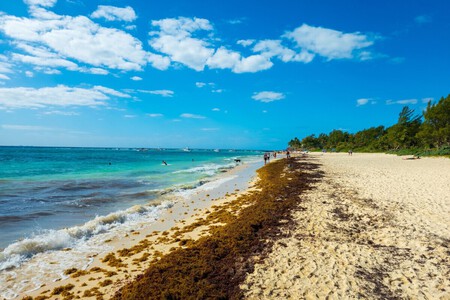
The Caribbean has gone from turquoise to chocolate. The Riviera Maya, the tourist corridor that connects Cancun to Tulum, was one of the areas hardest hit by the attacks. During the months of maximum expansion, thousands of tons of algae arrive on its beaches every day and form mountains that can reach three meters in height. In Puerto Morelos, a town south of Cancun, residents described a sea that had lost its characteristic blue color and looked like chocolate.
When sargassum rots under the sun, it releases gases such as hydrogen sulfide and ammonia, which are responsible for the strong smell of rotten eggs and are potentially harmful to health in certain concentrations. The problem has turned some paradise beaches into places where excavators and workers must constantly remove large amounts of organic matter.
Tourism has started paying the bill. Between January and July 2026, airport traffic in Quintana Roo, which concentrates a good part of the Riviera Maya, fell by about 6%, while hotel occupancy fell by about four percentage points. Sargassum adds to other factors that are hurting the sector, including high travel costs. In Puerto Morelos, a snorkeling instructor told The Times that trips have gone from four boats a day to one, while restaurant and business income has suffered.
Some staff have had to take unpaid leave and others have reduced their base costs to cope with the drop in clients. The degradation of beaches especially threatens an economy that depends on the image of clear water and white sand that attracts millions of visitors each year.
115 million dollars for the Navy. In July, President Claudia Sheinbaum announced a $115 million investment to expand military operations against sargassum. Between January and September, the Mexican Navy harvested nearly 25,000 tons of seaweed directly from the ocean, more than double the amount for the same period in 2025. That’s less than a third of what cleanup teams collected on the beach during those months.
The government expects to induct a new vessel with greater capacity before the end of 2026 and acquire two more in 2027 to strengthen its small boat fleet. The aim is to trap more algae in the high seas than on land, reducing damage caused by its arrival on the coast. The Mexican experience has already piqued the interest of the Dominican Republic, which is considering acquiring one of these specialized vessels.

Blue Gold from Public Enemy. Another part of the strategy is to find an economic outlet to harvest large quantities of sargassum. During an international conference held in Cancun, companies and institutions presented construction materials, liquid fertilizers, creams and cosmetic products made from this algae. The Mexican government is also developing a facility capable of processing up to 4,000 tons per day, while the European Union, World Bank and other organizations are funding initiatives to promote its industrial use.
The objective is to create a circular economy that turns sargassum harvesting into a profitable activity and thereby reduce the costs borne by affected countries. Hence, some companies already market their derivatives under a more attractive name: blue gold. The challenge for Mexico will be to grow that industry enough to take advantage of an expanding invasion, driven by Atlantic environmental conditions.
Picture | NARA, Pexels
In Xataka | In Mexico, the cartels have found an inexhaustible mine of cars, renting them out and never returning them
In Xataka | Mexico’s beaches have so much algae that it’s got an idea: turn sargassum into sandals and cosmetics