Although Spain is not free from deflation and the war in Iran looms large on the horizon, the current scenario does not resemble the frenetic growth that will follow the war in Ukraine in 2022. Two facts come to prove this: In September, food and non-alcoholic beverages became more expensive, rising by 2-7% from 2-7 years ago. 10.5%. The big question is… is this slowdown giving Spanish houses oxygen? Are we recovering affordability?
There are indicators that invite us to be skeptical.
Key Data: 39.5%. For some time now, year after year, OCU has been doing an exercise with which it wants to help Spanish families: compare supermarkets to identify the cheapest ones. To do this, it is based on a prototype basket made up of 244 items including food, cleaning, drugstore and hygiene products.
The exercise is interesting because, incidentally, it allows to get another view of how prices evolve, which is a complement to that calculated by INE.
However, the 2026 survey came as a surprise. Although OCU admits that the price of shopping carts has increased in the last year (from 2.5% to 1.8% in 2025), its technicians warn that if the focus is widened and the accumulated growth in the last five years is analyzed, an alarming statistic is found: its products have increased by an average of 395% since 2021. If we talk about fresh items, the increase is greater and about 44%.
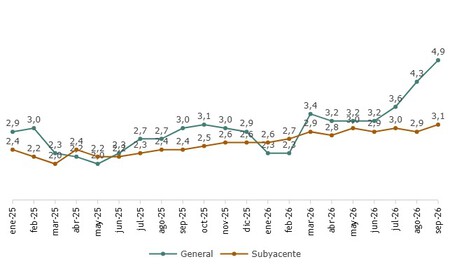
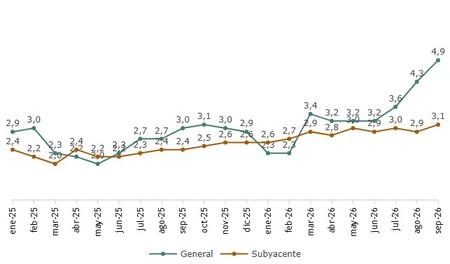
Annual CPI rate. Common and Implicit Indicators (Percentage).
Bad news, coffee lovers. The OCU analysis shows something else: There are some items that have doubled their prices in recent years. or more. Economical ground coffee, for example, increased by 142%. Size M eggs cost 135% more, L eggs 123% and milk chocolate bars 101% more. In general, the company could identify only three products that are cheaper today than at the beginning of the epidemic: detergent, Danone brand natural yogurt and rice drinks.
Given the data it handles, OCU’s conclusion sounds: “Households have yet to recover their pre-pandemic purchasing power, and even less so than before the 2008 crisis.” When analyzing his report, one key aspect must also be kept in mind: although it was published in September, it is based on surveys that do not yet fully capture the “effects of the Iran war.”
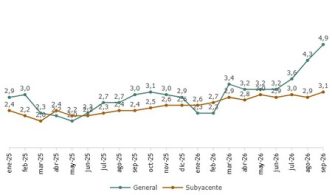
Enlarging the photo. The OCU report is interesting, but if we want to understand how the purchasing power of Spaniards has changed, we need to go beyond their shopping basket. The CPI calculated by INE provides another valuable aid. Its September data showed the simple annual rate was 4.9%, six-tenths higher than in August. This is a long way from the 11% it will reach in 2022, but it confirms that there are still goods and services that put pressure (choke) on household accounts, such as transport or housing.

Prices are up… and salaries. INE tables show that not only prices are rising. In recent years, wages have also risen, so the question is not so much whether the shopping basket, housing or transportation become more expensive, but rather what the household income is worth today. Are they able to buy the same things as before the pandemic? Have they gained or lost purchasing power? The same question was asked not too long ago by The Adecco Group Institute. And his response is not exactly positive.
In the report of the ‘Adecco Annual Monitor on Salaries’, based on data from INE, the company reached the alarming conclusion: although the average salary in 2025 was 2,055 euros per month (gross), reflecting an increase of 3.4% compared to the previous year, the gains in real purchases were low. And it disappears when we widen the focus and analyze salaries and prices from 2019.
Do you provide statistics? Clear. According to Adecco’s analysis, the average monthly salary increased by 3.4% between 2024 and 2025. Translated into hard cash, this equates to 67 euros more per month or 804 euros a year. If we consider that the average CPI in 2025 was 2.7%, that means (once the effect of inflation is discounted) the real purchasing power gain was 0.7%. This represents about 14 euros per month. or 168 a year. The impact of the rise deflates.
However, the situation worsens when we analyze the data for the last five years. Between 2019 and 2025, a cumulative salary increase of 21.3% is also recorded, a significant increase that does not compensate for inflation of 22.7%. In other words, accrual balances were negative by 1.1% during that period, according to Adeco. To understand family income, other sources of income must be taken into account, but the percentage is revealing.

“It’s down 2.2%”. Swiss companies aren’t the only ones seeing household purchasing power decline. Economist Gonzalo Bernardos estimates that “since Pedro Sánchez took office (2018), their (Spanish workers’) purchasing power, controlled by contracts, has fallen by 2.2%.” Cause: Aggregation of causes that go beyond Spain. “We cannot blame Pedro Sánchez alone. We can blame the war between Ukraine and Russia in 2022 and 2023 and Donald Trump for the pandemic this year.”
“Relevant Questions”. Another analyst who invented calculators to do math is José María Roteller, doctor of economics and professor at Francisco Marroquín University. In a column published a few days ago, Dr EconomistQuestioned the amount of salary increase in recent years.
“Salaries have increased in current terms. However, the relevant question is not how much is taken nominally, but what purchasing power the salary provides,” he cautioned. It’s at that point, when we get to the stats, when the photo stops being flattering.

A reduction of about 5%. Roteller admits that the average gross salary will rise from 26,992 euros in 2018 to 32,446 in 2025, an increase of 20.5%. However, after excluding personal income tax and contributions, it is found that the average net salary actually increased by 16.5% to 25,400 euros. First adjustment. The second comes after discounting for inflation (22.5%). This amendment verifies that, although the average worker earns 25,400 euros net, his purchasing power Indeed This equates to a person earning 20,729 euros in 2018.
“The results are clear. Real net purchasing power has gone from an index of 100 in 2018 to an index of 95.1 in 2025. In other words, the average worker has lost 4.9% of purchasing power over this period,” he concluded. In practice, this means that to preserve your 2018 purchasing power, your 2025 net salary would need to be around 26,700 euros.
Photo | Kirsten Weingert (Unsplash), INE and Toufiq Barbouia (Unsplash)
In Xataka | Spain has ridiculously low public housing rates, and part of the answer lies in a 2013 law