Before you downloaded an app for something very specific that you needed and you had to include the rest of the extra functions. To compete, developers make their apps fat to an often absurd level. So there you were, with an app that served you for one specific thing and it added thousands of other functions that wasted resources. The developer was in charge, and the only recourse was advice
Difficulty pleasing everyone. An application is usually taken off to cover a specific need. Let the user drink water, activate the flashlight or share photos with their friends When there are dozens of applications that cover these needs, the only way to keep standing is to bulk up the software. Also, there is an additional problem: there will always be very specific tasks that will be omitted because the dev cannot specialize the application for each user.
It is impossible to please everyone. Like the meme my mom put on WhatsApp group, the first thing is to make yourself happy. If you know what you want, why not have a button for it in the app? That’s exactly what AI is facilitating.
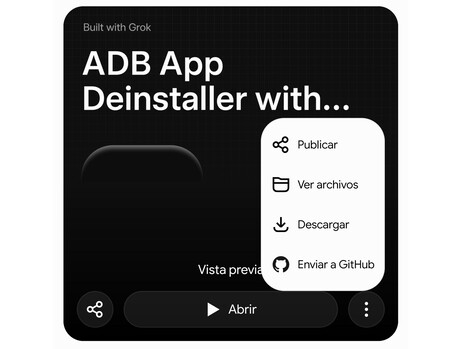
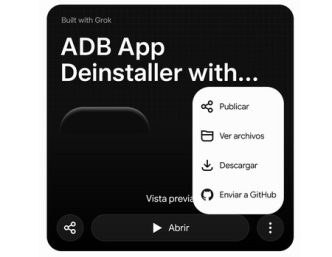
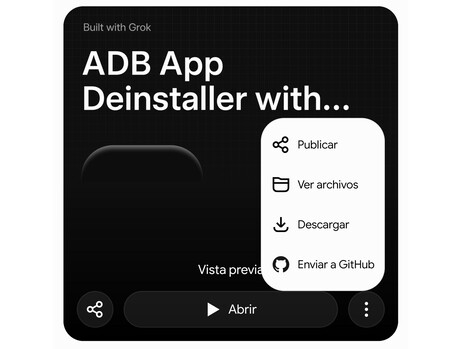
The app is built with Grok. You can run it from there or download APK to install on Android
If you want something, do it yourself. Vibecoding is allowing something that was impossible a few years ago: creating an application like a tailor who makes custom suits. Not just a tailor and developer, but an LLM with a chat interface.
I have already created many applications adapted to my specific needs. I’ve built an app to control home automation without data from my network, software to remove bloatware from Android phones, and even a family task app with a database on my own server. If you have imagination, you can make it.
Vibecoding not only gives you the ability to develop without knowing code, there is one more important detail: you can adapt the application so that all the data is in your environment.
This is nothing new. It feels like a revolution, and I think so. Of course, this isn’t something that AI invented: building adaptive applications is almost as old as software itself, what’s changed is that AI doesn’t need to learn how it works. For example, there are Excel macros. Or tools like IFTTT, Tasker on Android or Shortcut on iOS. It’s possible to get gold from them with a little practice, but they’re not as easy as writing “I want you to do this”.
Energy is not lost, it moves. Earlier, it was the developer who decided what an app could or couldn’t do. This “dictatorship” is diluted in favor of the user, but it does not imply that there is real freedom. Because the power is now with the AI model. Basically, OpenAI, Anthropic, Google, xAI and company.

What today seems like just another service, almost a “product”, eventually becomes a dependency And sooner or later there is a charge for dependency. If you want a good Vibe-coded app, it’s better to pay for a better model. So the subscription doesn’t disappear: it moves from the developer’s app to the contracted AI plan. Master moved.
Just because you can do it doesn’t mean it’s better.. Yes, we have an app that adapts to our needs, but it’s still an app that works without us knowing very well why. We have no support, error correction is in favor of the model, and there is no guarantee that it won’t mess up something subtle.
I don’t think vibecoding will replace developers, just like creating images and text doesn’t replace designers and writers. AI facilitates access and democratizes it, but only up to a point: it gives you an app that works for you, not an app that can withstand thousands of users, is secure, or will be maintained in the future.
missing button. In the short term, this is how I see the outlook: simple apps will continue to cover what almost everyone needs, and Vibecoding will fill in the gaps that no developer can fill. No more asking for that button you missed in the suggestion box: just enter the order in a chatbot. Of course, it’s important not to forget who’s on the other side of that conversation.
Cover image Edited by Ivan Linares
In Xataka | Someone used Opus 5.5 to Vibcode the entire Adobe suite, including Photoshop, from scratch.