In November 1956, Life magazine published a report on the practice of moving animals to floors at the University of Michigan Hospital in Ann Arbor where young children were admitted. Photographer Francis Miller photographed two girls bathing a pig, a million patients balanced on a wire above their heads, and three-year-old Peggy Kennedy lying in bed with a plastic respirator on her chest while ducklings swam in a basin beside her.
What was wrong with Peg?And. The culprit was poliomyelitis, a disease caused by a tiny virus that enters through the mouth, almost always through water or food contaminated with feces, and settles in the intestines. There it multiplies and in most cases it goes no further. In fact, about 70% of infected children don’t even have symptoms, and about a quarter experience something like a mild flu that clears up on its own within a week.
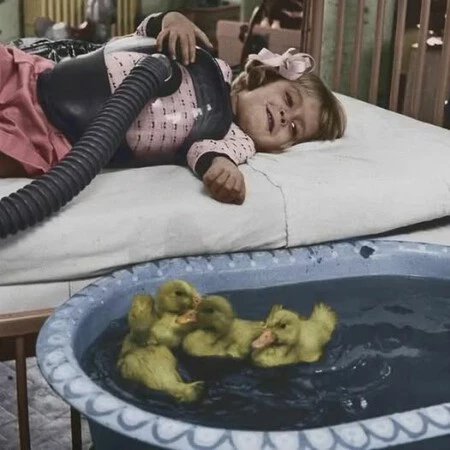
Photo of Peggy Kennedy in Life magazine report (Frances Miller)
The problem arises when the virus is able to reach the blood and, through it, the spinal cord, where it attacks a very specific type of cell, the motor neuron, which is responsible for ordering the muscles to contract. If you damage them, the muscles that depend on them lose strength and can sometimes be permanently paralyzed, which occurs in one out of every 200 infections and usually affects the legs. And when the injury reaches the neurons that innervate the muscles between the diaphragm and the ribs, the child can no longer breathe on its own, which is how 5% to 10% of patients die. Polio returned to the United States every summer, and in 1952 alone it caused more than 21,000 cases of paralysis and nearly 3,000 deaths.
Peggy’s lungs were a breathing apparatus. This eased the pressure around the chest and helped him breathe. This is the same principle as the iron lung, although here the machine was made of plastic, it only covered the chest and left the arms free. It was a negative pressure respirator, with a tube, that helped Peggy and other children like her compensate for their breathing difficulties.
In 1956 there was still no cure for polio, but doctors could keep a child alive for weeks or even months who couldn’t breathe on their own, thanks to machines like the iron lung, and from 1951 Michigan had one of the nation’s first respiratory centers. There was no shortage of vaccines either. Nineteen months before the report, on April 12, 1955, epidemiologist Thomas Francis Jr. took the stage at the same university’s Rackham Auditorium and announced that the Jonas Salk vaccine, evaluated in a trial involving 1.8 million children, was safe and effective. The vaccine protected those who had not yet become ill. Children who were already breathing with a machine could not already reverse their consequences, and Michigan continued to care for them for years.
That million-dollar scene inside a hospital ward is a far cry from what SHEA recommends (Society for Health Epidemiology of the United States) which since 2015 has recommended that therapeutic visits only include dogs at least one year old, trained and with behavioral evaluations, accompanied by a trained handler, and anyone touching them to wash their hands before and after. Dogs have entered the children’s ward in many cases. In A Coruña, the Teresa Herrera Maternal and Child Hospital presented this summer a program with cancer patients between 2 and 15 years. The little ones first meet the dogs with virtual reality glasses and then take in their sights in person.
effect. A 2022 review combined 21 studies of children and adolescents seen in hospitals and clinics, all with dogs. Studies measuring pain or pressure before and after visits have found improvements. When compared with groups without this intervention, results were mixed. There are signs of benefit, but the authors call for larger, more rigorous studies. Seventy years after Peggy’s photo, research is trying to determine how much these visits relieve, to whom, and for how long.
Picture | Made with Magnificent AI