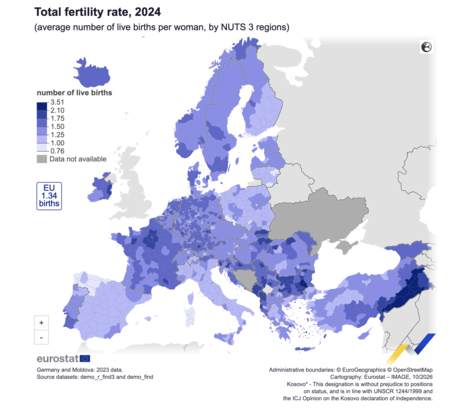
Is Spain left without children? In Alfonso Cuaron’s masterpiece ‘Children of Men’, humanity has gone 18 years without a single birth and the story takes place in 2027. There are two months left for that prediction, and children continue to be born, but a Eurostat map that has been circulating these days on the Internet explains why this comparison fits: 1204 children for every 1620 women in the region. The reason? Dozens, but the main concern is not biological.
What the data says. The EU fertility rate in 2024 was 1.34 women per child, the lowest since 2001, and Spain closed at 1.10, only above Malta. Within Spain, the four Canary Islands have the lowest values in the EU, with La Palma at 0.76.
If we leave that aside, Eurostat mentions Orense and Pontevedra among the following, along with regions in Greece and Italy. INE data for 2024 confirm this: Ourense 0.88, Pontevedra 0.93, Asturias 0.95, Leon 0.95 and Zamora 0.96. Lugo, with 1.03, is slightly higher. A Coruña was around 1.01 in 2023. In Orens, 4.15 children are born per thousand inhabitants, compared to the national average of 6.49.
What does 0.88 mean? The replacement rate is about 2.10, not talking about immigration. Ourense, with 0.88, is less than half. If this number were maintained without immigration, each generation would have less than half as many women as the previous one. INE itself cautions that indicators for smaller populations are more volatile and that this data is historical, not constant, but it points in a direction.
nothing new Galicia has not reached the replacement level since 1979. A REIS study already determined 2.26 children per woman in 1970, compared to 2.86 for the Spanish average. In 2002, the Galician Statistics Institute recorded 0.93 children per woman in Galicia and 0.80 in Lugo and Ourense. Then came the boom and immigration, and Spain reached about 1.5 in 2008. We have already counted it in 2019: 7,600 births and more than 16,000 deaths were registered in Galicia in the first half of that year, which is double.
late motherhood Eurostat points to greater education among pregnant women, where they choose professional careers before having children. Determining factors in precarious employment and housing costs and child rearing In 2024, the average age of mothers was 34.7 years in A Coruña and Leon and 34.5 in Pontevedra, compared to 31.9 in the EU.
They decide. Fertility is the sum of countless personal decisions, and surveys show that many women end up having fewer children than they would like: according to the INE Fertility Survey, nearly three in four want to have at least two children, and from the age of 35, the most cited reasons for fewer are work, economic or compromise.

And stress is never the way. In 2020, Poland approved an almost complete veto on abortion, and in 2024 its fertility dropped to 1,099, a historic low, which cannot be attributed solely to the law, as the drop comes from earlier. The same government that promoted “500+” aid admitted in 2020 that they did not increase long-term fertility. In 2022, 52% of Polish men and 67% of Polish women believed that the law made people less willing to have children. In the United States, a JAMA study found that the first 14 states to restrict abortion resulted in 22,181 more births than expected, even as infant mortality rates increased over the same period.
Generational effects. Those born in the 1990s, when fertility was at its lowest, are now old enough to become mothers, and there are fewer of them. Added to this is the fact that immigration, which supports the statistics, mainly reaches other places: in 2024 foreign-born mothers accounted for 33.3% of births. In Galicia, foreign women had 1.24 per woman and Spanish women 0.96 in 2023.
Small rebound. There were 321,164 births in 2025, up 1.0%, the first increase after a year of declines. But deaths exceeded births by 122,167 and natural growth was negative in all communities. In the first half of 2026, 156,887 births were registered, 1.07% more, with Galicia losing births and Asturias gaining them. INE will publish the final data for 2025 in a few days.
Lost Descendants ‘Son of Man’ envisioned zero births, a regression scenario, but with Orens at 0.88, we’re still a long way from anything like that. According to Eurostat, between 2014 and 2024, the natural population loss in two regions of northwestern Spain was more than 10 per thousand.
Leave is contributory; Care, no In Spain, from July 2025, each parent has nineteen weeks of maternity leave at 100% of the regulatory base. Helplessness comes later: Childcare leave does not collect pay for up to three years and no one pays contributions in the worker’s name until it lasts, although the time counts as a contribution.
The system modifies this up to a maximum of four, with a fictitious contribution of 112 days per childbirth and up to 270 per child and a supplement of 36.90 euros per month per child: a modest patch in the face of a gap that persists, since the average retirement pension for women is 29.3% lower. For comparison, Germany equates care with working time: each child contributes up to three years of compulsory contributions, with contributions paid by the state, which today translates to a higher pension of up to 127.56 euros per child per month. Let’s take these data into consideration before looking for the culprits.
Picture | Eurostat
In Xataka | Extremes of demographic decline in Galicia, Spain: twice as many deaths as births