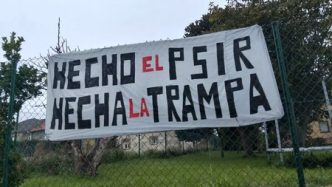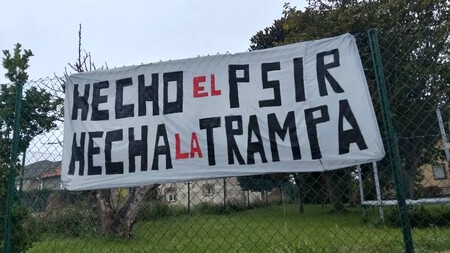

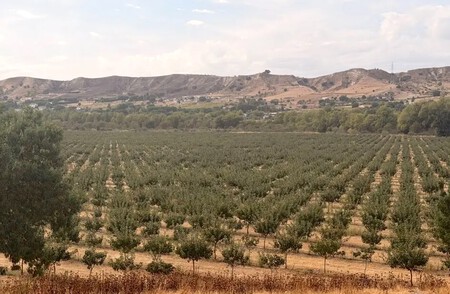
Valdetorres de Jarama has about 5,300 inhabitants and one of the largest pistas in Madrid. Its owner, Sancorganic, boasts more than 500 hectares between Madrid and Avila and more than 100,000 pistachio trees. But since 2022, neighbors and environmentalists have accused it of destroying the riverbank. And to finish burning that bridge, trees are being cut indiscriminately since September. According to the company’s own documents, more than 370 plants have been loaded.
Cut down or not cut down. The company owns about 150 hectares in the municipality and has requested to change the use of four plots totaling 56 hectares from forestry to agriculture. His own ecological studies count those 370 trees: poplars, ash trees, willows and elms, like a river bush. Environmentalists have described the area as a forest and seasonal wetland, connected to the Natura 2000 network. They estimate that it covers more land than Madrid’s Tierno Galvan Park.
The company, founded in 1990 as a limited company and which has grown like wildfire for the “healthy snacks” model, has another version: it says that those lands were cornfields, that later came a gravel pit, and when it closed, the land turned into a forest again. He also said that the Natura Network is outside his farm. Parties answer that the lands are contiguous or partly inside.
Cultivating fashion. Now it will be protein, but the pistachio is still experiencing a commercial fever and taking into account this context, the demand. About 90,000 hectares in Spain and 1,341 in Madrid, 8.8% more than the previous year. It was powered by Dubai Chocolates, as we already said. On this farm, the first 25 hectares to be planted in 2022, according to the company, are 5,000 kilos of greenery. Of the 56 new ones he expects 2,750 kilos per hectare: about 150 tonnes.
Four years since the crash. It all started in March 2022, when the company planted pistachios in the grove. In December, the community imposed a fine of 3,500 euros for clearing forest land and removing vegetation to erect fences. That fence cuts off the road that neighbors consider public. According to them, today there are five people.

Groups later complained that the fence trapped wildlife. PACMA, Ecologistas en Acción and ARBA protested against the “death fence” and in August SEPRONA collected three dead roe deer and the case ended up at the environmental prosecutor’s office. On September 23, PACMA and neighbors went to Pozuelo de Alarcón and filled the facade of the business group’s headquarters with posters. The company assures that it opened the door and installed the ramp and water point and has had no problems since. To this, neighbors responded that the ramps were not working and animals were still trapped there.
Water. Pistachio trees grow under irrigation. Actually, a short note: pistachios can require up to 7,000 m³/ha/year of water. It depends on the variety, but it is not unusual for each plant to drink about 12,000 liters per season until production is consolidated. Because growing pistachios takes a long time and requires patience (although they are already studying methods to shorten that wait). In return, it can provide 50 years of uninterrupted harvest.
Important point: The company asked Jarama to revise its concession to remove 520,000 cubic meters per year, about 200 Olympic swimming pools. Results: In 2024, the Tagus Hydrographic Confederation imposed a fine of 212,149 euros. The city council paid for it, not the company: it allowed SunOrganic to irrigate municipal wells without approval. The mayor replied that the matter was in court and we would have to wait.

Green light (not so green). In February, the Ministry of Environment signed a favorable environmental impact report. It was a simplistic approach, not a general one, which reduced public participation.
And although in 2023, biodiversity was not required to eradicate trees, the company avoided the requirement. As compensation, the company will reforest about 125 hectares in Fuenteduena de Tajo, no longer 80 km away. Parties find this inadequate. The City Council not only raised no objections but supported SunOrganic’s “professional and ecological” project.
the chair. But the city council is worst off in property-linked urbanization. There in 2022 everything started with an exchange. According to neighbors who oppose it, Suncorganic would get 140,000 square meters of developable green space in exchange for 228,000 square meters of rural land. On October 2, 2022, about 200 people attended the rally and called for a mandatory neighborhood vote. A year later they are still demanding.
On September 25, 2023, the neighbors reported the mayor and secretary to the prosecutor’s office. They accused the former governing board of supporting it, with a legal defense they found dubious and of not addressing their requests. Three days later, a plenary session of the municipality attempted to dissolve the urban planning entity to transform Sililos into another neighborhood. The victims were found within two days. For them, so much haste just wants to cover up irregularities.

Pending Accounts. The fine for the well (212,149 euros) is still pending judicial resolution. The other, planted in a priority conservation area for 2.58 hectares, is also pending. Somos Sililos says it prefers to settle rather than sue. And the company has already collected its first 4,000 kilos of produce this year.
In 2024, the ministry received the association and told it that blocked roads and encroached green areas are the responsibility of the city council. The City Council, for its part, supported the Chittagong Hill Tracts and Vias Pequarius fence. The mayor was asked by the media and responded that he was “very busy”. Three years later, it is not known who executed the swap or whether the charges will stop deforestation.
Picture | Pexels (1 and 2)
In Xataka | The world is preparing to harvest 36% fewer pistachios. This is great news for Spanish farmers