

In the United States there was a problem measured in millions of tons: every year, a mountain of used carpets and rugs ended up in landfills. In 2007, a group of researchers found a solution that was as strange as it promised: using them to feed cement kilns. The amazing thing is that they were able to prove that it worked. What followed was a lesson in the distance that separates a good idea from a profitable business.
Millions of tons of carpets. In the early 2000s, the United States generated 1.8 to 2.3 million tons of carpet waste annually, most of which ended up in landfills. The problem was in its composition: synthetic fibers, adhesives, support fabrics and minerals, a mixture designed to withstand years of use, but extraordinarily difficult to separate and recycle.
For researchers at the Georgia Institute of Technology, that mountain of waste raised a question: What if each material was used for its energy content instead of being recovered?

The incident made more sense than it seemed. Carpets contain nylon fibers, polypropylene and other petroleum-derived polymers that release energy when burned. Their base also contains calcium carbonate, which is used as a raw material in the manufacture of cement. This combination made cement kilns attractive candidates: they could use plastic energy and accept mineral materials.
In preliminary tests, the calorific value of certain mixtures is about 23 megajoules per kilogram, lower than that of conventional coal, but sufficient to study its use as a supplemental fuel.
First we had to check what was coming out of the chimney. Between November 2003 and February 2004, researchers at the US Environmental Protection Agency (EPA) conducted 62 tests with polypropylene rugs and carpets and two types of nylon, introducing a load of about 400 grams into a test oven.
Tests showed they could burn, but also revealed differences depending on the material: nylon fibers increased nitric oxide emissions and batch feeding produced transient carbon monoxide spikes. The experiment did not prove that carpet burning was environmentally harmless, but it did demonstrate that there was a technological possibility worthy of study on an industrial scale.
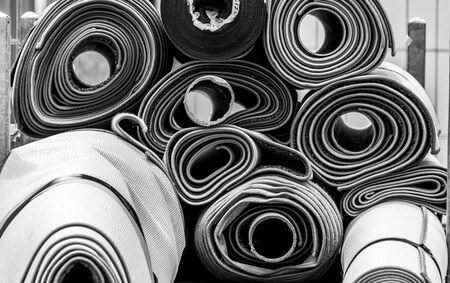
A real cement factory jump. The decisive test came at the Lehigh Cement facility in Evansville, Pennsylvania, where researchers burned cut carpet with regular fuel. The material came to represent between 10% and 15% of the energy contribution, with a feed of about two to two and a half tons per hour.
The results were encouraging: the oven was able to use the mats without the measured emissions exceeding the permitted limits during the test. Nitrogen oxide and sulfur dioxide records were below the permissible maximum, although the latter showed apparently higher values during joint combustion.
The first enemy was a machine that was getting stuck. The industrial experiment planned to use about 1,000 tons of carpet, but only managed to put 200 tons in the oven. The reason: the feeding system, originally designed for wood chips, got stuck when taking in that fibrous and heterogeneous material.
Carpets were also not easy to prepare: they had to be shredded, dried, and a great deal of waste had to be handled. Furthermore, the calcium carbonate present in its composition causes considerable wear on the cutting surfaces.
And then came the bill. The final report published in February 2007 revealed that the biggest obstacle is not combustion, but the money needed to transport and prepare the mats. The researchers calculated that its energy value was equivalent to about 1.2 cents per pound, but the actual cost of preparation and delivery reached 4.3 cents: 1.5 for packaging and loading, another 1.5 for crushing, and 1.3 for transportation.
In other words, it costs $550 per truck just to transport material for a trip of about 161 kilometers. That is, the total cost is more than five times the initial forecast of 0.8 cents per pound and far exceeds the cost of the fuel received.

A solution that worked, but it didn’t pay off. The study, led by Matthew Rieloff from Georgia Tech and funded by the US Department of Energy, concluded that carpets are technically suitable as an alternative fuel, but economically unviable under the conditions studied. A plant closer to storage, better crushing equipment or more expensive conventional fuel could replace the bills, although it was also necessary to invest in storage and feeding systems.
The experiment thus left a paradox: the United States had millions of tons of usable waste and ovens capable of using it, but no logistics chain that would allow it to be done profitably. In 2007, researchers didn’t find that carpets were a bad fuel, but instead found that it was more expensive to take them to the furnace than to burn them.
Picture | Magnificent, on Pixabay
In Xataka | America had the idea to kill mosquitoes 20 years ago. China has made this a reality with an automated laser turret
In Xataka | In 1970, the United States had a crazy idea to build roads. 56 years later, paving with glass is no longer science fiction