In the middle of the Cold War, the United States had an idea that seemed straight out of a fantasy novel: to surround the Earth with millions of copper needles to protect its military communications from the Soviet Union. The experiment worked, but it left a most unexpected legacy. More than six decades later, part of that giant artificial ring continues to circle the planet.
A battle that was also fought in communications. In the late 1950s, Washington had a strategic problem. Their long-distance communication relies on submarine cables and the ionosphere, a layer of the atmosphere that allows certain radio waves to be reflected. The former could be sabotaged by the Soviet Union, and the latter a victim of solar storms or interference by enemy activity.
In the event of a nuclear war, losing contact with forces deployed around the world could be catastrophic. The Pentagon needed a system that would work even if the ground infrastructure was destroyed.
The solution was 3,600 km high. In 1958, MIT Lincoln Laboratory engineer Walter Morrow proposed the construction of an artificial ionosphere using millions of tiny metal filaments. The initiative, initially known as Project Needles and later as Project West Ford, sought to build a massive radio reflector that did not rely on cables or weak repeater stations.
Instead of betting on a single infrastructure that could be attacked, the US would deploy millions of tiny passive antennas in space, impossible to disable all of them at the same time.
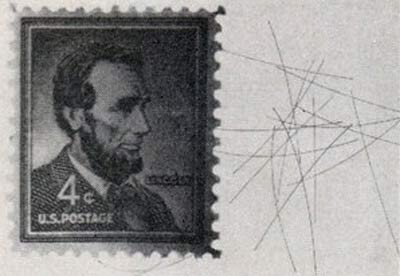
Compared to the West Ford Project Needles postage stamp
480 million needles surround the planet. On May 9, 1963, the United States launched a payload containing approximately 480 million copper filaments, each 1.78 centimeters long and less than 0.02 millimeters thick. The needles, weighing a combined 20 kilograms, were packaged in material designed to evaporate under solar radiation and released at an altitude of about 3,600 kilometers.
For about 40 days they spread until they form a belt around the planet. Each filament acts as a small antenna capable of reflecting microwave signals around 8 GHz, allowing messages to be transmitted between ground stations separated by thousands of kilometers.
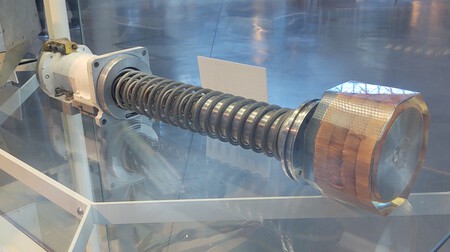
The Westford Dipole Dispenser display at the Steven F. Udvar-Hazy Center
And it worked. The first attempt in October 1961 failed because the needles did not spread properly. The second mission was to establish communications between Massachusetts and California, sending voice, digital data, and teletype messages. Early tests achieved speeds of 20,000 bits per second, although the capacity gradually dropped to about 100 bits per second as the filaments separated.
After about 50 days, the cloud was too thin to maintain initial contact. The US showed it could turn space into a giant antenna, but that solution has important limitations.
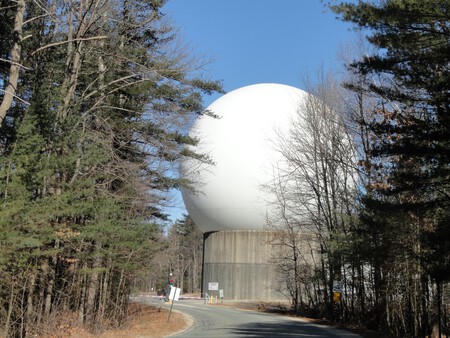
The 18.3 m Westford radio telescope was built by Lincoln Laboratory in 1961 as an X-band radar antenna for the Westford project.
The scandal has reached the United Nations. Astronomers have been complaining for years that millions of metal fragments could damage sky observations and cause space pollution. The International Astronomical Union formally protested in 1961, and the Soviet newspaper Pravda accused the United States of soiling space. Kennedy intervened to give assurances about the duration of the test, and Ambassador Adlai Stevenson had to respond to criticism at the United Nations.
The debate, in fact, helped fuel the debate about the responsibilities of states in outer space, an issue that would be reflected in the Outer Space Treaty of 1967.
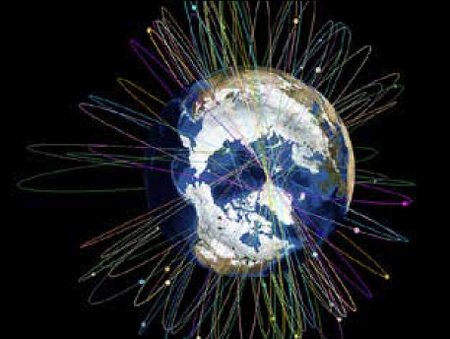
Graphic representation of the 46 West Ford project needle clusters in orbit as of late 2013
The problem is that millions of needles never separate. Those responsible calculated that solar radiation would gradually change the orbits of the filaments until they returned to the atmosphere. With individual needles they were right: by the end of 1965, the artificial belt had practically disappeared.
However, later NASA research found that only 25% to 45% of the 480 million filaments were correctly dispersed. The rest remain grouped in small groups, some able to survive much longer in orbit. Scientists predicted that most would return in less than ten years, but many fragments have passed that time frame.

63 years later, they are still orbiting the Earth. An analysis published in October 2026 based on the Celltrack and GCAT orbital catalogs, 36 to 39 needle clusters are still recorded in orbit, although there are some discrepancies at both bases. The hardest figure is the 23 objects identified by the catalog and recent orbital data.
The last recorded re-entry occurred in April 2024, more than six decades after launch. No collisions caused by these debris have been documented, but their persistence illustrates the problems with space debris like many others. Active communications satellites make West Ford an obsolete technology, but part of that artificial antenna continues to orbit the Earth, a testament to one of the Cold War’s most unusual experiments.
Picture | RawPixel, General Notability, Daderot
In Xataka | In 1964, the USSR had a key mineral to build new US spy planes… and the US cheated to get it.
In Xataka | The mystery of “Farah III”: A Cold War spy satellite explodes in orbit and no one knows why