Spain is completely unaware of European Central Bank (ECB) rate hikes and Euribor fluctuations. The reason is simple: that segment of the population doesn’t have to knock on the door of a financial institution to buy a home. Although housing does not stop becoming more expensive and the crisis of access to the housing market has become so bad that (via the parliamentary soap opera) it has forced the government to bring forward the election, there are thousands of families in our country who pay for their house “every time”, without going into debt with a mortgage.
In fact, there are several autonomous communities in Spain where the ‘rare’ thing (if we say on a statistical level) is to buy a house after signing a loan with the bank.
Own a mortgage? It is the most common in Spain, at least if we base it on the statistics of the General Council of Notaries (CGN). In its latest report released a few days ago, albeit with August data, it reflected that more than half of the home sales that closed that month did so with the help of bank financing.
Translated into statistics, this means that 19,875 of the 34,599 registered operations involved loans, representing 57.4%. Notaries calculated another 5,848 additional credits in the same study, although they were not allocated to buying a house.
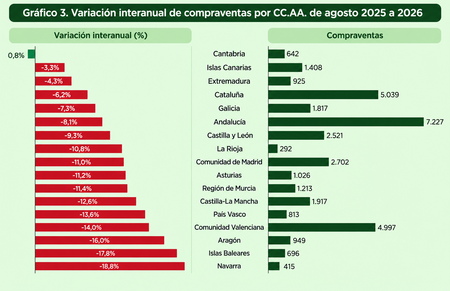
It’s to be expected, right? Of course the percentage is not surprising if two factors are considered. First, residential square meters (m2) have plunged into an upward spiral over the years. A recent balance sheet published by the Efe agency shows that housing has become almost 50% more expensive since 2018, raising its nominal value (real value is another thing, which takes into account the effect of inflation) above the height of the real estate bubble.
The second reason is that these price increases (including skyrocketing rents) are straining the finances of many households. The BBVA Foundation estimates that 9% of the population is in a situation of “housing expense overload”, meaning that they dedicate more than 40% of their income to housing. If we talk about the youth, they are 20%. Among immigrants this rose to 26%.
This pressure reduces household savings and explains why anyone looking to buy a home has to knock on the bank’s door for financing.
Does it matter where you live? yes And this is one of the most interesting lessons that the CGN study leaves behind. Although in Spain in general 57.4% of house sales are financed by mortgage loans, this percentage varies considerably from one autonomous community to another.
This is best appreciated when comparing the two regions most and least dependent on debt: Madrid and Castilla y León. In the former, 94.4% of sales are financed with mortgages, while in the latter, 40.6% do so. In other words: “tocateja” is provided in only 5.6% of operations in Madrid, less than 59.4% in Castilla y Leon.
|
CCAA |
total operation |
% of Purchases Financed on Credit |
Average Financing % |
|---|---|---|---|
|
andalusia |
7,227 |
55.4% |
73.9% |
|
Aragon |
949 |
54.2% |
72.6% |
|
Asturias |
1,026 |
50.2% |
74.1% |
|
Balearics |
696 |
56.5% |
67% |
|
Canary Islands |
1,408 |
58% |
77.3% |
|
Cantabria |
642 |
41.8% |
69.7% |
|
Castile and Leon |
2,521 |
40.6% |
75.7% |
|
Castile-La Mancha |
1917 |
43.8% |
79.3% |
|
Catalonia |
5,039 |
70.2% |
74.1% |
|
Valencian C. |
4,997 |
46.2% |
73.8% |
|
Estremadura |
925 |
49.9% |
81.5% |
|
Galicia |
1,817 |
47.3% |
73.1% |
|
madrid |
2,702 |
94.4% |
70.5% |
|
Murcia |
1,213 |
51.8% |
77.2% |
|
Navarre |
415 |
66.8% |
71.2% |
|
basque country |
813 |
87.2% |
66.3% |
|
Rioja |
292 |
56.7% |
74.8% |
|
total |
34,599 |
57.4% |
72.3% |
And the rest of the country? The overall balance of notaries can be seen in the table accompanying this report. It shows that the five regions with the most housing paid in cash (or with financing outside the bank) are Castilla y León (59.4%), Cantabria (58.2%), Castilla-La Mancha (56.2%), Valencian Community (53.8%) and Galicia (52.7%).
What causes more or less dependence on mortgage loans? An aggregate with buyer profile (for example, the weight of foreigners looking for a second residence) or market characteristics (more or less attractive for the profile of investors or tourists) and park characteristics, which includes, for example, the weight of new construction.
There are more keys. An important aspect is how accessible bank credit is or the population and wealth structure of the region. After all, between one autonomous community and another, not only the price per m2 varies, but also factors such as the average age of the population or the weight of residents over 65.
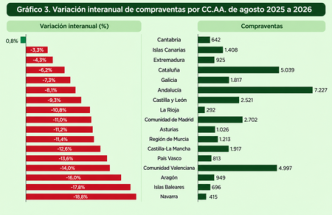
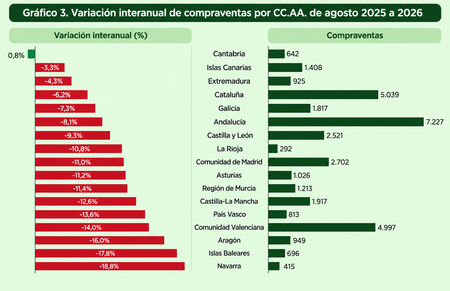
Do we know anything else? yes The CGN report leaves other interesting conclusions. In general, notaries confirmed that house sales fell in August in the 16 autonomous communities and there were 9.8% fewer closed operations. This explains why mortgage lending for home purchases fell by 5.6% year over year. Oddly, the average amount granted increased by 1.3% to 164,978 euros. Something not strange if we consider that m2 in general increased by 12.8%.
Picture | Jordi Vic Navarro (Unsplash) and CGN
In Xataka | Homes sold for up to 50% off in Japan. There are two words that explain it: “Ziko Buken”.