The Wallis Annenberg Wildlife Crossing, an animal overpass that crosses all ten lanes of the US-101 freeway in Agoura Hills, northwest of Los Angeles, is nearing completion. Its promoters present it as the world’s largest wildlife crossing, although recognition of that record depends on how it is measured. The idea behind this whole project is to be able to reconnect a habitat that was divided by the highway decades ago, especially for pumas.
Bridge covered in hills. The structure that spans the highway is about 64 meters long and about 53 meters wide. The land is spread over with native plants, and the project’s website explains that it includes walls and other measures against the noise and light of more than 300,000 vehicles a day. In fact, its extraction has forced the relocation of power lines and a water pipeline, to protect oaks classified as heritage and to create slopes connecting protected lands to the north and south.
A bill that hasn’t stopped growing. The project started with a budget of 92.6 million dollars, about 82.6 million euros at the exchange rate, although it is already equivalent to 101.6 million euros. According to officials, the price increase is due to tariffs, inflation, supply problems and labor costs, while record rains in 2022 and 2023 halted land consolidation and delayed the opening planned for 2025. Annenberg led. However, the additional cost has many raising their voices that it is a waste that California cannot afford.
Cougars stuck in the highway. And why so much effort for the bridge for animals? Well, because of the mountain lions of the Santa Monica Mountains, who have been trapped by highways and housing development for decades and have crossed paths with relatives. Seth Riley, chief wildlife officer for the United States National Park Service’s (NPS) Santa Monica Mountains National Recreation Area, says that 41% of matings recorded since 2002 have occurred between close relatives, and some specimens already show twisted tails and deformed testicles.
A 2016 study in which the NPS participated estimated a 99.7% chance of extinction within 50 years if populations remained isolated and inbreeding prevented reproduction. Author Mary Ellen Hannibal sums it up with a phrase that appears on the National Wildlife Federation’s project website: “Nature doesn’t work offline.”
The first visitor, a coyote. On October 28, 2026, an NPS camera photographed a coyote climbing the south slope of the structure, the first known large mammal to set foot on the pass. Beth Pratt, president of the Wildlife Crossing Fund, was also excited by the photo of the mountain lion near the south end: “There’s a lot wrong with the world, but we fixed it,” she explained.
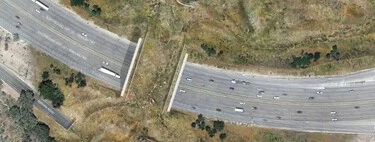
And more pictures will come, as NPS biologists install remote cameras and begin deploying sensors that record body temperature and heart rate, first in deer and then mountain lions, to find out if the animals are stressed while driving on the highway. During the work they have already seen bobcats, coyotes, gray foxes, mule deer and mountain lions using a trail next to the structure.
If no winter storms delay the end, the pass will open to wildlife on December 2, 2026. Its promoters want it to serve as a global model for conserving wildlife in cities and reducing roadkill, though that would be hard to measure because there aren’t many of them because the animals almost never try to cross. However, biologists are confident that northern mountain lions from the Simi Mountains will eventually cross over and bring new blood in spades.
Picture | California Govt
In Xataka | California’s Mountain Lion’s DNA Is in Danger, So They’re Building a $114 Million Megabridge to Save It