
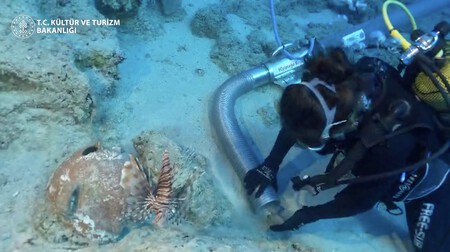
Near the Turkish island of Kekova are the remains of a ship that sank between 4,400 and 4,700 years ago. Well, we assume it’s because they’re finding and identifying the remains of their cargo, as there’s no sign of a wooden hull. We’re talking about a shipwreck that dates back to the early Bronze Age, the oldest known remains on record.
discovery. Although the initial paper is from July and the discovery is from 2024, Turkey’s Culture and Tourism Minister Mehmet Nuri Ersoy announced it on his X/Twitter profile a few days ago. The politician said that in Mavi Vatan (the Turkish name for its waters) they were illuminating the traces of the world’s oldest shipwrecks. Excavations began in 2026 under the direction of the Antalya Museum and under the scientific responsibility of Hakan Oniz of Akdeniz University, with the permission of the Ministry.
Archaeologist Karin Sowada from Macquarie University (Australia) joined the investigation and told the ABC that two types of objects were discovered: a series of stone anchors and quite a bit of ceramics. The latter were used to transport food and materials such as cereals, oil, resins or wine. Some of those recovered retained a thick, shiny residue that is still being analysed: it could have been olive oil, wine or resin, or even come from the later reuse of the jugs, as he explained to the BBC.
Why is it important?. If research progress supports initial estimates, the Kekova shipwreck will surpass the Dokos wreck (Greece), which dates back to about 4,200 years ago, as the oldest. According to the date range considered, it would have sunk during the construction of the Great Pyramid.
According to Turkish Minister Ersoy, the amphorae confirm the roots of maritime trade on the coast of Anatolia and trace the interactions between cultures already existing in the eastern Mediterranean. The minister added that clay analyzes indicated that the amphora was probably produced in workshops in the Jordan Valley and that similar samples were found in Egypt, Troy and Crete, a key piece of information that suggests commercial networks connecting these points on both sides of the sea. According to Smithsonian Magazine, Sowada summarized it as a “missing piece” in the history of Eastern Mediterranean trade.
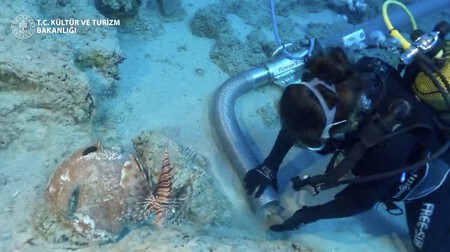
Click to go to the post and watch the video from the Turkish Ministry of Culture and Tourism
Very old shipwrecks are rare. Bronze Age shipwrecks are very rare and hard to find. One reason is that wooden hulls, as happened with Kekova wrecks, do not usually last so many millennia under water. However, there are some: the best known are the Uluburun ruins, also from Antalya and around the 14th century BC. C., more than a thousand years after Kekova. And the oldest intact shipwreck record (the ship is still present) is in the Black Sea and is about 2,400 years old.
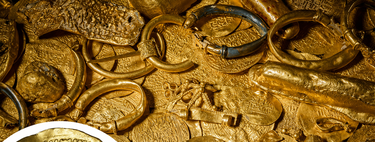
No helmet, but amphora. Except for the wood, there is no material to radiocarbon date the wreck, so the archeology team dated the vessel by the shape of the amphora (with two handles, a central crest, and a flat base), comparing it to Egypt and the Middle East of the time. That date is approximate: if the jugs were reused, as Sowada points out, they were made before the ship sank.
The minister highlighted an interesting find: an amphora with nine different markings on the surface and two holes in the body, which could have been used as a butter dish or for making cheese, suggesting that sailors prepared their own food on long voyages. Discover magazine hypothesizes that the goats were brought on board precisely for this purpose.
In Xataka | When the Yongala sank in 1911, she left no trace but a racehorse. Today it is full of a wall
In Xataka | A cargo sunk in a Swiss lake 2,000 years ago confirms this: Roman soldiers did not deprive themselves of anything.
cover Mehmet Nuri Ersoy