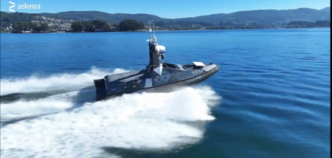
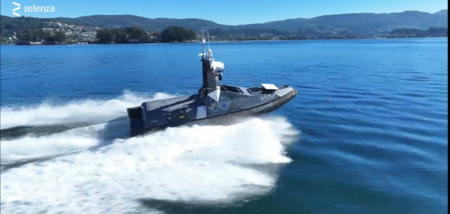
On December 9, 2024, at the Rota Naval Base, the Spanish Navy received a seven-meter fiberglass boat that at first glance looks like any other semi-rigid boat. It was not: it was no place for anyone.
SEAD 23 reaches about 36 knots (about 67 km/h), carries up to 600 kg of fuel and sensors, and can spend a week at sea at four knots. It is the first surface drone of the Spanish Navy. It costs 1.1 million euros. Today the Navy has two.
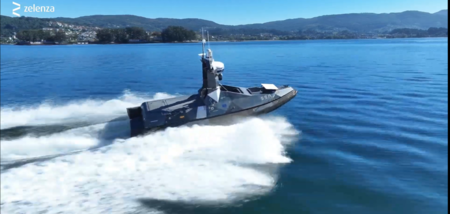
SEAD 23 during testing in the Vigo Estuary. Image provided.
It was built by Sidron, a small shipyard in Vigo. Since 2023, Seadrone belongs to Zelenza. And Zelenza, for the vast majority of its 2,500 employees, isn’t a drone company: It’s a company that operates networks, maintains infrastructure and serves other people’s customers.
That double life is what’s interesting about this company.
Two companies and one logo
“Today Zelenja is a technical services company because historically it has been,” he sums up. Pedro Alfaro, its CEOconversation with Xataka. A mature market that concentrates almost the entire workforce and income. And, next to that, another thing: a promise “very focused on defense and security and the unmanned world.” Alfaro himself calls it “a breaking point”: they’re under the same umbrella, but they’re two environments that aren’t the same.
Statistics allow us to get an idea of every ratio of the business. Of the 120 million euros entered in 2025, defense and security contributions account for 20, one-sixth. And almost everything sold there is an R&D project, pilot or prototype, not a recurring contract. The Zelenza of drones is still more of a promise than a businessAnd its CEO does not hide it. Indeed, he answers our questions with a frankness not so common in that role.

Pedro Alfaro, CEO of Zelenger. Image provided.
Zelenza was born from a merger in 2018: Alza Group joined another of similar size, POAS Group, and both new names “so that there are no winners and losers.” Alfaro then arrived, after a full career at Telefonica, where he was director of defense and security and then CEO of Telefonica Security Engineering. Jose Fernandez, the owner and sole shareholder of the group, wanted to defend himself. TOlfaro proposed a niche that was then primitive, unmannedand a method.
The proposed method was born out of a scar. “Every time we took on a startup, within a year we were left without a technology, without a company and without a startup,” he recalls of his earlier phase.
So wouldn’t buy Zelenza 100%. But their participation is always the majority, above 50%, and the founders keep the rest, stay as partners, maintain their brand and control R&D until the product is defined. From there the group enters the following stages: industrialization, financing, market access and sales. An SME of engineers usually comes up with bad solutions because it’s simply not their specialty.

Today the ecosystem has four legs:
- ZelenzaTech, built from the ground up for command and control software.
- Swarm is dedicated to technology and solutions.
- Sidron, Naval Platformist.
- and simphor, simulation, to reach the end.
The risks of the model seem clear: ending up with a collection of companies doing different things with the same logo. When asked about this question, Alfaro responded by talking about shared committees, common strategies and cross-selling: one person’s software steering another’s ship. It is a reasonable answer. It is the one that will give any Holding Company.
A pilot, a controller, a drone
Eight years ago, Alfaro explains, the drone was understood as a trio:
- an instrument
- An order.
- a pilot
This method was very useful for mounting a camera, but useless for mounting in an army. The bet was software that would break that one-to-one relationship.
That software is called Simacoda. The operator does not fly: he defines missions on a map and distributes them among several drones, whether aerial, naval or terrestrial. The system prevents them from colliding, lets you reassign tasks on the fly and, if a sensor detects an unfriendly device, send your own to locate it. The pilot becomes the supervisor.
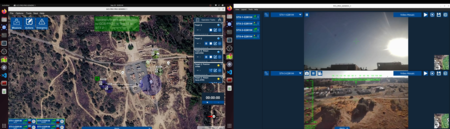
Command interface: four drones, assigned missions on the map and live video of each. Image provided.
The next step is flockingAnd Alfaro tries to break down the popular image, a symptom that repeatedly boils down to the same superstition: it “has nothing to do with the little lights of city festivals. A military swarm is a group of drones with on-board computing, communication from everyone to everyone and no hierarchy.” If they lose units, they regroup and continue the mission.
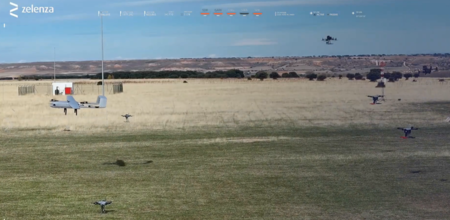
Swarm testing with multirotor and fixed-wing drones. Image provided.
The difficulty, he insists, is in the software, because “most platforms are the same.” And keeping AI to about 200 grams of on-board computing, with a computing budget that has nothing to do with land. What they logically don’t have is silicon: they run on NVIDIA’s Jetson Orion modules.
Two open fronts are the rest of NATO: being able to survive without communication and navigate without GPS, including inertial systems with georeferencing in kilometers, LiDAR or terrain maps.
From there comes the most uncomfortable argument of the conversation. There are no links in Ukraine’s so-called “death zones” and therefore no humans in the loop: “Machines must already have rules of engagement.” Just like an anti-missile shield, where no one makes a decision in time. Alfaro raises this as a technical finding, not a position. But this is exactly the debate that Europe has put off for years, and Companies like Zelenga are solving this with data.
Regarding his position, Alfaro does not fall short: he says that in flocks they are “very comparable to the leading countries” and in Europe “we can safely say that we lead.”
It’s hard to verify from the outside, but there is information that goes beyond the demo. CETEDEX, the Ministry of Defence’s test centre, bought a flock from them red team: Attack the armed forces’ anti-drone systems with it and see if they hold up. They also have a concurrent program contract to develop this technology and have also tested it with three armies in NATO exercises. And they have signed confidentiality agreements with large European, American and Asian defense firms that are interested in it.

Sell cartridges
If you’re asked what your projected company’s future value will be, the answer isn’t software. They are ammunition.
Zaragoza developed Zelenza with Gunner Installaza, A loitering weapon that hopes to be industrialized next yearBetween 40,000 and 50,000 euros per unit. And finishing HALCÓN, an aerial anti-drone interceptor, capable of carrying warheads for about 3,000 or 4,000 euros. At sea, its ORCA serves as a naval loitering munition in USV configurations.
“You can’t destroy an Iranian drone worth 20,000 euros with a million-dollar missile,” Alfaro said. But with several 3,000 interceptors, yes. And spending 50,000 to stop a tank pays off.
It’s like selling paper and ink cartridges from selling printers: Many cheap, consumable, volume products. And this is the most profound change in the nature of the company. Asked to say what was out of reach five years ago, Alfaro didn’t mention ships or swarms. Mention it. “Five years ago we were not thinking of getting involved in the ammunition issue.” Zelenza enters the defense with dual technology, useful for emergencies or boundaries as well. Now that makes things all the more ready for war.
clamp
Every business transition has a downside, and Zelenja is visible: Old businesses fund new ones, and old ones are threatened. Not yours in particular, but your entire sector.
Alfaro expects Defense to bill about 200 million annually within five years. That is, multiply the quotient by ten in five years. And he believes, at the same time, traditional services could shrink “both people and revenue” because it’s a market “very influenced” by AI and agents. More machines, less people, lower prices. That’s unusual clarity for someone with 2,500 employees on that side of the house. And it is appreciated.

Meanwhile, R&D is paid for “everywhere.” According to his estimates, it is between 3% and 4% of turnover. About 120 million, which is between three and five million a year: not a lot for someone aspiring to be a technology leader in Europe, but it compares to the 20 million Defense and Security currently receives.
And rearmament money, for the moment, is not going down. Tractor companies (Indra, Navantia, Airbus) have already taken loans to expand and modernize their industrial capacity. For medium and small companies, “it hasn’t caught on yet.” For companies of its size, European restructuring continues to be a “matter of expectation”.
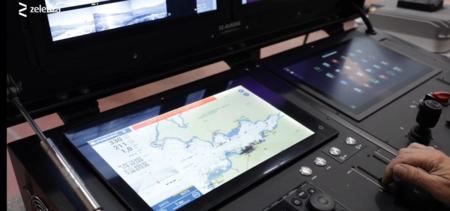
Sidron USV Control Console. Image provided.
There are signs of traction. While the Navy already has two SEAD 23s, Zelenza has submitted a proposal to an Asian country and said it has received interest from several countries in Europe, America and Asia. The Civil Guard, through CDTI, provides a drug boat interception system with maritime drones in May 2025: 2.3 million, three years and three phases. Now it’s on to the second with prototypes of autonomous interceptors with AI on board. But the scale remains the same: a deal of one or two million for a division aspiring to bill 200.
Zelenja lives A clamp: a mature business that AI can leverage and another promising business that relies on public money that is yet to come.. The bet, on paper, makes all the sense in the world. The question is whether the rehabilitation will pay off before it eats up the business that pays for AI. Or at least at times one thing compensates for the other.
Featured Image | has been borrowed
In Xataka | Fifteen years ago Escribano was a lathe workshop. Today it forms the battle tower of the Spanish army: it’s EM&E inside