

Anthropic opened its account as a prerequisite to an IPO expected in mid-November. Stock market brochures are read to look for losses, debt or risk, but there are some data that say more in line and explain many of the things we see in other big tech companies.
Among the big debt or profit figures, there’s one that caught our attention: it measures how much money each demographic employee earns. This information helps to understand what is happening to the workforce of large technology companies and why they are cutting their workforce: they want to look like Nvidia.
6.6 million per worker. In the twelve months ended Sept. 30, the company generated more than $6.6 million in revenue per employee, according to Anthropic’s S-1 prospectus filed with the SEC. Just a year ago, that ratio was 1.4 million for each employee. It is almost five times more in a year. However, what’s most surprising is that the increase comes at a time when the company itself indicated in a previous survey that its workforce is doubling annually, from about 940 workers by the end of 2024 to about 5,300 in September, it said. CNBC.
Information provided in Anthropic’s documentation indicated that it had a turnover of 16,286 million in the first half of 2026, up from 1,163 million a year earlier. The company attributes this to what it believes is “the deepest concentration of AI research talent in the world.”

Nvidia has been in that league for years. Nvidia has been playing this field for a long time. Its latest annual report counted a total of 42,000 employees in 38 countries, with 31,000 of them working in research and development. With this workforce, the company led by Jensen Huang brought in 96.2 billion in the quarter ended July alone, up 106% from a year ago.
If the last four quarters are added, there are about 303,000 million. When divided by Nvidia’s announced 42,000 employees, the result is that each of its employees contributed 7.2 million in benefits to the company, a figure similar to Anthropic.
Microsoft also wants to stay in that ratio. Microsoft lags far behind in this, which doesn’t portray an efficient company to investors. With 331.8 billion in revenue last fiscal year and 223,000 employees, that’s about $1.5 million per employee. That’s about five times less than Nvidia.
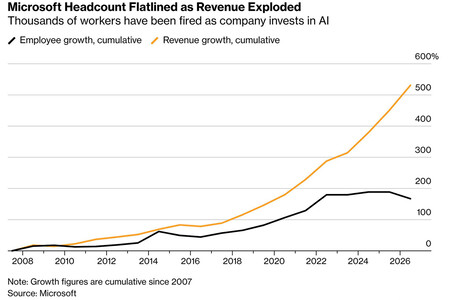
Microsoft Benefits and Workforce Data. Starting in 2022, the workforce stagnates and profits skyrocket. Source: Bloomberg
Microsoft is one of the major technology companies that has been cutting its workforce the most in recent months, and it just announced that it will open a new voluntary exit plan to further reduce its workforce. Amy Coleman, Microsoft’s chief human resources officer, defended the proposal in an internal statement sent to employees as “an important part of how we’re evolving our vision for change.” The formula behind this evolution is simple: same facilities and a smaller workforce, higher profit ratio per employee. As a result, they must use AI agents so that a single employee can do the work of four.
Cut to pay for AI. Microsoft isn’t the only one trying to make its numbers more attractive to its investors. There have already been 92,000 layoffs in the sector in the spring, and Meta has cut 10% of its workforce and left 6,000 vacancies unfilled. Amazon announced 30,000 layoffs in three months. All of this is happening while Big Tech is spending more than $760 billion on AI this year.
Anthropic acknowledged that its AI agents already work six times more hours than its employees, making the link clear between the use of AI agents and this increase in the benefits of their accounts receivable staff. Microsoft has already outlined this scenario when defining Agent Boss organizations in 2025, a model where employees delegate their tasks to agents and supervise them, thereby improving the productivity of each employee. Meta already tried to implement this model with its project OT, but had to abandon it because the results were not as expected.
In Xataka | Companies make their founders and CEOs millionaires. There is one that has made its employees millionaires: Nvidia
Picture | Flickr (Fortune Brainstorm Tech)