
Its long awaited IPO anthropologicalA frontier in artificial intelligence has created the first, persistent feedback from the laboratory. The statistics are overwhelming: the company earned $16 billion in the first six months of this year, registering a loss of $80 billion during the same period. Despite everything, it announced a margin of 10%, positive for the first time since its birth in 2021.
In short, Anthropic is already making money on a consistent basis in its daily operations. Its big problem is the revaluation of the convertible bonds with which it was financed, mostly in Amazon’s hands, and which grows as the company does; And its real burden is the purchase commitment signed with Hyperscaler, about $265.6 billion until June 30, 2026, with a term of up to 20 years.
All this and more appears in its S-1, the prospectus that every American company must publish before going public.

Of course in November we’ll know how markets interpret Anthropic’s accounts. Until then, what we have are more or less viral fragments of documents. If you’re an AI enthusiast, you’ll notice Anthropic’s huge revenue diversification—more than 11,900 customers with annual spend of more than $100,000, which is much higher than the previously mentioned concentration; According to the NYT, No client is more than 10% of Anthropic’s annual turnover.
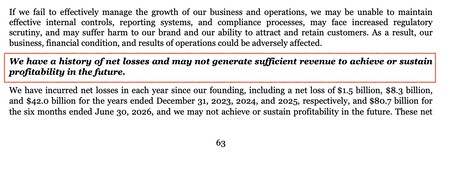
What if one destroyerAn AI pessimist? I would be tempted to share this paragraph included on page 64 of the S-1. We copy and paste verbatim with bold:
If we fail to effectively manage the growth of our business and operations, we may not be able to maintain effective internal controls, information systems and regulatory compliance processes, we may face increased regulatory scrutiny and our brand and ability to attract and retain customers may suffer. As a result, our business, financial condition and results of operations could be adversely affected.
We have a history of net losses and may not have sufficient revenue to achieve or maintain profitability in the future.
We have recorded net losses in each year since our inception, of $1.5 billion in 2023, $8.3 billion in 2024 and $42 billion in 2025, and $80.7 billion in the six months ended June 30, 2026. We may not achieve or maintain profitability in the future.
Capture Inside:
The phrase is, no doubt, interesting. When a company incorporates one with losses of more than $80 billion in just half a year Disclaimer Among these features, it is worth taking seriously. This is common in all IPOs of large American companies, especially technology companies.
A review of Uber’s S-1, Spotify’s F-1 and SpaceX’s S-1, three companies with smaller capitalizations than Anthropic expected—$2 billion at the most optimistic estimate—but large ratios nonetheless, yielded returns. similar phrases in their respective documents. Uber, specifically, claimed that it had “suffered significant losses since its inception”; Spotify admitted that it “won’t be able to generate enough revenue to be profitable.”
These are copied from formulas used by Anthropic and this is not a coincidence. Its S-1 has 94 pages of risks associated with buying shares. It is exceptional, in that it duplicates the caveats offered by other companies in their IPOs, but it follows the same pattern: legally protecting themselves against speculative claims from investors if the company is not profitable in the medium term. In essence, the S-1 warns prospective investors that if they lose money with Anthropic, it’s not Anthropic’s fault, they warn.

The explosive nature of tech companies, which operate at a loss for years and are backed by private investors with unlimited credit, highlights what, on the other hand, are the inherent risks of putting your money in the stock market. Something can always go wrong. Anthropologie, like Uber and Spotify before it, isn’t profitable right now; Its value lies in the technology it operates and its future capabilities, both from a technical and financial perspective.
Following Uber’s example: Founded in 2009, it didn’t announce operating profits until 14 years later; Only in 2023, four years after going public, did it come out of the red. The risk existed, but in the long run it was a winning bet.
The massive scale of the AI industry Increases risk Inherent in any IPO. And alongside polarized discourse around its economic viability, hence the viralization of an obscure standard paragraph in Anthropic’s S-1. The big move by the company led by Dario Amodei should address one of AI’s big questions: Are we facing a bubble that is inevitably going to collapse or are we facing the most profitable business ever?
If the world comes to an end, his brochure puts bandages before wounds.
Picture | Anthropological S-1
In Xataka | Microsoft has opened a massive voluntary exit plan for about 27% of its workforce, about 60,000 employees.
In Xataka | Bill Gates, on the transition to the age of AI: “This will be one of the most turbulent times in human history”
In Xataka | Anthropogenic AI has just taken an important step in the industry: opening its account to the public