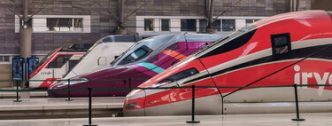
Another terrible train accident in Spain. An AVE train leaving Atocha arrives at an Erio train stopped on the tracks of the Andalusian high-speed line near Urda (Toledo). This is the second fatal accident this year on the Madrid-Andalusia line. In February, a Renfe train collided with an Erio train in Adamuze (Córdoba) due to a track break.
On this occasion, the first investigation suggests that the disaster occurred after a fall LZB system All along the line. The first information indicates that circulation on the line has completely stopped and that the backup system is implemented at that moment. Once the emergency protocol is activated, the trains start moving.
When traffic was restored the AVE reached the Erio train, which was completely stopped on the track as it was unable to resume movement.
The LZB system, how it works
The Andalusian Corridor is the oldest high-speed line in our country. Inaugurated with the opening of Madrid-Seville in 1992, it uses the LZB safety system, which is also used on the C-5 Cercanías line in Madrid and the entire Uscotrain network.
The abbreviation LZB stands for the German word LinenzugbeeinflussungAs the system is also used in Germany and Austria.
The system consists of a cable that stretches along the track, concentric but drawing a slight zigzag that is crossed every 100 meters. This wiring sends information about the train’s speed, the maximum speed on the track and the remaining distance before reaching the new speed limit change. This information is managed by a central computer that controls the sector between 30 and 40 km.
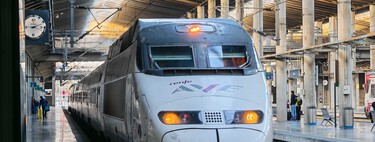
The wiring sends electrical signals in a closed circuit to recalculate the aforementioned variables via beacons. When the track is blocked, the transmission is interrupted and the system automatically orders the train to stop. This occurs with a protocol that considers a first audible warning for the driver, an automatic braking of the train by the track system and, finally, an emergency braking to bring the train to a complete stop.
The first information indicates that this LZB system is down on the line, so all trains are ordered to stop immediately. then, When the LZB system shuts down What happens is that a backup protocol is enabled. If this happens, the driver is called to the so-called ASFA Digital (Signal announcement and automatic braking) Here, speed is automatically reduced and this backup system is one that applies emergency braking if the driver ignores the signal.
On this occasion, when the entire line was dropped, the information indicated that it was directed from the CRC (Command and Control Center), a sort of “control tower” for Adif. From here, using screens that show open and closed sections and the position of each train, where trains are ordered to stop or pass. In the case of the Andalusian Corridor, this CRC is located in Atocha (Madrid).
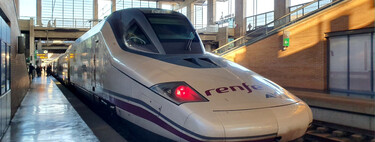
First information indicates that once the line is down, the CRC has taken command and directed the trains to resume movement. The AVE driver would have found the crossing signal closed but would have been allowed to proceed to resume traffic from the Adif “control tower” without knowing that the Erio train had been stopped on the track.
Mechanics confirmed Xataka that It is not unusual for the CRC to instruct the driver to continue Their journey despite the red light signal, as long as there is an incident on the road. In that case, the checkpoint controls because it contains a global photograph of the entire map of the line.
In that case, the train can move but under conditions that allow it to brake safely, always at a very low speed. The maximum limit for these cases is 40 km/h until the incident is overcome or the LZB system is available again. It is considered that at this speed, the driver can safely stop the train. However, everything indicates that the speed at which the Renfe train caught Irio was too high.
Picture | Civil Guard
In Xataka | After the Adamuz accident and high-speed chaos, the results came: 30% fewer train passengers