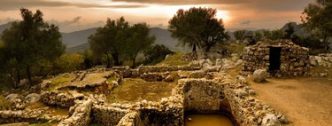
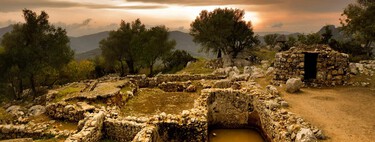
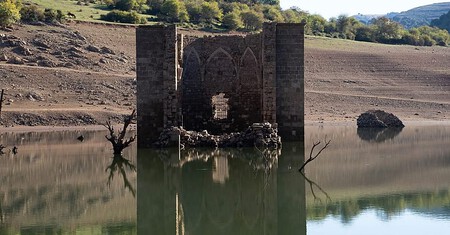
At this point, walls, stone arches with moss and several road layouts can be seen in the Mancilla Reservoir (in La Rioja, between Mancilla de la Sierra and Villavelayo). According to the EFE agency on October 25, the old Mancilla de la Sierra has resurfaced with its stone arches and tree ruins in the Najerilla reservoir, about 70 kilometers from Logroño. And why is it news? As if the picture alone wasn’t enough, just look back to gauge the contrast: in February, after doubling its stock in just three weeks, the reservoir was at 89% of its capacity, about 68 cubic hectometres. Eight months later, there are weekends when visitors arrive by bus to walk through the mud and debris.
The city has already moved. What emerges, however, is not the origin of the mansilla. Since 2016, a team of archaeologists has been excavating next to the monastery of Santa Catalina, the only building standing on the shore. It is only the apse and presbytery of a Romanesque church that was the medieval parish of the city. Beneath this they found three superimposed temples and a late Roman building below. There are Celtiberian and Roman ceramics, and fires that carbon 14 date to the first church between 576 and 654.
The important fact is that, in the 16th century, the neighborhood moved to the Gatton River and the old church was converted into a quarry. That second city, the “Old City”, was swept away in the 1960s.
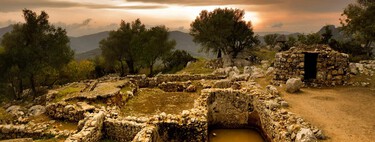
Thirty-three years of papers. That second step took place very little. The book is ‘not to be forgotten. Memorias de Mancilla de la Sierra’ (1927-1960), published this year by the Institute of Rioja Studies, follows the project from the first news in 1927 to its inauguration. Its authors, Luis Vicente Elias and Benjamin Blanco, can be found in the archives of the previous proposals of the Ebro Hydrographic Confederation that located the reservoir in Ventrosa or Anguiano.
They also document the work of political prisoners on the embankment, the difficulties residents had in collecting their compensation, and an early plan that employed them in colonial cities. The work framed the case on a grander scale: in the 20th century some 500 Spanish towns were left under water, displacing some 50,000 families.
With water up to your knees. The mayor, José Manuel Ballesteros, a rancher like his family, said his elders had to “escape” with the animals when the water was already knee-deep. With more than 10,000 cattle and 12,407 hectares of land, the stone city was prosperous for the Siete Villas region. According to EFE, it once had 600 inhabitants and today the registry is no more than 60. Archaeologists have a different picture: about five hundred inhabitants before the migration and less than one hundred and fifty after.
The new town, with white terraced houses, was built about two kilometers from the ashram. Displaced people miss being able to reuse stones from their homes. The elderly, among them the mayor’s father, 85 years old, once again saw their childhood unfolding: the barrack house, the church, the square, the Puente del Molino.
The Girl Who Wrote The Swamp. Mansila also has a place in literature. Anna Maria Matute spent much of her childhood in her maternal grandfather’s town, and transformed it into the Artamila of her story. ‘Halfway’ (1961) and ‘The River’ (1963) evoke those years. In the second he describes how, when the marsh level drops in August, the slopes appear “curled like bones”.
Souvenir tourism. The irony of all this is that, for many visitors, it is memory tourism. And, for posterity, a tribute. It’s something else for those who were born and lived there, and you only have to ask any archaeologist to fan the flame. What motivated their first intervention was to protect the flagstone tombs that had been left at the water’s edge, due to flooding, spoils from visitors and cattle traffic. 79 graves have been cataloged and 26 have been excavated.
A gabion containment now protects the necropolis and cattle traffic is prohibited. Its stated purpose is that the site serves the people of Mansila themselves, to recognize themselves in the past that the dam interrupted. When the water rises again, the roads will disappear again, and almost as well at that. But the question cannot be submerged: to whom is a man connected when it is no longer there?
Picture | Lewis A. for Flickr. Gonzalez
In Xataka | A million years ago, people came to this place in Tarragona like going to a supermarket. Archaeologists continue to find things