
Almost every Minecraft player has ever built a crooked house or an endless tower. Some have worked a little harder and created recreations of real buildings, but some have even considered creating an entire country within the game. A player proposed it and although it took him some time, he achieved it: he created his native Switzerland in great detail.
The most intriguing thing is to discover where the references were found to achieve that level of accuracy. The Block website has a map of the construction and, just below, a slider enabled that reveals actual aerial photos of Swisstopo. The results are incredibly precise.
The whole country, block by block. As I have gathered Middle German 20 minutesA 22-year-old student from ETH Zurich has created a 1:1 scale digital version of Switzerland within Minecraft. The student calls himself Manifold in the game and teaches himself 3D modeling and the use of geodata. “It started with a desire to lend a hand as a physical model to the Swiss mountains and valleys,” says Manifold.

According to what he told German media, the student used real publicly accessible geological data as a database to create the game’s digital landscape. “In my case, it comes from data provided by the Federal Survey Office, Swisstopo,” says Manifold. To establish an equivalent scale between the digital landscape and the real data, he used the simplest possible transformation: a Minecraft block would equal one meter in the real world. This leaves us with a map covering 41,285 square kilometers. Most of the digital maps of Switzerland created by Manifold are available by subscription, but the young student has freed up the entire Jungfrau-Aletsch region, a UNESCO World Heritage Site.
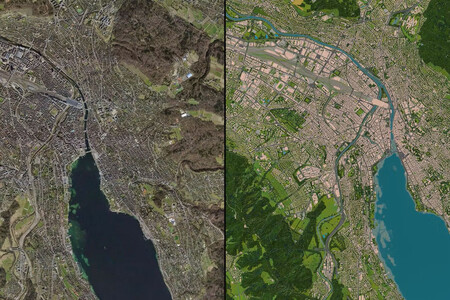
Comparison between a real satellite image and an aerial view of Minecraft
Open data, single author. The world that Manifold creates is nourished by different data sources. The terrain comes from the swissALTI3D elevation model, the lakes and reservoirs from swissBATHY3D, the forest and tree heights from swissSURFACE3D and the buildings from swissBUILDINGS3D.
As the website of the Swiss Federal Survey Office reminds, until March 1, 2021, special permission was required to use most Swisstopo digital products. Since that date, maps, aerial photos and landscape models have been open for free use and free data, even for commercial purposes. “This project is only possible because Switzerland makes its geographic data freely available to the public,” admits the student. Manifold acknowledges that the Swiss case is unique. “As far as I know, there is nowhere else with such detailed open data for everyone as in Switzerland,” said the Swiss student, and that’s why his project for Digital Switzerland in Minecraft cannot be replicated anywhere else on the planet with such an extreme level of detail.
Other countries have already tried it. In 2014, the Danish Geodata Agency reproduced Denmark at a 1:1 scale with approximately 4,000 billion blocks. The idea came from Simon Kochendorff, an employee of the agency, who thought of it as a teaching tool and started from a 3D elevation model of the organism.
In 2013, the British Ordnance Survey brought Britain into the game with more than 22 billion blocks. It was built by an intern, Joseph Braybrook, and each block covered 50 square meters. This scale reduces the “resolution” of the map, leaving a much coarser aerial view. On the other hand, the Swiss version is much more detailed thanks to the 1:1 scale.
However, what’s really impressive about this project is that games like Minecraft have gained the ability to take large amounts of geodata and convert them into digital recreations of real-world places. CartoVoxel takes data from real streets, building floors, and terrain to create areas of New York. Map2Minecraft does something similar using OpenStreetMap data.
In Xataka | A Swiss town collected so much tax that they don’t know what to do with the money: They’ll return 2,700 euros per person