
There are those who think they are Tourism in Spain has been lost And judging by things like the cost of housing in tourist areas, which can be decisive when choosing a destination for example in an opposition party or where you’re going to study a degree just because of the price of rent, it makes a lot of sense. And that’s not to mention the inconvenience of your block looking like an eternal bachelor party due to tourist fare.
Tourism is an important economic vector, but additionally it takes a toll on housing, public spaces and services. But that line of pressure is not clear-cut and varies greatly from place to place: reaching a city of 20,000 inhabitants is not the same as reaching another city with 2 million. Simply put, how many people visit a city doesn’t tell how much it affects it, as it also matters how many people live there, which is what this graph tries to address.
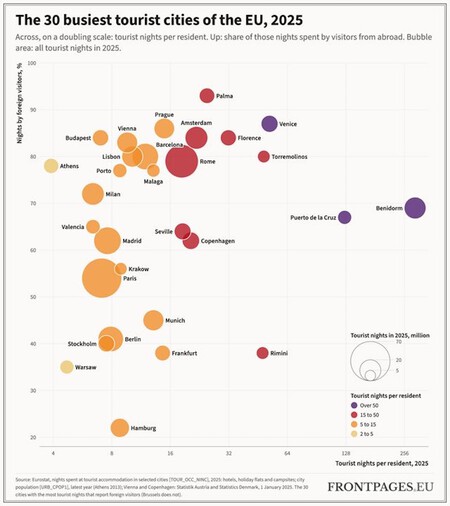
This bubble chart is titled “The 30 busiest cities for tourism in the EU in 2025“And for its preparation it uses data from Eurostat on nights in tourist accommodation in selected cities through 2025, whether in hotels, tourist apartments or campsites. These nights are compared with permanent residents to obtain tourist intensity, i.e. tourist nights per inhabitant.
Population also comes from Eurostat, in addition to other state statistical offices. Cities on the list have 50,000 or more people, so some smaller municipalities like Dubrovnik are left off the list, as detailed by its author on Reddit. From here, each bubble is a city and the horizontal scale is logarithmic with base 2, which forces us to read the axes carefully because inertia tends to make us decimal scale.
Tourism hot spots in the EU
The important thing about this graph is precisely that relationship: The total volume of tourist nights is deceiving. Thus, Paris may have a larger bubble, but less pressure per inhabitant. However, smaller cities such as Benidorm or Canary Islands Puerto de la Cruz support much higher charges per inhabitant, in fact the highest. In addition, it also suggests where the economy may be more dependent on tourism or where there is a greater risk of conflict between those who live there and those who travel to the city. Another clear example: the case of Palma is extreme, where almost 93% of tourist nights are related to foreign visitors, so its dependence on international tourism is very high, just the opposite of Hamburg.
According to Eurostat data collected by Euronews, in 2025, Spain will be the number one European destination for overnight stays of around 330 million international visitors. So it’s no surprise that the state that contributes the most cities to this list is Spain: 9 out of 30 specifically.
30 busiest tourist cities in the European Union
How to explain it? Further to the right, more tourist nights per resident. The higher up, the greater the number of foreign visitors and the greater, the greater the total nights. Colors indicate tourist intensity (nights per resident), from yellow (between 2 and 5 nights per resident) to purple (more than 50 nights per resident).
Let’s go back to Benidorm and Puerto de la Cruz because they are the most extreme cases. In the case of the city of Alicante, there are about 290 nights per inhabitant and 69% are foreign, indicating a strong presence of tourism from outside. In the municipality of Tenerife, more than 100 nights are registered per inhabitant (about 126) and about 67% come from outside. We have not finished leaving Spain and we have already entered Italy: Venice, Torremolinos, Rimini and Florence have between 30 and 50 overnight stays per inhabitant. The case of Rimini is curious: its intensity is very high (about 50 nights), but its tourism is mostly Italian (38% foreign visitors).
In the central area of the graph, between 8 and 25 nights per inhabitant, Rome is one of the largest bubbles and about 79% are foreign, as well as Amsterdam, Prague, Lisbon, Barcelona, Seville and Copenhagen. At the bottom, with little foreign tourism, are Hamburg (about 22%), Warsaw, Frankfurt, Munich, Berlin and Stockholm, each with 15 nights or less per resident. Paris and Madrid stand out for their size and low intensity: Its large population means low per capita ratio.
In Xataka | Map that reveals the pressure of tourism in Europe: 10% of the territory already has more visitors than inhabitants
In Xataka | History’s first beach bar began with looting, which saw the deaths of dozens of sailors in Cadiz