Bedroom, kitchen, bathroom, hallway and living room. With luck, maybe a little balcony where you can enjoy the sun. When you think of an apartment, the first thing that comes to mind is the basic, rudimentary scheme, which is common to both apartments in the most expensive residential areas and in the suburbs. However, for more and more young people who rent, the reality is different: in search of greater returns, their landlords are removing common areas to increase the number of tenants.
This is a new symptom of ‘overwhelming Spain’.
Goodbye, living room. Hilal is 21 years old, Austrian, studies automotive computing and rents a university apartment in Malaga. Until then nothing is out of this world. Curiously, Hilal does not actually sleep in a room, but in a room converted into a living room with her bed, desk, closet and chest of drawers. For this he pays 450 euros a month, slightly more than his two partners, who pay 360 and 410 euros. Various incomes. Different room sizes.
Recently I talked about Hilal’s case the world In an article where he analyzes a reality that has been affecting the Spanish rental market for some time: apartments without common areas. Or rather, apartments where common areas are dedicated and converted into bedrooms.
The logic is simple: the landlord changes the configuration of the house to get extra room, thereby increasing the number of potential tenants and (hence) the money he receives at the end of the month. The sacrifice is made in the living room of Hilal’s apartment. In other cases, a terrace is closed off and the dining room is cut out to create a bedroom from scratch.
Is it something common? It is widespread enough that the government has proposed to tighten the control of single room rents He has already tried this with the express decrees on housing that failed in Parliament in early October, and he has done it again with the decree-law he now wants to ratify in the permanent deputation of Congress. Their target: Cases like Hilal’s, where a landlord removes common areas to increase the number of tenants, stop paying.
“When it comes to renting rooms, the sum of all rooms rented cannot exceed the rent that would be applied to rent an entire house in an area with a stressed residential market,” they clarify from La Moncloa. At this point, landlords can renovate their apartments and convert shared spaces into bedrooms, rooms that they normally rent individually, and at different prices depending on their size. They only have to respect the habitability conditions set by the city council.
“Actually, I need it.”. Alba, another university student who lives in a rental, admits that when looking for an apartment, she only found options without a living room. He resigns himself and stays on the same floor as Hilal, convinced that he can live without the common space intended for watching TV, sitting on the couch or hanging out with friends. Now he’s not so sure.
“With a living room you interact more with your colleagues. After all, the kitchen is also not very big and since there are two of us, the third room doesn’t fit anymore,” admits the 20-year-old. Now, after the experience of spending days and nights locked in her room, she admits that “I actually need it.”

Each room, a “floor”. Your case is just a drop in the ocean. A quick Google search turns up similar testimonials. For example, Lucius (aged 25), who ended up in an apartment in Madrid’s Ciudad Universitaria, where the landlord had changed to get an extra bedroom. As? Close the terrace and reduce the living room.
Worse is the experience of Sonia and Camilla, who told Inside Vanguard How looking for a rental apartment when they had an independent ‘flat’ for 800 euros in a property in Barcelona where each room was rented. All without accommodation of course.
ghost of the crowd. It may seem anecdotal, but the sacrifice of common areas to rental apartments (especially those aimed at young people) connects to a much larger phenomenon: the housing crisis that Spain is suffering. The mismatch between supply and demand drives up prices, delays emancipation, and forces renters to look for options that don’t eat into their monthly budget, even if that means sharing an apartment or even a bedroom. This is a phenomenon that has been thoroughly studied by organizations such as Eurostat.
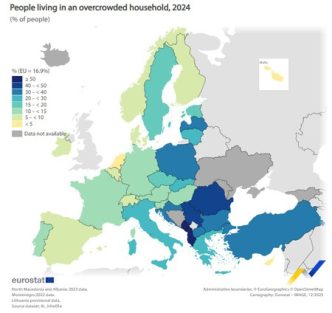
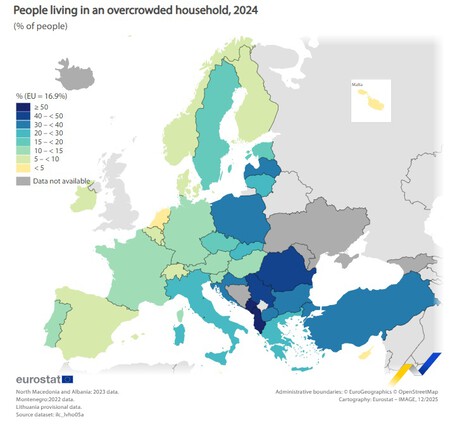
Data: 9.5%. In its latest report on the matter, the EU statistics office warned that Spain has been increasing its “overcrowding rate” for years, an indicator that shows “overcrowded” homes where there is no room for every couple or adult.
If we talk about housing in general (both owned and rented), this indicator is 9.5% in Spain. The percentage puts us well below the EU average (16.8%), but it leaves a worrying reading. 9.1% marked in our country in 2024. and in 2016, 5.4%. In fact, the national rate has been increasing slightly since 2021.
Youth and rent. If you look a little deeper into the Eurostat table, you will see that overcrowding does not affect the entire population equally. The problem is particularly acute among young people and in rented houses. When we focus on renting (excluding home ownership) we see that the Spanish rate rises to 20.5% (one fifth of the total), much closer to the community average (23.8%). Additionally, it has been increasing in recent years, moving away from the 11.7% it recorded in 2016.
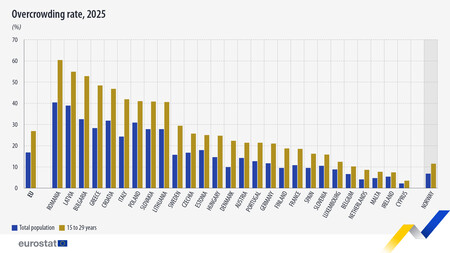
And young people? They bear the brunt. At least that’s what Eurostat shows, which reveals that 26.9% of young people aged 15 to 29 in the EU will live in saturated households in 2025. Among this group, the rate is 10.1 percentage points higher than the general average (16.8%).
The worst unemployed are young people in Romania, Latvia, Bulgaria, Greece, Croatia and Italy, the European countries with the highest index of youth overcrowding, but this does not mean that the problem does not affect Spain. The youth crowding index here is 16.2%, much higher than the general average of 9.5%. In 2011 it represented 11.2% and a decade ago it did not reach 10%.
Picture | David Schultz (Unsplash) and Eurostat 1 and 2
In Xataka | Spain has ridiculously low public housing rates, and part of the answer lies in a 2013 law