Teaching a cow to use the toilet sounds like a comedy. However, in 2021, a team of researchers from Germany and New Zealand decided to test whether this is possible. What they discovered in just ten days not only challenged what we know about the intelligence of these animals, but also opened up an unexpected way to reduce pollution on farms.
A concept that seemed impossible. For decades, scientists assumed that cattle had little control over when and where they urinate. Unlike other animals, such as dogs, which can learn to relieve themselves in certain places, cows seem to do so without much attention.
But Jan Langbein, an animal psychologist at Germany’s Institute of Farm Animal Biology (FBN), asked himself a seemingly simple question: If we can teach dogs and horses, why not cows? Together with researchers at the University of Auckland in New Zealand, he decided to test that hypothesis. The result was published in the scientific journal Current Biology on September 13, 2021.

A toilet called Mulu. The researchers designed a small confined area, covered with artificial grass, which they named MooLoo. The experiment began with a training session of approximately 45 minutes on 16 calves. First, the animals lived inside the enclosure and received a reward such as a sweet drink or crushed barley each time they urinated.
When they learned to associate the place with the reward, the scientists led them to an outside hallway from which they could voluntarily enter the toilet. When they came inside and urinated, they got food again. If they make it outside, they get a brief spray of water for about three seconds. They also tried unpleasant words, but they were ineffective.
Ten days that changed expectations. The amazing thing happens when the calves start anticipating the need to urinate and move to the enclosure on their own initiative. After about ten days of training, 11 out of 16 animals learned to use the MooLoo, a success rate of around 77% among those who completed the training. The other five tests did not reach the same level of time, although the researchers considered that they probably needed more time.
Experiments have shown that cattle can recognize signals from their bladders, control their behavior and learn to urinate in a specific place. According to the authors, their performance during certain phases of toilet training was comparable to that of younger children.
The real problem was the urine. Although the experiment seemed like a simple curiosity about animal intelligence, its purpose was far more ambitious: reducing pollution from animal husbandry. An adult cow can produce ten liters of urine per day, and with the world’s nearly 1 billion cattle, the accumulated volume is much higher. In stables, urine mixes with feces and promotes the release of ammonia, a pollutant that harms air quality and contributes to ecosystem acidification.
Also, part of the nitrogen in urine can be converted to nitrous oxide, a potent greenhouse gas, while another part pollutes soil and water. The researchers’ idea was to collect the waste before it is mixed and take advantage of nutrients like nitrogen and phosphorus to make fertilizer.
A solution with amazing statistics. Calculations cited by researchers indicate that collecting about 80% of cattle urine in certain facilities can reduce ammonia emissions from barns by more than 50%. The proposal would allow direct action on one of the major sources of livestock pollution without requiring changes in animal feed.
And this had another advantage: by separating urine from feces, it would be easier to treat and restore its nutrients. However, these reductions were estimated based on previous studies, not environmental outcomes measured during testing with 16 calves. What the team showed was that animals could learn to use the toilet, not that the system already worked on an industrial scale.
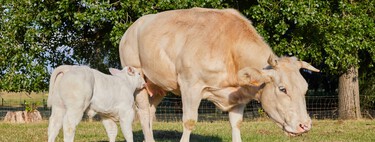
Millions of cows from 16 calves. The big hurdle was transferring that experience to cattle farms, where there can be hundreds or thousands of animals and it’s not possible for one person to oversee every visit to the bathroom. For this reason, the researchers proposed developing automated systems with sensors that are able to detect when an animal has properly urinated and distribute rewards without human intervention. Langbein also expressed interest in testing whether cows can learn to defecate in specific locations, something the 2021 experiment did not show.
The study thus left a conclusion as unexpected as it was, where the scientists managed to teach 11 calves to use the toilet in just ten days, although much bigger challenges had to be solved to transform that skill into a tool against pollution. What started out as a seemingly nonsensical question shows that perhaps we have been underestimating the poor cow for far too long.
Picture | crying
In Xataka | 30 years ago, a farmer dared to install a wind turbine in his cow: today he is showered with money
In Xataka | In Zamora, a small town regularly runs out of water: the fault is not the drought, but some cows