China has just announced a breakthrough that could change the rules of naval warfare: It has been able to launch and retrieve a stealth combat drone from a nearly 40,000-ton amphibious ship. We’re not exactly talking about an aircraft carrier, but it incorporates one of its most important technologies. And what’s really troubling for the U.S. is not just the ships, but the prospect that Beijing is advancing itself in a capability that the U.S. Navy itself explored and ended years ago.
the soul aircraft carrier The hero is Sichuan, the first Chinese amphibious assault ship of the Type 076 class, designated 51. With an estimated displacement of around 40,000 tonnes, it belongs to a category traditionally designed to transport troops, helicopters and landing craft.
However, China has included a large flight deck, a hangar, elevators and above all an electromagnetic catapult and a braking cable system. In other words, it’s an almost perfect combination for an amphibious ship: it allows for the launch and recovery of fixed-wing aircraft, a function normally associated with aircraft carriers. It’s a hybrid platform, if you will, that can combine amphibious operations with long-range air missions.
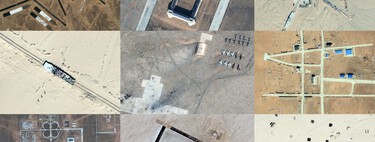
The first flight changed the rules. An official account of the People’s Liberation Army announced, the GJ-21 stealth drone has already successfully completed its first takeoff and landing in Sichuan. The announcement represents a potential milestone, though it has one important limitation: Chinese authorities have not released photos or videos of the operation, nor have they specified when it happened or how many tests were carried out.
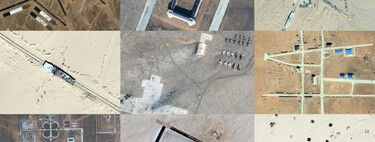
Satellite images examined by The War Zone analysts show that the ship left its usual berth in Shanghai for several days in October, although this in itself does not prove that the announced flights took place. For now, the trailer must be attributed to the official Chinese version, pending independent visual confirmation.
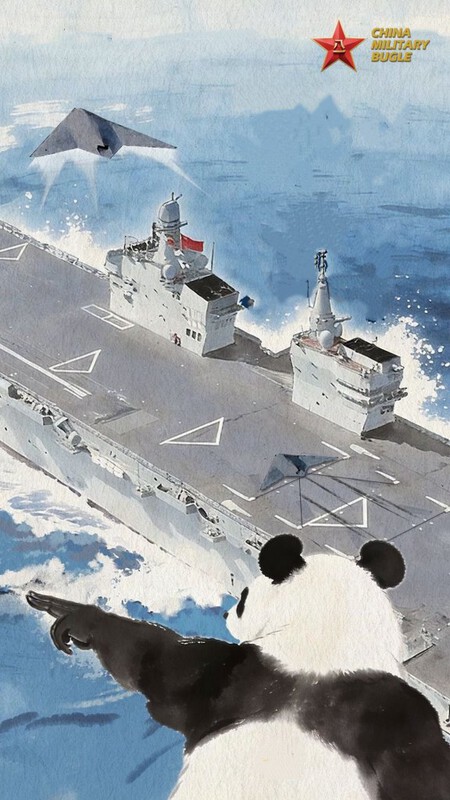
A photograph accompanying the publication in the account “China Military Bugle” at X relating to the GJ-21 and Type 076.
A drone is designed to go where others cannot. The GJ-21 is a naval variant of the GJ-11, known as the Mysterious Dragon, an unmanned combat aircraft with a flying wing configuration. Its design dispenses with conventional tail surfaces and seeks to minimize its radar signature, a feature particularly valuable for conducting reconnaissance and attack operations in protected airspace.
The shipborne version incorporates modifications for operation from a ship, including a launch bar on the front landing gear that allows the use of a catapult. Although its full operational capabilities are not public, its potential use from Sichuan would allow China to deploy stealth drones away from land runways and expand its fleet’s surveillance and attack options.
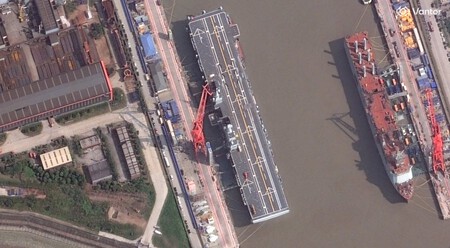
Type 076 “Sichuan” amphibious assault ship, at the Hudong-Zhonghua Shipyard on October 10, 2026. On the right, you can also see it serving as a mother ship for a large unmanned underwater vehicle (UUV).
A catapult that explains the whole strategy. The Type 076’s real differentiating factor is its electromagnetic launch system, a technology that accelerates the aircraft using electrical energy rather than traditional steam catapults. In October 2025, a red test vehicle was photographed on the deck of Sichuan, used to test the operation of the catapult.
The ship went to sea for the first time in November of that year, and in February 2026, models of GJ-21 were observed on its deck and in one of its elevators. The next images also show new markings from aerial operations and components connected to the three braking cables. Everything points to a progressive preparation for operating fixed-wing drones, although the announcement of their first flight is still pending visual tests.
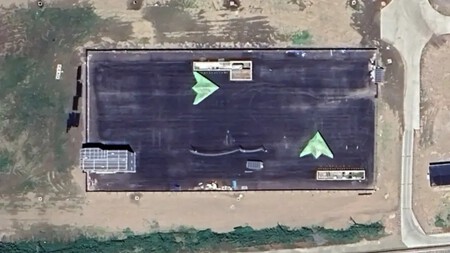
A pair of possible mock-ups of the GJ-11 at a test and/or training site on Shanghai’s Changxing Island in May 2024, where the Type 076 ship was then under construction.
America’s headache. Because Sichuan’s biggest potential threat is not directly competing with US supercarriers, but increasing the number of places from which China can deploy warplanes. An amphibious ship capable of operating stealth drones can complement reconnaissance, surveillance and attack missions, support landings and conventional aircraft carriers such as the Fujian.
This capability would be particularly relevant in crises around Taiwan or in the South China Sea, where Beijing wants to expand its military presence. Instead of concentrating all its aircraft on a few carriers, China could spread them across multiple platforms, complicating surveillance, defensive planning and targeting of US forces.
The technology that allows Washington to get away with it. The paradox is that the United States pioneered the development of stealth drones capable of operating from aircraft carriers. The US Navy has demonstrated advanced launch and recovery technology with unmanned aerial vehicles, but has prioritized the MQ-25 Stingray, designed primarily for aerial refueling.
Meanwhile, China continues to develop the GJ-11 and its naval variant, the GJ-21, along with other flying wing designs. If Beijing can convert these tests into regular operations, it could overtake Washington’s operational deployment of stealth combat drones. This does not mean that China has overtaken the US in naval aviation, of course, but it is advancing in a specialty where the US Navy does not yet have an overtly equivalent capability.

A new way to fight at sea. Sichuan was launched on December 27, 2024 and began navigation tests in November 2025. Its full load displacement exceeds 40,000 tonnes, according to Chinese authorities, and its design allows the integration of helicopters, drones and amphibious equipment on the same platform. Still, key answers are missing, such as how many GJ-21s it can carry, how often it can launch them, what weapons they will use or how they will integrate with the rest of the fleet.
The recent announcement is important, no doubt, although as we have said, it does not prove that the system is yet ready for sustained combat operations. What it reveals is the direction of the Chinese gamble, converting large amphibious ships into mobile bases for unmanned stealth aircraft. And for the United States, the challenge may not just be facing more Chinese ships, but a fleet capable of launching airstrikes from platforms that until recently were not designed to do so.
Picture | Vantor, X
In Xataka | Boats taking lift: The impressive network China has built to make the Yangtze navigable
In Xataka | Something is afoot at one of China’s largest shipyards: an important technological leap in the form of a fourth aircraft carrier