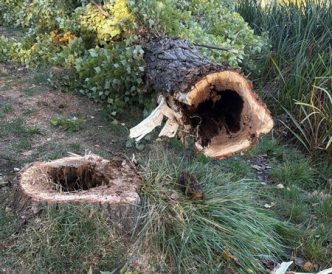
Last Monday, October 26, the Salamanca City Council announced “tree risk management” in the La Aldehuela Sports City and on the banks of Tormes between the Enrique Estevan and Sánchez Fabres bridges. In plain English, this means cutting down a good handful of trees.
The city council complained of “internal rot, cavities, dead branches” and wind-blown trees. They promise to plant twice as many native specimens. Larger wood will go into the heating boiler. A week later, the image is of a partially deserted area. About twenty mature poplars along the pier have disappeared. In its gap you can see the cathedral better than ever.
perspective. This is one of the main complaints, because the context has a tail. Logging is part of a “recreational and touristic use” project co-financed with European funds. It includes a pier, viewpoint and a 15-meter stand next to the water. And be careful: it costs 820,000 euros to clean the river banks and we all pay for it together.
The point is that in 2025, when requesting the permit, the city council wanted to clear the weeds that spoiled the view of the Enrique Estevan Bridge, a protected asset whose image is protected. The general secretary of the local PSOE, David Serrada, put it this way: “Maybe now tourists can take better selfies.”
CHD limits. Confederation approved the project except for the Channel Islands. But with one condition: less than 25 meters from the Romano and Enrique Estevan bridges, only certain trees can be cut that pose a real risk to the monument if they fall. No one talked about systematic logging. The Antinuclear and Ecologists Committee doubts that this has been met, which is why the PSOE demands the publication of technical reports. City council hides behind CHDs and prior inspection approvals.
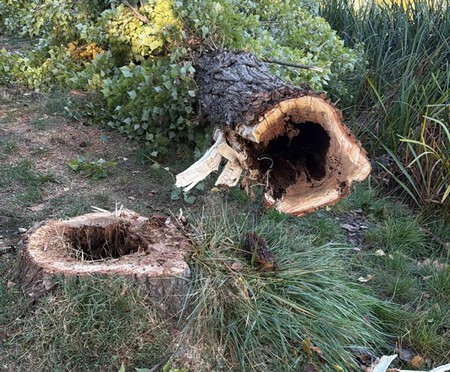
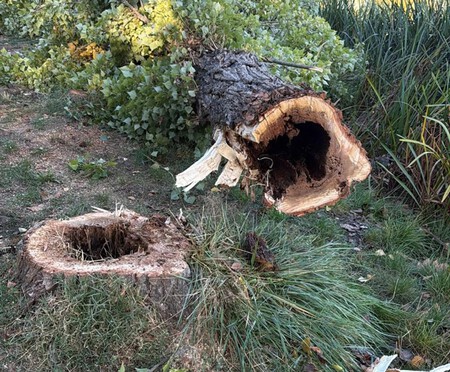
Poplar goes. Poplars are fast-growing, short-lived and can be hollow inside even if the crown looks healthy. Some published photos show that a hollow stump and a tree in that condition, next to a pier, are a real hazard. We return to the debate that we addressed in the same situation: is it cheaper because it is cheaper than properly supervised maintenance?
Green Salamanca. At least the city has planted a lot of trees: 32,000 in 2025 and 30,000 this year, which will exceed 200,000. The problem is not policy, but verification and scale. It is not known how many trees will fall in total, and the city council itself has warned that this will not be a one-off intervention but part of a tree management strategy.
Double planting is not profitable. The point is that a plant does not provide shade for decades. The University of Granada measured 19 species in a city park over two years. It is known that the shade of a tree cools on average 2 ºC and, at critical moments, up to 3.5. But as we have already said that the age of the tree is important for health.
Another study, rather a simulation of the Barcelona example, found that dense vegetation on very dry soils, in the middle of a heat wave, could leave streets 0.3 ºC warmer. But he’s talking about planting too many trees too tightly together, not removing mature trees. Even with dry soil, shade retains between 71 and 97% of the cooling effect.
precedent. I remember that in October 2024 the city council cut down 12 trees in the Plaza del Ost and the protest ended with a prisoner and two police officers injured. The mayor, Carlos García Carbayo, defended that it was not “bound”. The phrase is identical to the one used in Zaragoza, where neighborhood groups and environmentalists estimate the number of trees to be lost at 10,000 by 2022, although Europe has named it Green Capital 2028.
Salamanca is facing a similar situation, but technical reports on each plant and how many will fall in total between La Aldehuela and Tormes remain to be known. Indeed, if the riverside poplars were within 25 meters of the bridges, why were they allowed to rot? And the main question is missing: when and where the pledges will be planted, because no offer from the city council has been published.
Picture | Flickr/Salamanca 24 Hours
In Xataka | Our cities never needed trees so much and we never had so many reasons to remove them