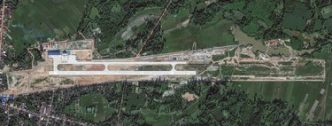
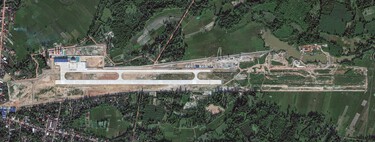
An image taken from space on October 5 focused on Chinese aviation facilities. It shows four aircraft of a model that was introduced only two years ago. They’re not stealth fighters or bombers, but they could be just as important to the future of air warfare: their mission is to detect the enemy, coordinate attacks, and turn dozens of aircraft into a cohesive force.
Four aircraft that set off the alarm. Images captured by American company Vantor show four examples of the new KJ-3000 at the Xi’an-Yanliang Aeronautical Complex, where Xi’an Aircraft Company (XAC) operates. Three appear next to the factory, while the fourth is located at the facilities of the Chinese Flight Test Center (CFTE).
Mitchell Institute for Aerospace Studies researcher J. For Michael Dahm, the concentration of aircraft indicates that China has already started mass production. Other experts, such as Andreas Rupprecht, are more cautious: it could be the start of a limited production run or just a coincidence of the four prototypes. The images do not allow us to confirm which of these possibilities is correct.
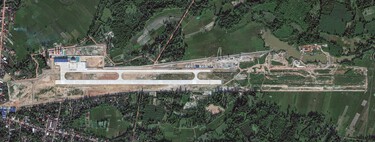
They are not fighter planes. Because they tell the fighters where to shoot. The KJ-3000 belongs to the Airborne Early Warning and Control (AEW&C) category of aircraft, a true surveillance and command center that operates thousands of meters above sea level. Its mission is to detect aircraft, missiles and other targets, track their movements and transmit that information to fighters, ships and defense systems.
Thanks to its high position, its radars can monitor areas that are beyond the reach of ground sensors due to the relief or curvature of the Earth. In a conflict around Taiwan or in the South China Sea, having these aircraft allows us to coordinate operations over a large area of the Pacific Ocean and improve our ability to respond to distant threats.
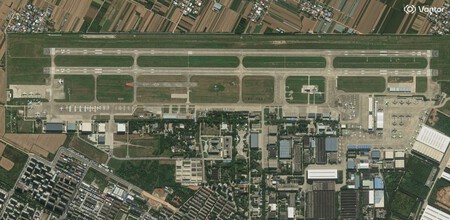
A general view of the Xi’an Aircraft Company (XAC) facility on October 5. A total of four KJ-3000 will be seen
A monster built another monster. The KJ-3000, also known as the KJ-20, is based on the Y-20B, an upgraded version of the Chinese Y-20 military transport aircraft equipped with indigenously developed engines. Atop its fuselage is a large circular dome that houses the radar system, along with numerous antennas and electronic equipment.
It also includes an in-flight refueling probe that can significantly prolong its missions. Although the exact configuration of the radar is still unknown, China already uses active electronically scanned array (AESA) antennas on other early warning aircraft to provide 360-degree surveillance. The new device may also include intelligence and reconnaissance sensors, passive detection systems and improved jamming resistance.
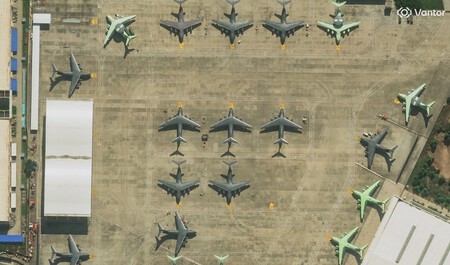
Three KJ-3000s at the XAC factory in the western part of the facility, along with other Y-20s
China’s problem was four planes. Now there may be more. So far, Beijing has only managed to complete four large KJ-2000 early warning aircraft built on the Russian Ilyushin Il-76MD platform. A shortage of available fuselage, dependence on Russian supplies, and the aging of those aircraft limited fleet expansion.
The KJ-3000 aims to solve this problem by using a platform made entirely in China, which will facilitate the creation of new instances, their maintenance and future modernization. The program became visible in December 2024, when the first low-quality photographs were circulated, and in May 2025 a more detailed image of a specimen identified with the number 7821 appeared.
That piece could make the J-20 even more dangerous. The true value of the KJ-3000 lies not only in its ability to detect threats, but also in its potential to multiply the effectiveness of other combat systems. Its radar and communications can provide targeting information to platforms equipped with J-20 stealth fighters, unmanned aerial vehicles and long-range air-to-air missiles.
TWZ analysts said that, in some situations, fighters can receive external information without activating their own radars, reducing the risk of disclosing their location. In 2022, US General Kenneth Wilsbach already highlighted the synergy between the J-20 and KJ-500 aircraft, whose sensors supported the use of long-range weapons. A KJ-3000 with greater autonomy and surveillance capabilities could, in theory, significantly expand the operation model.
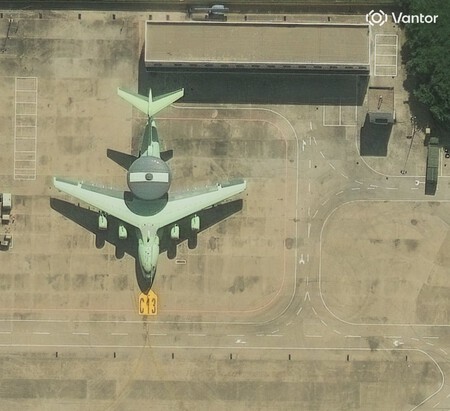
A close-up of one of the KJ-3000s at the XAC factory
The Pentagon was already keeping an eye on them. In its 2025 annual report on Chinese military strength, the US Department of Defense confirmed that the KJ-3000 had made an initial flight and noted that it could include an advanced digital radar with anti-jamming, passive detection and target identification capabilities. In this regard, its development is part of a larger expansion that includes the KJ-500 and the new KJ-700, small aircraft based on the Y-9 turboprop platform that can operate from dispersed airfields and island locations.
While these models provide relatively close surveillance of Chinese territory, the KJ-3000 can provide coverage and coordination at greater distances. The contrast is particularly relevant as the United States faces problems with its E-7 Wedgetail program, intended to replace the aging E-3 Sentry.
A figure that anticipates a very different battle. The presence of four KJ-3000s at Xi’an-Yanliang does not prove that China has started serial production, nor does it allow us to know how many devices will be available for military operations. However, it points to a program that could significantly strengthen China’s ability to monitor its airspace and conduct direct operations far from its shores.
In a hypothetical conflict over Taiwan, the balance would depend not only on the number of combatants, their missiles or their stealth technology, but also on who detects the adversary first and manages to transmit that information quickly. These four aerial images show a sign of strategic interest for the United States from space: China is building an air infrastructure capable of operating all its military forces in a more coordinated manner.
Picture | Ventor
In Xataka | The US has just revealed that a secret Chinese plane has been orbiting in space for six years
In Xataka | China has been building a plane for years to compete with Airbus and Boeing. The C919 has just launched its first international route