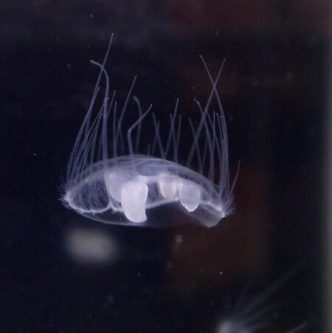
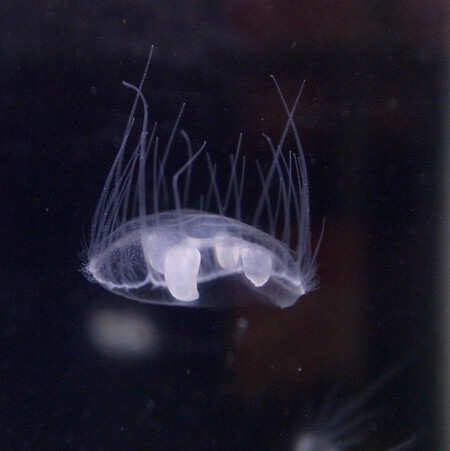
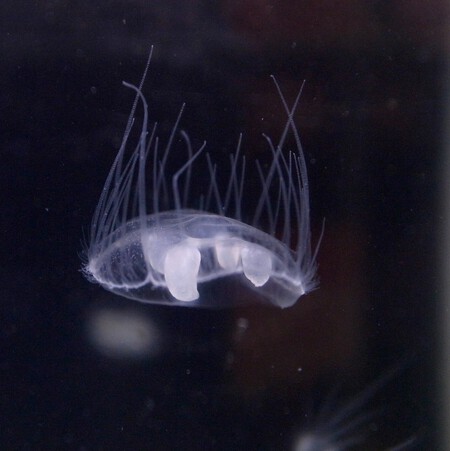
What you see above these lines may seem at first glance to be one of those jellyfish that scare bathers in the sea, but unlike those jellyfish, it is really small and lives in lakes, ponds and swamps, not in sea water. his name Craspedacusta SowerbyOriginally from China but back in Catalonia, rural agents are already sounding the alarm.
Flashing jellyfish. As detailed by MITECO, Craspedacusta sowerbyi is a bell-shaped invertebrate with a diameter of between 2 and 2.5 cm and 400 tentacles with cnidoblasts growing from its umbel. Probably native to the Yangtze basin, it is an invasive in freshwater systems around the world, as explained by Graellsia in the CSIC scientific journal.
Well, it has just been spotted in the artificial reservoir of Losa del Caval (Solsones) and is being tested to determine if this appearance is periodic or if the population has become established. For now, they’re going to clean and disinfect the boats, just in case.
Opencage
QOr does it matter. Although it has microscopic stingers, the good news is that this species does not produce relevant stinging lesions in humans, the not so good news is that it feeds on zooplankton, a staple food for many native fish.
Previous research shows that when Craspedacusta sowerbiei expands, zooplankton declines, disrupting the freshwater food chain. Time moves in favor of this hydrozoan, as projections indicate that climate change and increased temperatures will favor its expansion.
From China to the world. Outside of China, the first documented record of the presence of this freshwater jellyfish was around 1880 and occurred in an ornamental pond in London. Since then, its expansion has occurred slowly but surely across six continents. Its attack is silent: it is unknown to the general public, its life cycle is difficult to observe and furthermore, its presence is sporadic.
In fact, as expert ecologist Emilie García Bartho explains for El Periodico, it was not seen for the first time in Catalonia: the first records were found in 1968 in Sauté and at the beginning of the century in Banjoles, but it has not been seen for years. But we have already seen that this is their modus operandi. MITECO has a scattered presence in virtually the entire state.
Two small stages and a problem. Its size is a good reason why it goes unnoticed, but it’s also a good reason that it can be found in two phases. As a polyp it is tiny (even more) and as García Bartho says, it is attached to stones, plants or other submerged surfaces, which is why it is so important to work by treating boats without moving water or plants into the reservoir.
The species then reproduces asexually and occasionally appears in the gelatinous jellyfish stage. Because this jellyfish is so small and sparse, looking at the jellyfish provides little information about its distribution, so it is parameterized by polyp sampling.
In Xataka | This tropical mussel was the first invasive species in the Mediterranean. 150 years later, it is colonizing Spain
In Xataka | Ebro is filling up with brown shrimp, an invasive species that we’re finding more and more on our plates.
cover Alexander Mikvika