
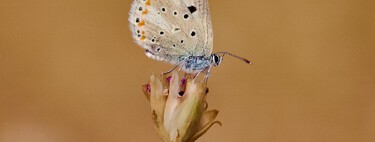
A big question in our mind may be why butterflies have bright geometric patterns and colors on their wings. The conventional explanation has almost always been camouflaged to go unnoticed in the environment, or aposematism, the visual strategy by which shrill tones alert predators to the presence of unpleasant venom.
A reply. To try to understand what is going on, a study has been published the nature demonstrated that certain anatomical and color features do not attempt to conceal the insect, but rather distort the calculation of speed and trajectory made by the predator’s brain when the butterfly is in motion.
How they saw it. To test the dynamic deception hypothesis, the researchers created a computer simulation in which they recreated the shape of 757 wings of 397 species of European butterflies. Once the system was in place, one hundred volunteers were recruited who took on the role of “hunters” and so their goal was to capture the butterflies in motion with the touch screen.
In parallel, the scientists designed an evolutionary simulation that allowed the algorithm to operate independently. The system generated more than 50,000 artificial wing patterns, automatically selecting those designs that produced the highest level of error and confusion in participants’ attacks.
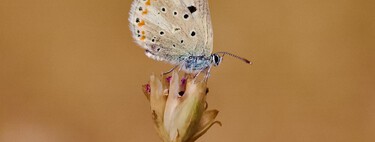
Results. Once the tests were completed, it was found that the best patterns abstractly generated by the computer matched the actual species that exist in nature. And the real trick seems to lie in the contrasting vertical stripes, the single transverse band, and the tail-like extension on the hindwing.
There are nuances. The visual system of predators is not the same in all species, but there are important variations. For example, birds process the image at a certain speed, but other butterfly predators, such as dragonflies, have a much faster resolution.
Among these predatory insects, capable of processing a large number of frames per second, the optical illusion caused by flapping their wings may not be affected, which explains why they capture butterflies in mid-flight with a very high success rate. This is why the winged defense mechanism that everyone falls in love with may not be suitable for all hunters.
Through this the country
Picture | Frederica Black
In Xataka | Spanish butterflies have a great advantage over British ones. The key is heat