
We are not aware enough about how protected we are in the world. Numerous protective barriers, from the magnetic field to the ozone layer, protect us from all kinds of external threats that would make our planet a very hostile place. One of these barriers includes the Van Allen belts, which are responsible for trapping a type of electron, colloquially known as killer electrons. They pose no danger on Earth’s surface, but they can be very dangerous for satellites and astronauts.
For a long time it was thought that these electrons could not penetrate the nearest region of the Earth, since there is a very clear limit of three radii from the center of the Earth beyond which they rarely venture. This was believed to be a virtually insurmountable barrier. However, scientists from Nagoya University just pointed out that in reality this barrier is not so inconsequential.
It was only a matter of time. In 2018 it was already realized that, perhaps, there are no insurmountable obstacles. It was noted that the problem is that the geomagnetic storms associated with these killer electrons are very short, so they disappear before the electrons penetrate deep into the magnetosphere. This can create the illusion that a barrier exists. Now, these Japanese scientists add that the intensity of geomagnetic storms has many implications, since they can form a type of wave, called a chorus wave, capable of further accelerating electrons trapped in the Van Allen belts.
The magnetic field protects us from the damaging effects of solar storms. However, it may pose some risks. When charged particles emitted from the Sun collide with it, most are deflected, but some are managed to pass through. Electrons, which carry moderate energy, are accelerated to nearly the speed of light by the action of electromagnetic waves, becoming killer electrons. They are so powerful that they can penetrate satellite shields and damage their electronics. They would also pose a risk to astronauts working nearby. Fortunately, it was believed that the most powerful electrons did not cross the three-radius barrier, which kept the region closest to Earth safe. Ahora esa creencia se derrumba.

Will they go?
Introduction to rays. Lightning from electrical storms creates waves that can travel through the magnetic field, pulling those killer electrons into the atmosphere, where they collide with molecules and lose energy. Thus, the Van Allen belts are being cleared, so that they can accommodate more electrons from a new geomagnetic storm. So, we have electrons coming from the Sun trapped halfway and finally released slowly by the rays coming from the Earth.
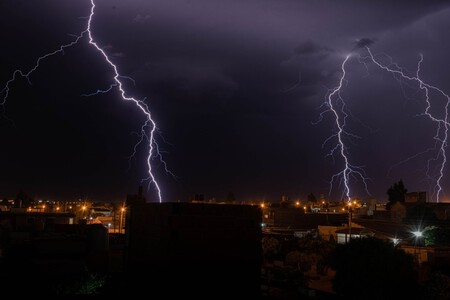
Electrical storms play a very important role in maintaining balance with these electrons. Credit: Nahuel Robledo (Pexel)
the missing piece. Surrounding the Earth, within the magnetosphere, is the plasmasphere, a region of low-energy charged gas, the so-called cold plasma. These plasma tension DOS effects are important. On the one hand, it dampens high-frequency electromagnetic waves, absorbing their energy. This prevents some very strong waves, such as chorus, from developing in this area.
On the other hand, other waves existing within this region help to eject electrons from their trapped orbits and into the atmosphere. Added to this is the scouring by waves generated by lightning, as we saw earlier. A balance is maintained between all these processes which, for years, was interpreted as an insurmountable obstacle.
. So far so good. The problem arises when the plasma is eroded by a very strong geomagnetic storm and chorus waves are formed, a type of wave capable of further accelerating the killer electrons.
In 2024, a geomagnetic storm became so intense that it violently attacked the cold plasma of the plasmasphere, severely corroding it. Since the plasma takes some time to replenish itself, the choruses were able to accelerate electrons for days. The Japanese Aras satellite recorded a stepwise increase in electron flux. The lower energies appeared first, half a day later the higher energies and approximately one day later those greater than 3 MeV. This indicates that the electrons gained energy right there instead of coming from outside.
Month of recovery. According to subsequent Arase observations detailed in this new study, it takes months to restore normal electron levels. At that time there could have been a problem with the satellite. Therefore, these scientists warn that it is important to know this process well. We were reassured by the presence of an indestructible shield, but now we know that it is not such a good barrier in extreme space weather. Knowing how it works is important to find ways to deal with the problem before it harms satellites or astronauts. This new discovery is a small step toward that knowledge.
Picture | NASA Goddard Space Flight Center/Johns Hopkins University, Applied Physics Laboratory
In Xataka | The Sun’s magnetic pole is about to reverse. Problem: Your activity growth won’t stop until it passes