Few ancient civilizations have been studied as much as Egypt and yet continue to surprise us with discoveries in the form of gigantic buildings that, curiously, are not pyramids. And be careful, it’s not that it didn’t go unnoticed by those who lived there or researchers who visited the North African country over the centuries, the fault was a massive sandstorm that literally buried it.
discovery. We are talking about a large adobe structure buried about 2,600 years ago at present-day Tell el-Farain Buto in the northwest of the Nile Delta. Later, the presence of Ushwatis (small funerary figurines) is revealed, a limestone altar with remains possibly containing animal blood and a faience baboon statue associated with Thoth, the Egyptian god of knowledge, writing, magic and the moon.
The subsoil is divided into layers: up to 3 m deep there were Ptolemaic (Greek) and Roman ruins. Between 3 and 6 meters, a large adobe structure of XXVI Dynasty, also known as Saita, emerged. Between 6 and 7 meters, a layer of sand that, according to the research team behind the study, was placed by the builders to stabilize the foundation, since it is located on clay soil.
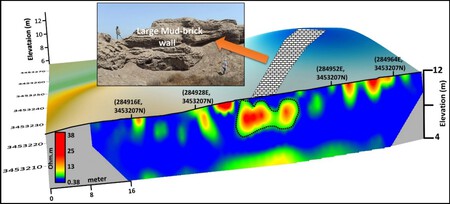
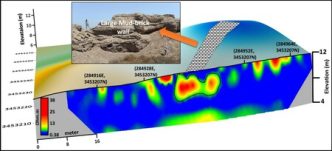
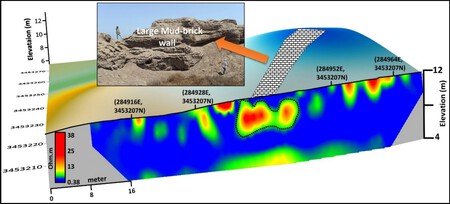
Correlation of one of the ERT images of a large partially exposed adobe wall
How they discovered it. The million-dollar question is how they know all this without digging: it started from space, with the European Space Agency’s Sentinel-1 satellite, which emits microwave pulses and measures how they return, thus they detected an oval anomaly measuring about 128 by 62 meters in the mound called C Kom.
Then, they made soil electrical measurements (ERT) to “see” what was beneath the 5,400 square meter area. Dating is based on stratigraphic layers, shapes of adobe and ceramics, and supplemented with carbon-14 on associated organic material. In fact, the idea is to come back with a more powerful ERT that allows reaching deeper layers.
Back to the original. After Assyrian and Libyan hegemony, the XXVIth dynasty marked a cultural renaissance in Nile Delta culture, and buto was a strategic point of ancient Egyptian identity. Hossein Basir, director of the Archaeological Museum of the Library of Alexandria, wrote for Live Science that the construction of a building of this scale reflects the efforts of these pharaohs to glorify the Nile Delta and its local religion, investing in an infrastructure of this magnitude after centuries of foreign rule.
Why is it important?. Buto was one of the most important religious centers in Lower Egypt and was associated with the protective cobra goddess Wadjet. However, despite its known relevance, the area’s water table has historically prevented mining of its deepest layers. In fact, only Greek and Roman remains have been found to date. Interestingly, the research team discovered what lies beneath the site without digging, something necessary where doing so is dangerous, destructive or simply unprofitable.
In Xataka | He went cucumber growing and found a pharaoh: a giant statue of Ramses II 3,200 years ago.
In Xataka | The location of Nefertiti’s tomb has fascinated archaeologists for a century. A hidden camera may provide the answer
cover Annie Spratt