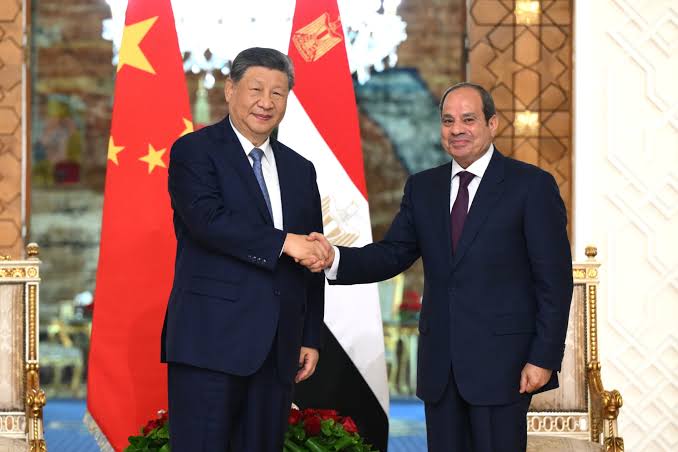
Chinese President Xi Jinping made his first trip to the most populous country in the Arab world in ten years on Tuesday, as nations throughout the Middle East reevaluate their security and economic relations in the wake of the Iran war.
In addition to upsetting international energy markets, the war in Iran has made Middle Eastern nations wonder if they can rely on the US as a long-term security ally.
He was greeted at Cairo International Airport by Egyptian President Abdel Fattah al-Sisi, according to Egyptian state TV footage. Folk dancers performed in his honor and soldiers participated in a parade as part of the red carpet welcome.
Egyptian state media has been highlighting Egypt’s diplomatic recognition of China, the first Arab and African nation to do so 70 years ago, and applauding Cairo’s expanding military and economic ties with Beijing for a week.
Sisi stated in an opinion piece published in the state-run newspaper Al-Ahram that China and Egypt have joined forces to strengthen the “Global South’s” position in the international system.
Egypt is the second stop on Xi’s second international trip of the year. He previously met with Russian President Vladimir Putin and other leaders at the Shanghai Cooperation Organization summit in Kyrgyzstan.
Xi claimed that the two nations, which have opposed colonialism and imperialism, are “like close brothers standing by each other” in comments reported by China’s official news agency Xinhua. He said he hoped for closer relations with Egypt.
Increasing military cooperation
Egypt, which gets roughly $1.3 billion in military assistance from the US each year, conducted its second annual military drill with China last month. Beijing started this joint drill last year in an effort to lessen US influence in the area.
Chinese state media reported that the drill was China’s first time sending J-16 fighter jets to Africa. Additionally, it featured a rare joint military exercise between French-made Rafale fighter jets and Chinese-made fighter jets.
Additionally, a Chinese Air Force tanker was observed refueling Rafale aircraft, providing Beijing with a close-up view of military hardware manufactured in the West.
Since the newly elected Sisi visited China in 2014 and signed a strategic partnership agreement, Egypt has been attempting to forge closer ties with Beijing, according to H.A. Hellyer, a researcher at the Royal United Services Institute.
The Gaza and Iran wars have shown “the degree to which the United States can be relied upon and the instability of its decisions” and have compelled Egypt to think about strengthening its ties with other nations, according to Hellyer, even though Cairo’s position toward Washington has somewhat softened since then.Egypt believes that it is becoming more strategically independent. It desires positive ties with Washington. However, the researcher added, “it also wants to have relations with Beijing, Moscow, and Europe.”
Global powers frequently view Egypt, which borders Israel, Sudan, and Libya and controls vital trade routes like the Suez Canal, as a strategic hub in this unstable area.
With billions of dollars invested in industries like manufacturing, ports, solar energy, green hydrogen, and satellite technology, Chinese investment in Egypt has grown dramatically in recent years.
Egypt was a “logical choice” for Xi’s visit, according to Eric Wolander, co-founder of the China Global South Project, because the nation is at the center of several significant Middle Eastern issues.The Israeli and Palestinian issues are involved, according to Wolander. “Africa is involved. The Persian Gulf issues are involved.
Palestinian rights were a major topic of discussion during Xi’s meeting with King Abdullah of Jordan in Beijing last week. Later this month, Xi is expected to travel to the US and India.