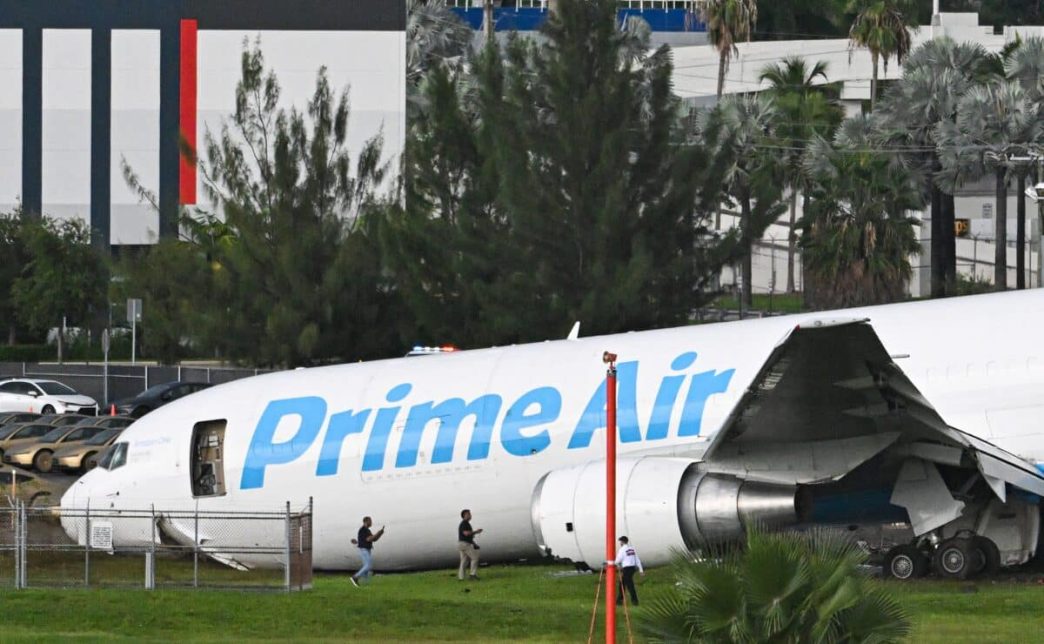
An Amazon cargo plane operated by 21 Air overshot the runway at Miami International Airport on Sunday, crashing into vehicles on a nearby road and killing five people. Five others were seriously injured in the incident, which occurred just before 14:00 local time (18:00 GMT). Officials have launched a formal investigation into what caused the Boeing 767-300 to exit the Miami runway.
The plane, which had departed Luis Muñoz Marín International Airport in San Juan, Puerto Rico, crossed a road beyond the runway and struck several vehicles. Over 200 firefighters responded after the aircraft burst into flames.
What Happened at Miami International Airport?
A Boeing 767-300 cargo plane overshot the Miami runway after landing, colliding with vehicles on the ground. The crash killed five people and left five others with serious injuries, three of whom were in critical condition, according to Miami Fire Chief Raied Jadallah. None of the deceased have yet been identified, and it remains unclear whether the fatalities occurred on the aircraft, on the ground, or both.
Miami-Dade County Mayor Daniella Levine Cava confirmed the death toll at a Sunday evening news conference, adding that rescue crews arrived at the scene within “seconds” of the crash. Several of the injured were trapped inside or under vehicles and had to be extricated by fire and rescue crews.
What Caused the Plane to Overshoot the Runway?
Investigators have not yet determined the cause of the Miami runway overshoot. The National Transportation Safety Board (NTSB), the federal agency responsible for investigating all air crashes in the US, has launched a formal investigation and planned to hold a news conference on Monday.
Experts who spoke to the Associated Press said video footage of the plane’s landing would be central to the investigation, specifically whether the aircraft touched down within its designated zone on the runway — and if not, why. Flight data from tracking site FlightRadar24 shows the Amazon cargo flight was traveling at 112 knots (129 mph, 207 km/h) as it exited the “useable runway.” The site also reported light thunderstorms and gusting winds in Miami at the time of the incident, which may be a factor investigators consider.
Eyewitness Accounts From the Scene
Local residents and aviation personnel described a chaotic and disturbing scene in the aftermath of the Miami runway crash.
Beth Tilman, a local woman, told the New York Times she had seen a black cloud rising from the crash site and detected an acrid smell unlike anything she had recognized before. “It wasn’t trees burning. It wasn’t mangroves burning. It was some other odour that I, honestly, had never smelled before,” she said.
Student pilot Rohan Ellis, who arrived at the scene shortly after the crash, described the state of the vehicles struck by the plane: “They were mangled.” According to FlightRadar24, the plane came to rest near a car park serving an Amazon warehouse and other businesses.
How Did the Crash Affect Miami Airport Operations?
The Federal Aviation Administration (FAA) temporarily grounded all flights at Miami International Airport following the crash. The disruption came over Labor Day weekend, one of the busiest travel periods of the year in the US. The Transportation Security Administration (TSA) had predicted 17 million travelers would pass through US airports in the week leading up to Labor Day, with approximately 2.3 million flying on Sunday alone.
Passengers at the airport reported frustration over a lack of official communication, with many flights cancelled or delayed. Long queues formed at airline counters as travelers attempted to rebook. One traveler named Faroush told Wired Terra: “The earliest I could find to fly to San Francisco was Tuesday morning. I’ll probably have to find a hotel and spend more time in Miami.”
Miami International Airport, founded in 1928, is one of the busiest airports in the country. According to its website, it is “America’s busiest airport for international freight and second busiest for international passengers,” and “offers more flights to Latin America and the Caribbean than any other US airport.”
Statements From 21 Air and Amazon
Both 21 Air and Amazon confirmed they are cooperating fully with the investigation.
Amazon’s Director of Corporate Global Media Relations, Kelly Nantel, said: “We’re heartbroken to learn that five people lost their lives in today’s incident at Miami International Airport. Our deepest sympathies go out to the families, loved ones, and all those affected by this devastating loss. The airplane, which was operated by 21 Air, was attempting to land when this incident occurred. We’re working closely with local authorities and officials to learn more and will co-operate fully with any investigation.”
21 Air CEO Keith Winters added: “Our deepest condolences are with the families and loved ones of those who lost their lives. Our immediate priorities are supporting those affected, assisting the authorities, and ensuring that accurate information is communicated as it becomes available.” The charter company, based in North Carolina, described itself as “devastated by the accident.”
Frequently Asked Questions
Q: Where exactly did the Amazon plane crash in Miami?
A: The Boeing 767-300 overshot the runway at Miami International Airport, crossed a road beyond the runway boundary, and came to rest near a car park serving an Amazon warehouse and other nearby businesses.
Q: What is a runway overshoot and why does it happen?
A: A runway overshoot, also called a runway excursion, occurs when an aircraft fails to stop or stay within the confines of the runway after landing. Common causes include excessive speed on touchdown, landing too far down the runway, poor weather conditions such as wet or slippery surfaces, or mechanical failure. In this case, investigators are examining whether the plane touched down within its designated zone, as well as the role of reported thunderstorms and gusting winds at the time.
Q: Who is investigating the Miami runway crash?
A: The National Transportation Safety Board (NTSB), which oversees all aviation accident investigations in the United States, is leading the investigation. The Federal Aviation Administration (FAA) is also involved. Both 21 Air and Amazon have stated they are cooperating fully with authorities.