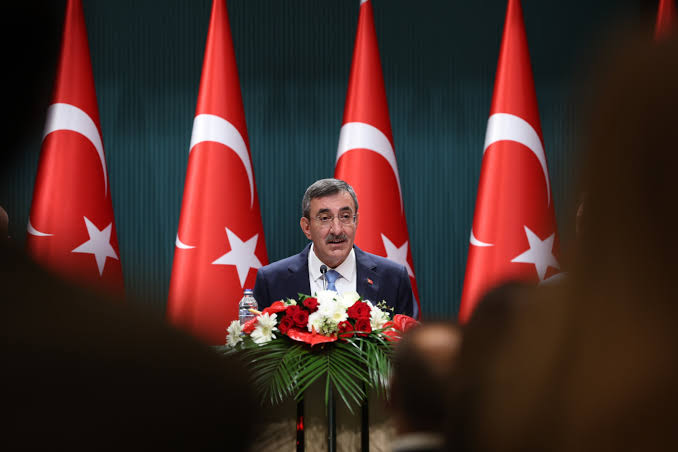
The new economic program projects inflation to decrease to 21% in 2027, 13.5% in 2028, and 9% in 2029, according to the vice president.
Official data shows that Türkiye’s annual inflation rate declined slightly to 31.51% in August from 31.75% in July.
The vice president noted that the conflict in the Middle East has significantly influenced the upward revision of inflation forecasts.
He explained that the central bank estimates the war’s direct and indirect impact on inflation to be about 7 percentage points.
The government has made notable progress in tackling inflation, which remains the main focus of its economic strategy.
Inflation, which had surged to 75.5% in May 2024, has started to decline clearly due to implemented policies.
At the start of his speech, the vice president emphasized the comprehensive involvement of various ministries in developing the road map that serves as the core policy framework. He also shared key targets and forecasts for the upcoming years.
Global Challenges
The vice president highlighted that the global economy is currently facing intertwined economic, technological, and geopolitical challenges, leading to decreased predictability and historically high risks.
He acknowledged that Türkiye’s economy is affected by global and regional developments.
The war’s effects are felt widely, impacting energy and commodity prices, global trade, inflation outlooks, and growth forecasts.
Due to these factors, assumptions from the previous year’s plans have been revised, particularly reflecting the regional conflict.
As an energy importer, Türkiye has been affected by sharp increases in oil and gas prices following the U.S.-Iran conflict.
The global growth forecast was slightly lowered from 3.1% to 3%, with the growth expectations for Türkiye’s trading partners and the euro area also revised downwards.
Economic Growth at 3.3% in 2024
The vice president shared that Türkiye’s economic growth for this year is now expected to reach 3.3%, with a recovery anticipated in the coming years.
The 2026 growth forecast was also adjusted to 3.3%, while industrial growth was revised to 2.3%. Inflation for year-end was increased to 28.4%.
Energy import costs are forecasted to rise from $63 billion to $71 billion, leading to a wider foreign trade deficit, now expected to reach $105 billion.
The current-account deficit as a percentage of GDP is forecasted to increase to 2.6%.
Tourism revenue projections were reduced from $68 billion to $65 billion due to the war’s impact.
Despite these revisions, the vice president stressed that the program’s overall direction and framework remain unchanged.
The authorities continue to pursue long-term price stability through conventional macroeconomic policies initiated mid-2023.
He affirmed that the economy continues to produce, grow, and generate employment.
Expectations for 2027 suggest improvements in the global outlook, which would support better trade conditions and stronger growth for Türkiye.
Officials are also closely monitoring risks amid geopolitical tensions.
The government is taking measures to mitigate the effects of these risks, conducting policies that consider various scenarios to enhance resilience to external shocks.
Program Yields Concrete Results
The vice president highlighted gains from the economic program so far, noting increased confidence in the Turkish lira.
The rise in the share of Turkish lira deposits from 31.6% to 61.5% by late August is a strong indicator that the policies are effective.
The exit from the KKM scheme was completed smoothly, and despite global uncertainties and geopolitical risks, gross reserves have risen by $89.7 billion to $188.2 billion.
This increase in reserves strengthens the economy’s resilience to external shocks.
Risk premiums have also fallen significantly, from over 700 points to below 220 points.
Exports reached $280 billion in August, with an improved composition showing more medium- and high-tech products.
However, rising energy and commodity prices have caused temporary pressure on the external balance.
The current-account deficit as a share of GDP was 1.8% in June 2024, 1.6% in June 2025, and rose to 2.3% by June 2026, with 0.7 percentage points attributed to the war.
Growth and Unemployment Projections
The vice president shared growth and unemployment expectations for 2027-2029.
Growth is forecasted to rise to 4.2% in 2027, 4.6% in 2028, and 5% in 2029, aiming for balanced and sustainable growth.
The unemployment rate is expected to decline gradually from 8.1% this year to 7.6% by 2029.
There is also a goal to reduce the budget deficit progressively, with a forecast of 3.1% of national income for 2026, improved from the previous projection of 3.5%.
Türkiye’s economy is expected to reach $1.8 trillion in size by the end of this year for the first time.
The vice president concluded by wishing success for the program.
The program unveiling was attended by top officials, including Treasury and Finance Minister Mehmet Şimşek and Central Bank Governor Fatih Karahan.