The London Underground has been transporting passengers since 1863. It was a world first and, more than a century and a half later, it remains a fundamental part of life in the British capital. If we’ve ever traveled to it, we’ve probably encountered a certain combination of these History and ModernityWith benefits associated with different eras. This coexistence has complications: it’s one thing to incorporate new technologies into newly built infrastructure, and quite another to do so in a network developed in the 19th century.
The next phase of that renewal was seen in Berlin. During InnoTrans 2026, Siemens Mobility displayed a unit of the Inspiro London, the train it will supply to Transport for London (TfL) for the renewal of the Piccadilly Line, which connects Heathrow Airport with the city centre. The September exhibition allowed attendees to enter the car and see it first-hand, although its design was already presented in 2021. In total, TfL ordered 94 trains to successively replace 86 units in a fleet in place since 1975.
This is the train that will renew the Piccadilly line
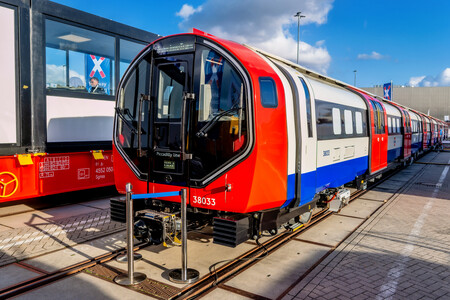
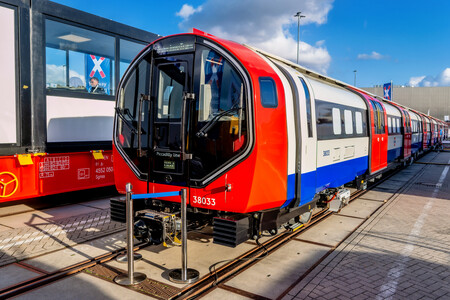
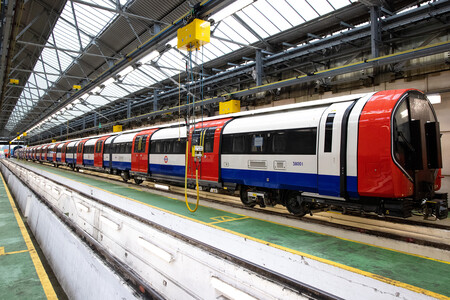
If we look at the photographs, we can see that the new model retains the traditional colors of the London Underground, but includes a rounded front end and a completely renewed exterior design. The length of the set is about 113 meters and consists of nine cars, a configuration that Siemens has developed taking into account the peculiarities of the Piccadilly line. Here we find one of its most interesting features: a multi-dependent structure that, according to the manufacturer, allows us to reduce the weight of the car and the demand on the road. It is not only about modernizing its appearance, but also about adapting its construction to network conditions.
The interior also presents significant changes, particularly in the way it takes advantage of the available space. The main novelty is one that We can walk between different cars of the trainA configuration that will facilitate movement in less crowded areas. Transport for London plans to develop a layout with wider doors, four spaces for wheelchair users and input from a disability advisory group. The experience will be completed with screens that will offer real-time information, video surveillance systems and visual elements designed to improve accessibility.
There is one innovation that deserves special attention: the air conditioner. While other London Underground lines already have air-conditioned trains, the Inspiro London will be the first to incorporate it into the deep tunnel network, where available space is much more limited. To achieve this, Siemens has developed a system that places the air conditioning equipment on the floor of the vehicle, taking advantage of a configuration that allows them to be integrated without compromising interior space. The challenge does not end there, as it is also necessary to control the heat that the trains themselves generate and release in the tunnel.
Improvements also affect what these trains will be able to transport and use As predicted by Siemens, each unit will offer youn 10% more capacity than current And will consume 20% less energy, thanks to technologies like regenerative braking and permanent magnet motors. TfL estimates that, with the new fleet and increased frequency, the line’s peak hour capacity could increase by up to 23%. There’s another less visible innovation: vehicles will send information about their location and the condition of their components to depots via RailGen, facilitating predictive maintenance.
Economic statistics help us understand the scale of projects. In 2018, Siemens was awarded a contract worth around £1.5 billion to supply the new fleet and provide associated services. This is a different amount to the 3.4 billion that Transport for London attributes to the Piccadilly modernization programme, which includes other interventions on the line. It also has an industrial commitment behind it: the German manufacturer will assemble 80% of the trains in Gulley, Yorkshire, where it has a railway complex for which it has announced an investment of up to £240 million.
The inclusion of these vehicles, however, is proving to be more complicated than expected. Although the first train arrived in London in October 2024, its integration into the network required a lot of testing and adaptation. Transport for London recognizes that introducing this technology to infrastructure which, in some cases, They are about a hundred years old causes significant difficulties. Added to this are issues related to vehicle design and preparation, modifications to existing signage, power supply and platforms, as well as integration testing between various systems. All this has contributed to delaying a commissioning which, while the contract was signed in 2018, was scheduled for 2024.
We still have to wait to see these trains carrying passengers. According to Transport for London’s forecast for September 2026, the first unit will enter service between December 2026 and June 2027, when the rest of the fleet will be progressively incorporated. And there is one important detail: although the vehicles are prepared for future automated driving, they will initially operate with a driver, as funding is still pending for the extensive renewal of signage required for this function. The modernization of the Underground will therefore not end when its new trains start running.
Picture | Siemens Mobility
In Xataka | Renoff’s plan to get the AVE that caught fire off the road in Rickshaw includes dismantling the cabin and pulling the chassis.