Charging at home is the cheapest and easiest way to use an electric car, as well as being the most compatible if your next step is to buy one. Although it still doesn’t hurt to test the car out on the road, or at least try to take advantage of those moments when it’s inevitably parked outside the house. There are currently a handful of cities, companies and town councils in Europe that are testing some alternative systems to be able to charge our cars beyond the chargers we have at home or at charging points spread across the continent, so in this article we decided to give them a review.
cost There is a clear price gap between charging an electric car at home and charging it outdoors And finding intermediate solutions could be a way to get more people to choose this type of car.
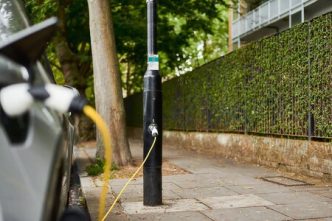
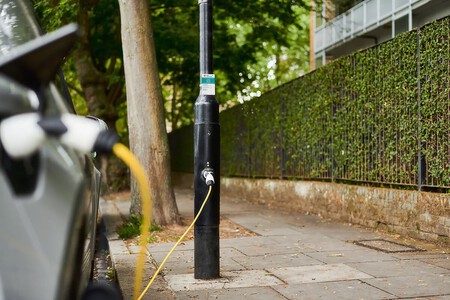
Charge at the street light? The idea of installing a socket in a street light is something we discussed at the time. It will take advantage of the power supply in such a way that new manholes or pits are not required. In London we saw the first stirrings of this idea, particularly in the districts of Kensington and Chelsea. It partnered with German company Ubitricity in 2017 to test charging points on street lights.
Since then, the model has expanded. Birmingham, for example, is trialling 560 charging points on streetlights in residential areas with off-street parking. Also in West Northamptonshire, England, operator char.gy has installed more than 3,000 street chargers, a significant number of them fitted to streetlights. The bad thing is, since the power is low, the chargers slow down the charging speed when the local network is stressed.
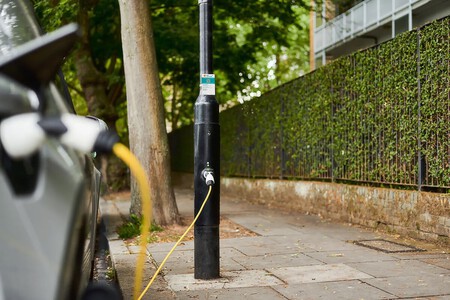
Image: Ubitricity
There is reason to doubt. Low power means a long wait, as a 7.4 kWh plug takes about eight to ten hours to fill a 60 kWh battery, so street lights are perfect for parking when you leave them overnight. We have also done some experiments with it in Spain. Media El Pais noted that Valencia had to remove 22 chargers installed in streetlights in 2021. This conflicted with the law, since the Valencian Territorial Industry Service “considered that the charging points should be independent of public lighting and forced us to separate them,” explained Luisa Notario, the councilor who promoted it with the European media.
Jorge Morales of consulting firm Proxima Energy also told the media that “the resale of energy is prevented, which isolates the supply. If you want to sell it, you have to install a second meter. And that makes things very complicated.” In the United Kingdom, meanwhile, there have been complaints from users about poor maintenance and plugs that stop working in bad weather.
barrier The German company Rheinmetall, known as an arms manufacturer, has also tried to integrate chargers into sidewalk carts. In a test in Lindenthal, Cologne, four loading curbs were tested on public roads between April 2024 and March 2025. The company has reported more than 2,800 successful loadings, more than two per day per point and more than 99% technical availability. Each session adds an average of about 19 kWh, about 120 km of autonomy. The unit can supply alternating current up to 22 kW.
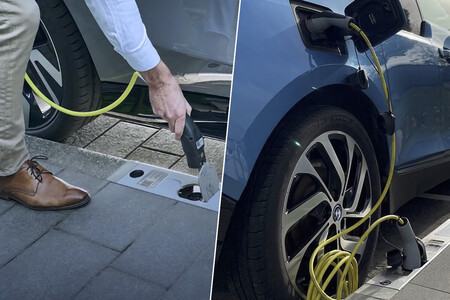
Photo: Rheinmetall
Since then, some of these units have also been installed in Düsseldorf, although according to German media Power to Drive, there are some nuances that must be clarified on a case-by-case basis before widespread deployment.
Each of these units isn’t exactly cheap, as according to Fourcoches Electricos, they put each unit at around 5,000 euros. Additionally, a curbside charger is still a public charger, so the space in front of it must be free for charging, occupying the same parking space as any other charging point.
A DIY version. A while ago we were able to chat with Antonio José Pérez, co-founder of the installation company Mi Cargador de Coche. Perez told us about a personalized measure for a client that was quite successful in a city near Seville. The installer buries the conduit from his garage to the curb, uses a weatherproof system, and connects it to a charger inside the house with cables. This way, the driver can plug the car in and out of his garage, in front of his house.

In the United Kingdom they’ve tried something similar but with sewers, it’s one of their most comprehensive options, and it’s basically digging a channel in the pavement that runs a cable from the house charger to the parked car. The issue of sewers is important, as it is illegal to run cables across pavements, according to the BBC. So at least your cable is protected, although it’s still a concrete measure for someone in front of their house.
More long term. A 1.5 kilometer stretch of the A10 motorway in France is being tested that wirelessly charges vehicles while driving. Gotland, Sweden has a similar test road, 1.6 kilometers long, built for moving trucks and loading buses. New Mobility Media reports that roads with this type of induction charging can cost between 2 and 6 million euros per kilometer compared to a fast charging station.
Also, another idea from Volkswagen: a robot prototype that charges a mobile battery by dragging it into a car. All these proposals are still very experimental, so nothing has been decided yet.
Cover image myenergi
In Xataka | DGT has cameras that impose a 200 euro fine for skipping a continuous line. The problem is they can’t prove it.