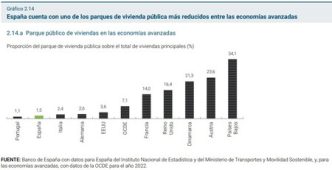
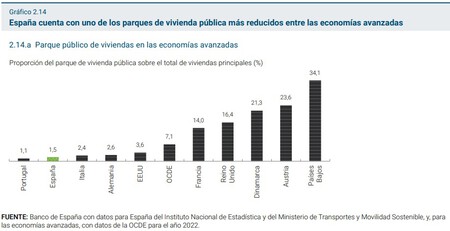
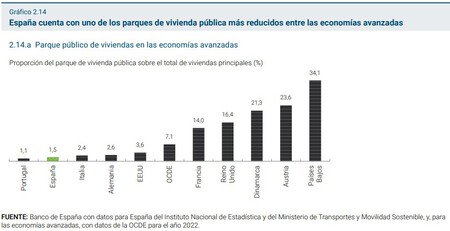
If Spain has seen anything in recent weeks, it’s the sheer depth (and complexity) of its housing crisis, one of the reasons for the electoral breakthrough. To understand this, a multifaceted cocktail of factors needs to be managed, including a slowdown in new construction, a growing shortage between housing and new home builds or a flight of supply towards the tourist rental market. However, there is an element that is often overlooked and partly explains the very low weight of public housing in Spain, where it represents 1.5% of the stock, far from the OECD average of 7.1%.
Which one? The hangover of ‘Montoro’s Law’.
Is there so little public housing? yes And we don’t say it. The Bank of Spain (BE) recognizes this in its latest annual report, where it warns of the “reduced public housing stock”: it represents 1.5% of the main houses, compared to the OECD average (7.1%), 2.4% in Italy, 2.6% in Germany, 14% in France or 16.4% in the UK.
According to the banking regulator, 11,000 subsidized homes were built in Spain last year and 15,500 were started. That improves the average for the 2015-2024 decade, but is still light years away from the 62,000 completed annually in the 90s or the 56,000 in the early 2000s.
Is it important? Yes, in the opinion of the organization. “This starting situation limits the ability to absorb situations like the current situation, where a significant component of demand is composed of low-income households and those with high efforts associated with renting at market prices,” warns the BE, although 1.3 million protected homes between 1991 and 2015 mean “universal lead protection schemes were built”. their sales.
Why are we away from the OECD? As is usually the case with complex events (and the housing crisis is one), there is no single factor that explains the reduced stock of public and social housing in Spain. Historical factors come into play, such as how deep the property culture is in Spain, the scarcity (and cost) of land, problems in the construction sector or a simple question of political attraction. Some analysts are sure that, for tempos and costs, public housing is an asset that is difficult to make selectively profitable.
However, there is another interesting point that is not usually taken into account. Over the past few years, municipal administrations (those with housing powers, along with central states and autonomous communities) have not had it easy when it comes to investing in public housing. As BE itself admits, they face “budgetary action capacity limited by the application of expenditure rules”.

What does this mean? To understand this, you have to go back to the recession years of about a decade and a half ago. Then, with Mariano Rajoy as head of Moncloa and Cristóbal Montoro as finance minister, the executive created a series of strict regulations so that public administrations could control their spending levels.
In March 2012, Montoro openly admitted that the obsession was “meeting deficit targets.” Against this background, the approval of the Law on Budget Stability and Financial Sustainability (2/2012) and Rationalization and Sustainability of Local Administration (27/2013) can be better understood. Today we remember it by a simpler name: “Montoro Law”, a legal framework that in essence binds councils and conditions their housing policy on financial sustainability.
What exactly does it say? Essentially, the rule applies multiple adjustments to local governance bases. The text recognized that the “promotion and management of public housing” are part of municipal powers, but also clarified that they must be exercised “with the criteria of financial sustainability”. Not only that. When listing “essential services” of local agencies, this includes water purification, garbage collection or public transportation, but not housing.
In other words, the 2013 law maintains housing as a municipal competence, but outside its “necessary” powers. Councils can promote it, but only as long as it doesn’t go against a larger objective: budget stability. That was the key.
Any decision in this regard has to fit the criteria of financial sustainability and debt control. FEMP, the city council representative, was quick to raise its voice to demand, if not end the cost cap, at least a “reinterpretation of how it’s calculated.” In other words, more flexibility in using your funds.

What effect does it have on practice? It is the condition of consistories. The use of municipal resources or debt had to be adjusted to the priority goal of cost control, a goal in which Organic Law 2/2012 for budget stabilization had already advanced. It was more difficult for corporations to activate accommodation policies in certain cases, especially if they faced a delicate financial situation. On paper they were not prohibited from promoting public housing, but in practice their scope of action was clearly limited.
Is it an important factor? This is a factor that is often overlooked. However, BE reminds, this does not mean that local corporations have certain ways of working “Although they have limited budgetary action power by enforcing spending rules, they have room for action if they are able to manage sustainable fiscal operations.” The regulator adds that municipalities can promote affordable housing projects using “various financial operation schemes” and even “public-private cooperation”.
The reality is that the regulatory framework has also changed over time, giving councils a bit more leeway. Although the Montoro Act was not repealed, roads were opened that expanded the room for maneuver by city councils. The most relevant one came just a few months ago, Royal Decree 13/2026, which affects the investment of municipal surpluses and treasury residuals. This was soon celebrated by FEMP, who hoped the rule would allow councils to use the surplus “especially for housing” for “a number of years”.
Picture | Ivan Henao (Unsplash), Bank of Spain and Pool Moncloa
In Xataka | Moroccans outpace Europeans in buying homes in Spain. They also pay less per square meter