

For decades, a British tycoon has devoted much of his fortune to hiring laborers to dig a giant labyrinth beneath the streets of Liverpool. No one knew what he was trying to achieve. The tunnels led to no specific place, reached some amazing depths, and their owner never left a plan or explanation. After his death, the construction was buried under tons of rubble and remained a mystery for almost two centuries. Now, after 30 years of research, someone has found an answer that is far more humane than anyone imagined.
The millionaire decided to hole Liverpool. Joseph Williamson was born in Yorkshire in 1769 and came to Liverpool aged just 11 to work in the tobacco business of Richard Tate, whose daughter Elizabeth would eventually become his wife. In 1803 he took control of the company and amassed considerable wealth through trading and other investments. Three years later he bought land in Edge Hill, then a poorly developed area a few kilometers from the center of Liverpool, with the primary intention of building a house.
The extraordinary came later: for 34 years, until his death in 1840, he supported countless men in digging underground sandstone rock and building tunnels, chambers and vaulted structures. The project grew until it became a construction whose true purpose Williamson never publicly explained.

An underground city that no one knew about. Beneath Edge Hill was a network of narrow passages, staircases, cellars and huge chambers distributed over several levels. Some estimates suggest that the network may extend over an area of about 2.6 square kilometers, although its actual extent is unknown. Among the most spectacular structures is the so-called Banqueting Hall, a vaulted room about 20 meters long and more than eight meters high, with a visible floor of an accumulation of rubble that can reach a depth of six meters.
Researchers have identified sectors with two and three overlapping levels and galleries that descend at least 18 meters, while some volunteers think certain structures may reach 27 meters. The prevalence of the work is particularly disturbing because it was created manually in the first half of the 19th century.
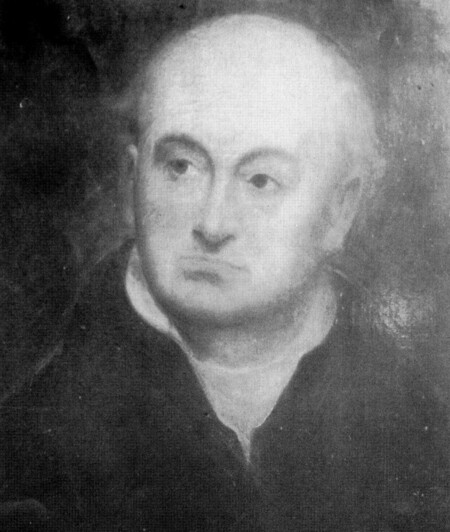
Joseph Williamson
Williamson led to the secret grave. The merchant had a reputation as a madman and was the subject of numerous stories whose authenticity is difficult to verify. He attended a meeting with King George IV dressed in patched clothing and work boots, hosted banquets to test the loyalty of his guests and even reportedly joked with the workers building the railway between Liverpool and London. One of the anecdotes says that he ordered his workers to hide in a tunnel to scare railroad workers when they accidentally crossed one of its galleries.
Their behavior fueled speculation about the excavations, which were carried out without known plans, detailed records or public explanations. After his death, the chambers began to be used as improved landfills and sealed under waste from homes, factories and businesses. As the decades passed, a good portion of that construction disappeared from the city’s memory.
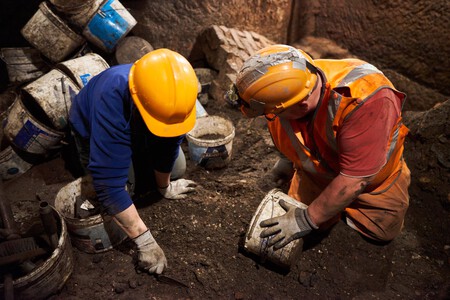
FoWT volunteers excavating a newly discovered tunnel section, May 2019
From smuggling to the ends of the earth. The absence of an explanation has given rise to all kinds of theories. Some researchers suggested that the tunnels were used to transport smuggled goods, while others speculated that Williamson built a shelter to survive an alleged apocalypse. This last hypothesis maintained that his wife Elizabeth was influenced by a preacher who was convinced of the nearness of the end of the world and persuaded her husband to prepare the underground chamber.
Interpretations related to house construction also emerged: the galleries and their large brick arches may have allowed the reclamation of old sandstone quarries and the construction of buildings on previously excavated land. However, this explanation finds some support in the architectural features of the complex, although it does not fully explain the extraordinary duration and depth of the work.
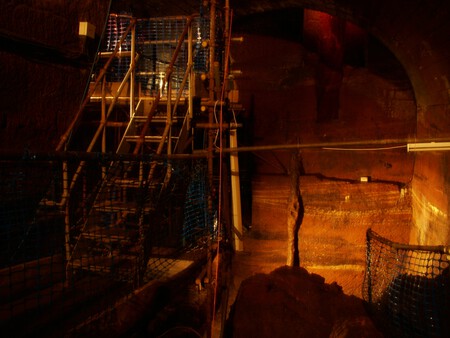
The tunnel and corner arch, built from individual sandstone blocks, overlook the waste chutes of the Biddulph factory.
Rediscovering the Forgotten Labyrinth. Interest in the tunnels was revived in the 1920s thanks to articles published by historian Charles Hand, which prompted an official inquiry in 1926. The Joseph Williamson Society was founded in 1989, and a decade later, a student housing development alongside work led to an entrance into the groups in an ancient basement. Thousands of hours have been dedicated to removing the debris accumulated over generations and restoring the original structure.
The work made it possible to extricate more than 120 containers from the rubble and recover objects as diverse as school ink, beer and poison bottles, clay pipes, hospital ceramics, animal bones and toys. Currently, the Friends of Williamson Tunnels and the Williamson Tunnels Heritage Center are investigating and showing parts of the complex to the public, while excavations continue to uncover new galleries.
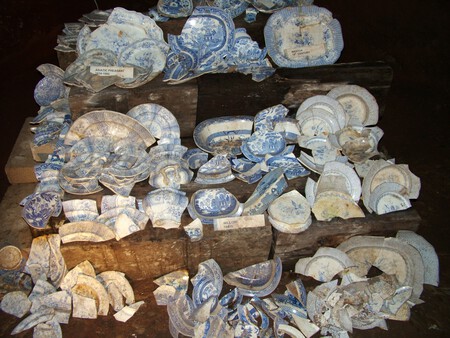
Among the objects found in the tunnel during the clean-up work were many pieces of tableware, dating from the 1830s.
That explanation completely changes history. After studying the structure for three decades, the people responsible for both organizations consider that the most convincing hypothesis is none other than philanthropy. At the beginning of the 19th century, Liverpool was a prosperous port city whose wealth was concentrated mainly among merchants, while thousands of workers survived on precarious employment. Industrial mechanization displaced many artisans, and the end of the Napoleonic Wars in 1815 brought back soldiers who needed to find work.
Williamson used his fortune to hire poor men, provide them with income and teach them the construction trade. The depth reached by some excavations is fundamental to this interpretation: volunteers found work whose economic utility seemed difficult to justify, including pits dug apparently to be filled in again. The possibility raised by the researchers is that the original purpose of the work was to keep hundreds of men employed for as long as possible.

An endless task so that no one is left without work. The researchers also found social clues to support that explanation. According to volunteers, baptismal records from a nearby church show that several families named their children after Joseph Williamson, a possible reflection of gratitude to the merchant. The hypothesis remains documentaryly unproven and some of the structures may have had practical functions related to the urbanization of Edge Hill.
Nevertheless, the scale of the excavation and the apparent futility of the specific work suggest that Williamson may have turned a work with no defined end into employment-based welfare.
Thus, almost two centuries after his death, volunteers continue to excavate the labyrinth and discover new parts of a construction that still preserves many secrets. And if the philanthropic interpretation is correct, Williamson’s genius ensured that his tunnels continued to employ generations long after his death.
Picture | Kyle J. May, Wikimedia, Captain Biscuitbeard, Wikimedia
In Xataka | Five Argentine planes were making life in London impossible. The UK’s response was to plan suicide missions
In Xataka | In 1993 Bill Wyman left Rolling Stone and devoted himself to his passion: finding archaeological gems with a metal detector.