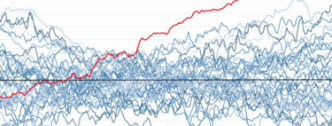
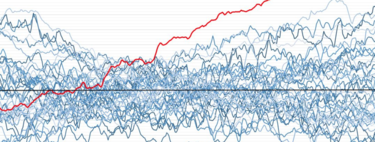
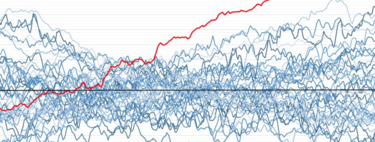
With data from 12 midnight on Monday, October 26, 18 of the 50 scenarios calculated daily by the European Center for Medium-Term Prediction said the polar vortex was going to break up in the next fifteen days. Twelve hours later there were 23. On Tuesday, 43. On Thursday the 29th, 50 people said the same.
This is not just a European issue. Over the past three or four days, the major prediction models have converged on the same idea: that the vortex is going to undergo a reversal (with a change in wind direction in the stratosphere) between November 4 and 10.
If that happens, we’ll have sudden stratospheric warming on our hands, yes; But not just one. First since 1958: nearly three weeks ahead of the previous record holder. We can almost take that for granted. What happens next, no one knows.
What exactly is the polar vortex? It is a stream of strong winds (west → east) that rotates around the vast reserves of cold air found at the planet’s poles. It is formed in the stratosphere; That is, at an altitude of about 16-48 km. In a metaphorical (or ‘journalistic’ if you push me) sense, the polar vortex is what locks in the cold at the poles.
Logic tells us that, in summer, the vortex is reduced to a minimum and, although it is true that we have not seen it completely disappear on these dates, it is so weakened that it hardly affects the climate of the hemisphere.
But in winter the situation changes and changes drastically. Very often the vortex grows and although “it is usually a solitary animal” and harmless, it overflows and affects the rest of the hemisphere. Looks like we’re going to see this weeks.
What about sudden stratospheric warming?? To better understand this process, it is good to remember that the atmosphere is a “lasagna of air layers” and each of them follows its own logic. That is, they operate quite differently and independently; But never completely independent.
This is what happens between air circulation in the troposphere (closest to the surface) and circulation in the stratosphere (the layer directly above): they are related, yes; But, in reality, everyone goes their own way.
During a “stratospheric flash”, atmospheric waves rising from the troposphere burst into the stratosphere and rapidly heat it, causing deep disturbances of high-altitude circulation. That is, for weeks, everything is reversed.
And what exactly is going to happen now? Well then. Around October 24, the stratospheric vorticity winds reached their peak of the season, about 23 meters per second. At midnight on Friday the 30th, it measured 13.2 meters per second. This is strange because the date average is about 23 or 24 meters per second. This was the first clue.
But, as I say, it’s not normal. NOAA records about six such investments per decade. What has never been recorded is one so early in the calendar. This level of change is “more visible in January and February,” MIT’s Judah Cohen explained to Gizmodo this week.
OK, but what does this all mean? No one knows for sure. As Victor González pointed out last year, “The ease of predicting sudden stratospheric warming in the medium term contrasts sharply with the difficulty of predicting its consequences.” Therefore, we already know with almost absolute certainty that something is going to happen in the North Pole stratosphere, but it is not clear what is going to happen.
Picture | PolarWx
In Xataka | A major “Stratospheric Sudden Warming” vortex is close to breaking. The question is how it will affect us