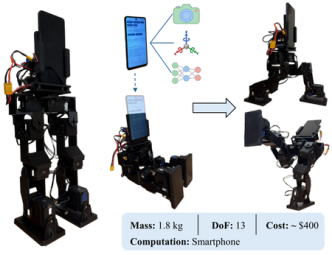
Many drawers contain cell phones that we will never use as phones again. We keep them after another opening, maybe in case we need them one day, and they stay there anyway Have a cameraA processor, motion sensor and wireless connectivity. We’re used to measuring their usefulness by how well they work for calling, taking photos or using apps, but these elements don’t disappear when we stop carrying them. And that raises far more interesting possibilities than giving them a second life as a spare phone.
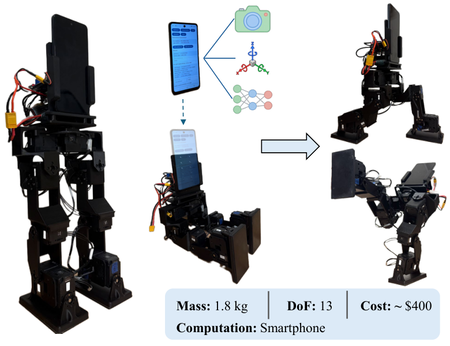
At the University of California, Los Angeles (UCLA) they’ve done something that looks like an idea from afar: step on a mobile phone. The result is called Phonebot and is a small robot 48.3 cm high and 1.8 kg in weight, with a smartphone installed in its torso. Behind its development is RoMeLa, a robotics laboratory that presented the project in a study published on October 6, 2026 on arXiv. But what is really interesting is not its strange appearance, but the phone directly participates in the operation of its 13 motorized joints, and researchers have already started walking it.
A cell phone that works with a brain and legs
To understand how PhoneBot works, we can think about what happens when we try to balance: we need to know how to position our body and make continuous movements. Here a good part of that work falls on smartphones, which It uses its sensors to know the robot’s orientation and to calculate its processor movement order. The camera, for its part, lets you visually interpret what’s in front of you. Instructions travel via Wi-Fi to a small electronic board that communicates with the motors, while the system can also receive movement commands from the user. So, balancing and deciding where to move are different functions.
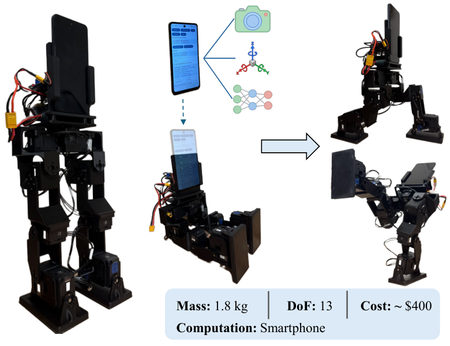
Having two legs does not mean knowing how to walk. Unlike a wheeled robot, the Phonebot must coordinate its joints while distributing weight and preventing one step from destabilizing the next. To achieve this, the researchers trained a control system in simulations using reinforcement learning, a technique that allows behavior to be enhanced through rewards and punishments. During this process they detected that the robot tended to favor one leg, so they introduced a mechanism to encourage symmetrical movement. They then transferred that system to a physical prototype to see if it could run.
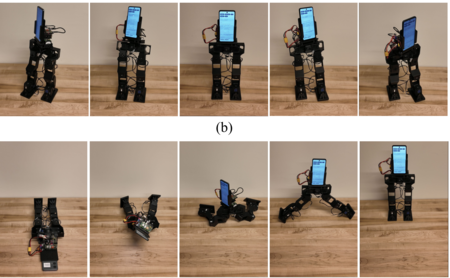
And it was time to test if it worked outside of the simulation. According to tests documented by the researchers, the phonebot has been able to walk and stand up after being prone, two abilities they demonstrated in their demonstration with the physical prototype. They also teach you how to use your phone’s camera Identify a person and orient the torso to it, though that doesn’t prove it can walk autonomously through any environment. The small robot also includes conversational functions, but there is an important nuance: the voice recognition and language model are executed on an external computer.
There’s one more detail that makes the test even more intriguing: one of the phones the team tested was the Honor 9, a model launched in 2017. It’s not the only one, as they used three other latest budget Androids, but its presence shows that the system doesn’t need a latest generation mobile. According to the study, the Honor 9 was able to perform the main functions evaluated with one exception: environment mapping using ARCore, which was not available in the US due to the absence of the necessary Google services on that device. Of course, the authors don’t attribute all physical displays to that particular phone.
Giving a smartphone a second life raises another question: How much does it cost to build the rest of the robot? The researchers estimate that the components needed to build the PhoneBot’s body cost about $400, not including the phone, and make up most of the budget. 13 motors in your joints. The team has shared documentation and design files for easy reproduction, albeit under a license that restricts commercial use. Therefore, although they present it as an open platform, these materials do not meet the usual criteria for open source hardware. We have not verified that all required software is publicly available.
The idea of using a smartphone as a robot brain is not entirely new. In 2021, researchers from Intel Labs presented at the ICRA OpenBot conference, a project that allows a phone to be transformed into the control center of a small wheeled vehicle, whose body can be built for about $50. The difference is in what they have now achieved at UCLA: transferring that method to a machine that walks on two legs, where balancing increases the difficulty. This opens up new possibilities for researching and testing bipedal robotics without necessarily relying on much more expensive equipment.

At this point, asking Phonebot to fetch us a coffee is not recommended: it doesn’t have arms to pick it up, nor is it ready to move on a surface. Its propulsion system is trained for flat terrain and its economical engines also impose limitations, though researchers They want to add light weapons and try more complex terrain. After all, there is something quite interesting about this experiment: while we forget a phone in a drawer because it is old, at UCLA they have shown that it can be used to give life to a robot with legs. And let him walk.
In Xataka | China introduces a supercluster of 100,000 “national” cards to supply larger, increasingly demanding models