Apple has been telling its AI story through Siri for two years. But yesterday, in his first call with analysts as CEO, John Turnus brought out another hero: the Mac, which he says is experiencing its own “AI moment.”
It’s a very catchy phrase for a product that explains the birth of the company and renewed its reputation with Apple silicon, but it’s still been overshadowed by the iPhone for years.
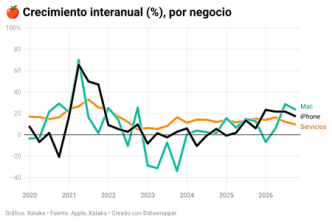
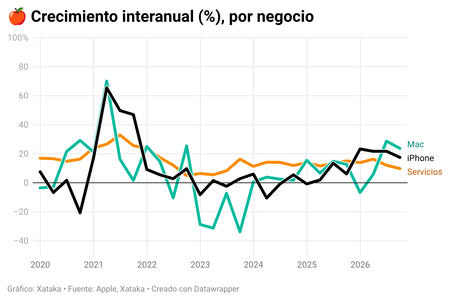
with numbers. Mac earned $10,792 million between July and September, up 23.7% from a year ago. The previous quarter grew 28.7%, its fastest pace since 2021. Later, iPhone grew by 17.5% and services by 9.8%.
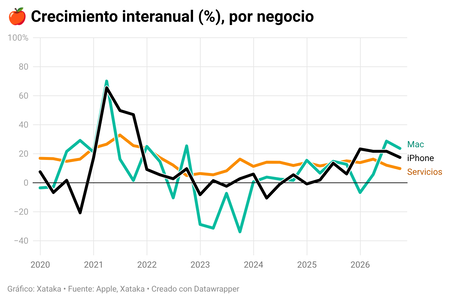
The fact that the Mac has overtaken the iPhone is not new, it has already done so in the fourth quarter of 2025. The most interesting thing is in the service, which has its slowest speed since mid-2023.
In terms of The Mac continues to account for 9.4% of Apple’s revenue and has grown less than the iPhone over the year: 12.5% compared to 21.2%.
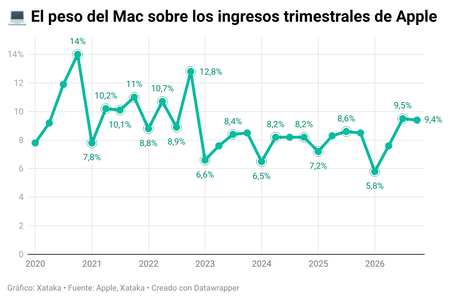
The valley always comes at Christmas, when the iPhone is discontinued. That’s why the current uptick, from 8.5% to 9.4% year over year, is important: it happens with the iPhone’s 17.5% growth, not because it’s weak.
It is also not the highest. Its record continued into 2022, with 40,177 million, before a 26.9% decline the following year. This year it remains at 37,929, so that’s part of what we see as a recovery.
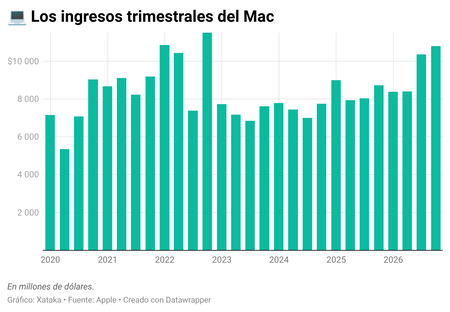
Apple claims it hasn’t sold as many Macs in a fiscal year, but it did 5.6% less than in 2022. More units and less money point to a cheaper average Mac Coincidentally, when the MacBook Neo is in the catalog.
Where the demand part comes from is new.
- In April, Tim Cook explained that people are discovering the Mac Mini and Mac Studio as great machines for native AI and agents faster than expected.
- Behind it was OpenClaw, which fueled demand for the Mac Mini to always leave as a small, relatively inexpensive computer standard.
In addition, the Macs come with unified memory from the M1, a decision that Apple introduced in 2020 for other reasons but that it reassessed with the rise of generative AI.
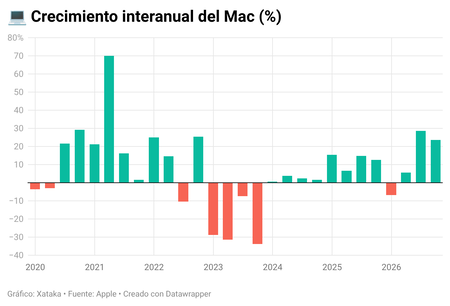
The jump follows Neo’s launch in March and Cook’s remarks about Agents in April. The calendar does not allow the two effects to be separated.
Yes, but. That doesn’t mean all growth comes thanks to sales driven by local AI use. Apple CFO Kevan Parekh blames the MacBook Pro, but also the MacBook Neo. And the Neo has a much more mundane explanation: It’s a clever Mac, but above all it’s a cheap Mac.
Also, Apple raised prices in June (including the Neo) and doesn’t differentiate price and volume. So no one outside of Cupertino can say how much each factor weighed on sales this quarter.
contrast. What’s interesting is the contrast with Siri. When asked about personal agents, Tarnus replied that Siri AI is “primarily” a request assistant and recalled that you need to know what you’re giving access to.
AI that Apple didn’t plan goes exactly the opposite way: People who buy a Mac can expose a foreign agent to it. The unified memory mentioned above helps, but perhaps the Mac is nothing more decisive than an open computer. That was enough for Apple not to get in the way.
and what now. The uncomfortable question remains. The memory the computer needs is at “unprecedented” prices and will limit the supply of Macs even at Christmas.
And the iPhone, which contributes half of the revenue, doesn’t work that way: only Apple decides what each agent can do. It remains to be seen how long he can keep that iPhone door closed. But you rarely want to open it.
Featured Image | Amanaj
In Xataka | Steve Jobs said a Touch Mac didn’t work and Turnus said “it’s not worth it now”: that difference is the new Apple