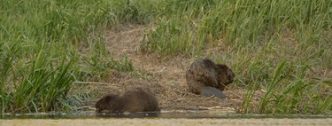

The Gran Chaco, after the Amazon, is the second largest biome in all of South America and spans Argentina, Bolivia, Brazil, and Paraguay. We are talking about a vast plain, mainly semi-arid and with an extreme climate, where the guanaco, a large herbivorous mammal, has disappeared for more than a century in the Dry Chaco of Argentina. However, a group of guanaco specimens have been reintroduced there after a long journey from Patagonia.
The guanaco is back. The guanaco is the wild ancestor of the llama. Well, 110 years ago it became locally extinct in the Dry Chaco of Argentina, but not on the planet: the IUCN classifies it as “least concern” due to its wide continental distribution with the bulk of the population in Argentina and southern Chile (Patagonia).
From there, a group of guanacos arrived thanks to the Rewilding Argentina project in collaboration with the National Park and the provinces of Chaco and Santa Cruz, which, according to the organization, is the largest transfer of fauna to conservation by land ever undertaken on Earth.

A long and prepared journey. In fact, on their trip they traveled 3,200 kilometers to the El Impregnable National Park. But it’s not their first time: previously, Rewilding took a group to Luro Provincial Park in La Pampa. And it won’t be the end: more migration is planned until a stable and healthy population is created. However, the actual success of the operation will be measured by parameters such as survival, reproduction and long-term adaptation.
The animals come from a healthy population in Patagonia Park, where studies of abundance, health and genetics have been conducted over the years that have made it possible to use them as a population source. Behind them, years of planning and adapting trailers, monitoring and temperature control. Before release, the animals spent time in pre-release pens to acclimatize to the local environment.
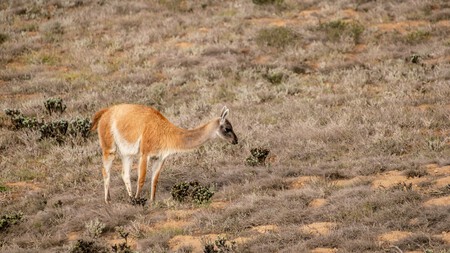
Photo: Nicolas Fernando Valdes Ortega
Why did it disappear?. As the rewilding details, only a hundred guanacos remain within the million square kilometers of the Dry Chaco, concentrated on the border between Paraguay and Bolivia. However, the animal disappeared in areas belonging to Argentina. Causes of its regional extinction include intensive hunting, herding, loss of grasslands, climate change or fire.
Why is it important?. Because a large herbivore like the guanaco performs a unique function in the ecosystem: it controls the growth of grass (which reduces the risk of fire in the second instance), disperses seeds and nutrients and, although it is ugly to say, it also serves as food for predators and scavengers. Indeed, Rewilding Argentina notes that the absence of pampas deer and other large herbivores such as swamp deer has contributed to ecosystem degradation.
Bringing a native animal back to its historic habitat is good news, but when it’s as attractive as the guanaco, it can also bring in wildlife tourism, which is no bad thing in an economically backward area.
In Xataka | Biologists confirmed it: they discovered a new species of cat for the first time in 100 years
In Xataka | In the 1950s, Argentina released Asian pheasants on a Patagonian island: today they dominate its forests and worry scientists.
cover Georgibulgaro