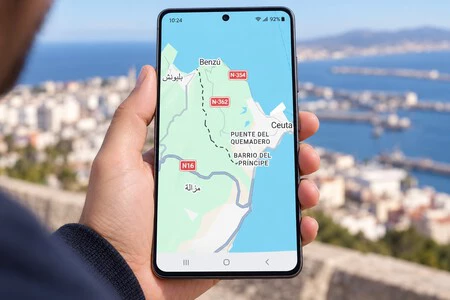
Google Maps draws a dashed gray line at the land border of Ceuta and Melilla with Morocco. A complaint asked the European Commission to act So that Google Maps changes the layout according to digital services regulations.
The Popular Party’s note on this subject has recently been published: a statement about both cities, according to which The Petition Committee approved the initiative. The complainant finds the representation of the boundary unclear and says that Google should show a solid line, not a broken line. It also called on the European Commission to deal with the risk of misinformation that could have created the map, according to the complaint. Your complaint reflects your position and does not demonstrate that regulations have been violated.

The Ceuta and Melilla Observatory reported that its director, Carlos EchevarriaGoogle wrote to Spain in 2023 about this. It also appeared in a note from the Observatory on September 23, 2026, which stated that the matter had not yet been resolved.
Google notes that the service distinguishes between different boundaries In the Boundaries and Country Names section, solid gray lines are reserved for international boundaries without negotiation, and dotted lines are reserved for those whose definition is a matter of dispute (and some temporary boundaries or limits set by treaty). You can’t tell just by the dashed line style that Google applies to each border.
What needs to happen to get approved by Google
Google Maps is subject to additional compliance rules Digital Services RegulationUnder which the European Commission classified the service as a “very large online platform” on April 25, 2023. Pursuant to Articles 34 and 35 of the Regulation, Google must assess the systemic risks posed by its services and implement measures to mitigate them.
The Commission may request information and obtain evidence if it suspects that a violation has occurred. Before deciding to sanction the company for non-compliance with the regulations, you must prove the violation and give it an opportunity to present its arguments.
Violation of this regulation may result in penalties Up to 6% of the digital service provider’s global turnover During the previous financial year. This figure is determined based on several factors, including the severity of the violation and its duration. The legal text establishes that percentage as a maximum without setting a specific penalty for drawing the map’s boundaries. The Commission may also order the effective compliance of certain obligations and its decisions may be subject to judicial review before the Courts of the European Union.

Gulf of Mexico incident
On October 22, 2025, the Commission issued a response Complaints of Pedro Lourenco About changing the name of the Gulf of Mexico on Google Maps. The Commission referred to Google’s risk assessment obligations in response to Lourenco’s complaint and sought evidence of potential negative impacts related to systemic risks provided for in the regulation.
The answer mentions another geographical name and not the boundaries of the two Spanish cities mentioned above. In order for the Commission to authorize Google to draw the boundaries mentioned above, there must first be evidence that Google has breached its obligations.
Picture | With Xataka and image GPT editing