

There are many ways to see an aurora. It can be boreal or southern depending on the hemisphere you observe it from. You may see it near the poles, where it is more common, or in mid-latitudes if solar activity is high enough to allow it. We usually see them from the Earth’s surface, although some astronauts have been able to see them from space. Auroras have even been seen on other planets. But, undoubtedly the result of collaboration between China and the European Space Agency (ESA), no one has seen the aurora as recently as the SMILE mission.
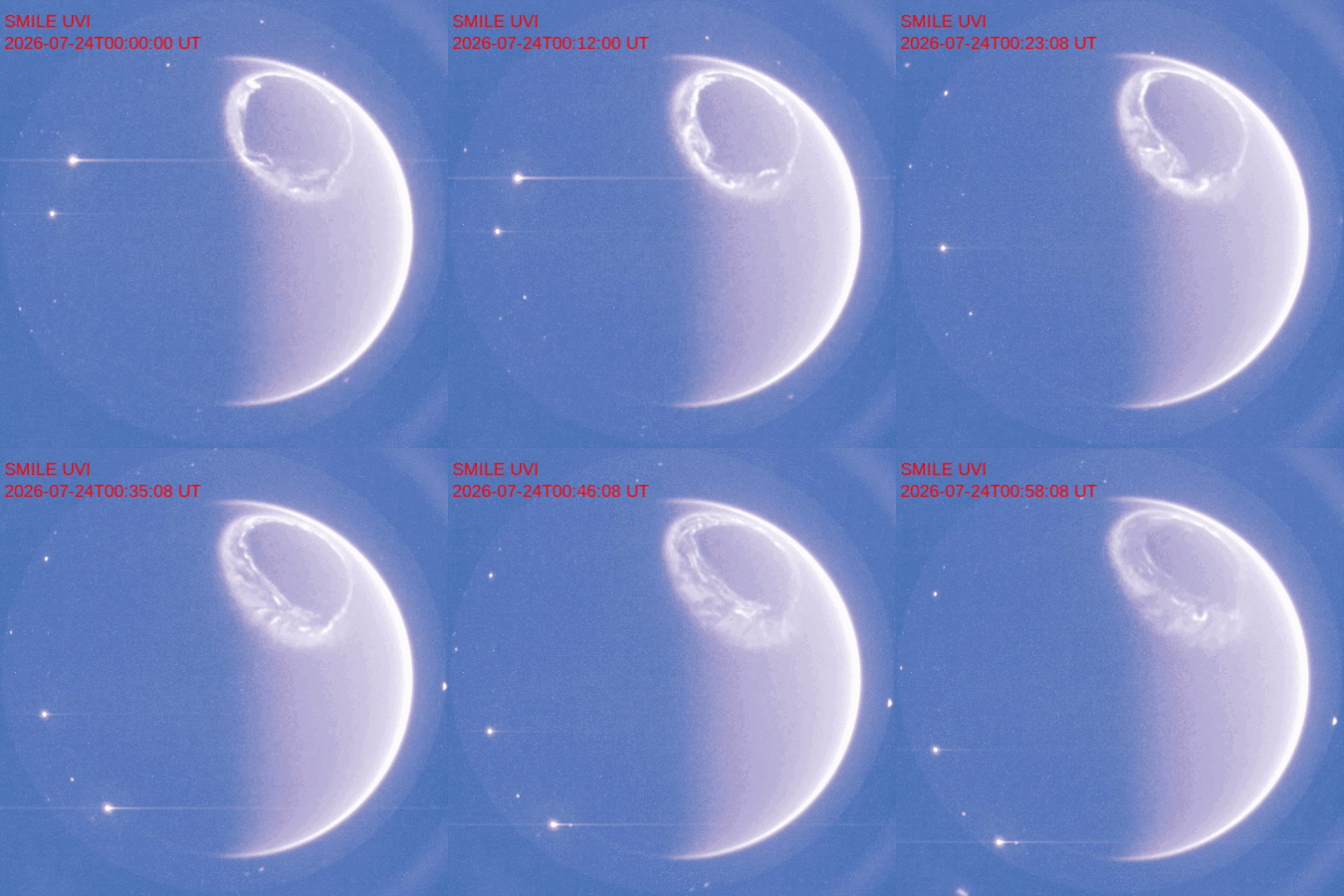
Complete auroral ring. An image released by the SMILE team a month ago shows the entire auroral ring. That is, the ring-shaped strip where auroras occur around each of Earth’s magnetic poles. It looks more or less like a swirling white ring. It has been almost 20 years since a mission managed to fully capture it. The last was NASA’s Polar spacecraft, since among its instruments it had an ultraviolet camera, similar to the one used by SMILE. However, SMILE has added advantages, such as 45 hours of direct observation of auroral rings and simultaneous imaging in the far ultraviolet and X-rays. This makes it a more comprehensive mission to study the interaction between the solar wind and magnetosphere.
Mission of SMILE The solar wind creates auroras when its electrically charged particles interact with molecules in our atmosphere. However, that is only the good part. They can also greatly affect our telecommunications infrastructure. Fortunately, Earth has a shield called the magnetosphere that protects us from that part of the solar wind. It is true that it acts as a funnel and can direct a part of the ions from the Sun towards the poles, which is why auroras are more visible there, but in general it protects us from the worst consequences. How do you do it? This is something we know more or less; But, if we want to strengthen security, it is important to know it more widely. This is where SMILE comes into play, which aims to study the interaction between the magnetosphere and the solar wind.
Ultraviolet camera. The image of the auroral rings, taken last July 2026, shows the Earth as a homogeneous pale blue ball. There are no oceans or continents to be seen. This is because the molecular oxygen in the Earth’s atmosphere absorbs the ultraviolet radiation emitted by the Earth, preventing it from escaping outwards. SMILE’s ultraviolet instrument, called UVI, is blinded to visible light to avoid interference and capture only UV. If you don’t see visible light and UV is blocked by the atmosphere, the result is practically a blank canvas. Auroras, on the other hand, are emitted from the upper layers of the atmosphere, where there is less concentrated oxygen, so they can be seen in all their splendor, even on the bright side of the planet.
More devices. As we expected, SMILE doesn’t only capture images in UV. It also has an X-ray camera called SXI, which is responsible for studying the boundary between the solar wind and magnetosphere. This is a region called the magnetopause. On the other hand, the mission has two other instruments: Magnetometer (MAG) and Light Ion Analyzer (LIA).
that
More than 300 auroras. SMILE is planned to run its operation for at least 3 years. During that time, if all goes well, it will capture about 300 auroras. Since they are one of the main results of the interaction between the magnetosphere and the solar wind, we can learn a lot from them.
Picture | that
In Xataka | This is what the Northern Lights look like from space