More than 20 years ago, the United States placed dozens of sensors under the Pacific Ocean to study its currents. Now, Chinese scientists have retrieved that data and found something that could have implications beyond oceanography: vast invisible corridors that connect the surface to the depths. Understanding them can become an advantage in the most contested military situations on the planet.
The Pacific Paradox. A team from the Institute of Oceanology of the Chinese Academy of Sciences has identified a phenomenon known as “inertial chimneys,” large natural corridors through which energy generated by surface winds can reach the depths of the ocean. The discovery, published in the scientific journal Deep Sea Research Part I, was made using measurements collected by a sensor network originally funded by the US National Science Foundation (NSF).
The research connects two seemingly distant realities: a two-decade-old American scientific project and China’s current efforts to understand underwater environments increasingly important to security and defense.
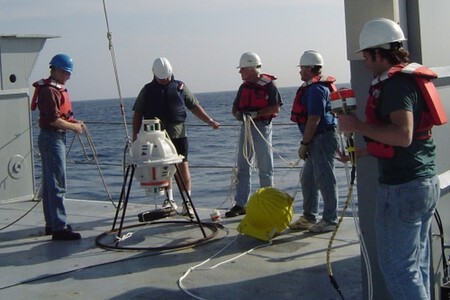
46 US censors and two years of record. The story began in April 2004, when researchers from the University of Rhode Island, Woods Hole Oceanographic Institution and the University of Hawaii deployed a network of instruments east of Japan in the expansion region of the Kuroshio Current. The system, known as KESS, consists of 46 stations distributed over an area of approximately 600 by 600 km, equivalent to 360,000 square km, and was operational as of June 2006.
Its sensors, installed on the seabed, measure pressure, depth currents and the time it takes for acoustic signals to travel to the surface and return. Two decades later, Chinese researchers took advantage of these scientific records to study how energy reaches the ocean floor.
Some chimneys that no one can see. The invention does not consist of solid structures or giant tubes hidden underwater, but dynamic energy transmission corridors. When wind agitates the ocean surface, it creates internal waves that can propagate through layers of water with different temperatures and densities.
The researchers discovered that certain anticyclonic eddies, which rotate clockwise in the Northern Hemisphere, allow this energy to condense and descend to depth. These corridors, called “inertial chimneys,” help explain how meteorological events occurring thousands of meters vertically can affect seafloor conditions.
There are discovery statistics. The Chinese team developed a statistical model capable of explaining 76% of the observed variability in near-bottom wave power. Of this explained variability, 68% is related to processes in the upper ocean layers: 28% to the power of waves from above, 26% to water stratification, and 14% to the rotation of eddies.
The remaining 32% was associated with local currents near the seafloor. The distinction is important: these figures describe the contribution of various factors to the behavior captured by the model, not that a physical flux of 68% of all oceanic energy from the surface has been directly measured.
Connection with submarine warfare. The importance of the discovery is not limited to a better understanding of ocean currents. Changes in temperature and salinity change the speed and trajectory of underwater sound, a fundamental variable for sonar systems used by ships and submarines. Knowing how these conditions evolve allows us to improve acoustic models, identify areas where signals are more likely to propagate, and predict others where their detection is more difficult.
The Chinese researchers themselves noted that combining long-term observations with sound propagation models can improve the prediction of the acoustic environment and provide useful information for underwater detection and communication. However, the study does not show that China has already developed a new military identification system based on this information.

China has been looking at the bottom of the ocean for years. In short, the discovery comes at a time when Beijing is expanding its knowledge of the strategic sea. A Reuters investigation published in March 2026, and which we talked about at the time, documented how Chinese scientific vessels conduct mapping campaigns in the Pacific and other ocean regions and collect ocean data that is also relevant to underwater activities. Knowing the depth, currents and acoustic properties of water can improve both navigation and the operation of military sensors.
In this context, the investigation of inertial chimneys illustrates the strategic value of maritime data: data collected two decades ago to answer scientific questions can today provide potentially useful knowledge in the naval competition between the United States and China. The irony in this case is that the original infrastructure was funded by Washington.
Picture | RawPixels
In Xataka | China is building a 120m nuclear submarine we didn’t understand: two holes solved why
In Xataka | Satellite images leave no doubt: China has launched an underwater creature that defies naval engineering