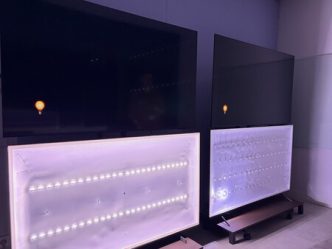
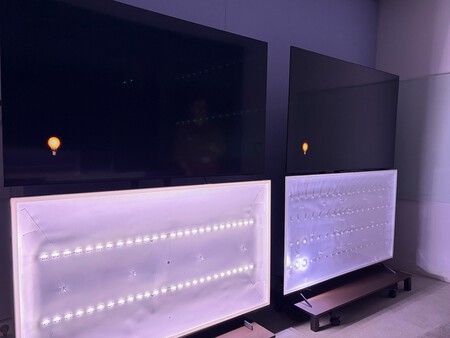
There is a part of television that is usually hidden from our eyes. We can spend hours in front of a screen enjoying a movie or series without thinking too much about how it manages to reproduce dark areas or illuminate bright details. However, much depends on the experience Occurs behind the panel. TCL invited us to its Madrid offices to show off that less visible side of its televisions, and what we found helped us better understand why, from the company’s perspective, not all mini LEDs work the same way.
Already in the showroom, there were two definite heroes of the comparison: a 65-inch TCL P8L and a television from another manufacturer whose brand and model we could not identify. According to the company, both compete in the mini LED entry range and operate in the same price range. The specialty was not only in their reproduced images: their backlighting systems were also exposed, so we could see how each one lit up. In addition, we were able to ask questions and review equipment configuration.
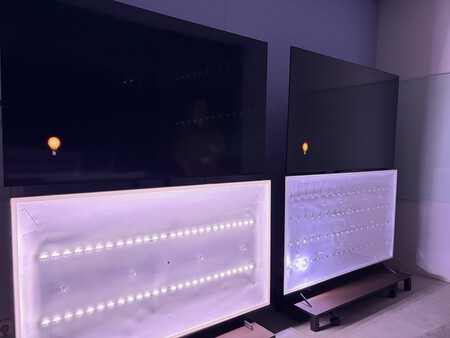
Let’s look at the bulb and LED backlight: on the right, the 65-inch TCL P8L, with zone lighting controls; On the left, a competing mini LED TV with two LED strips. | Photo: Xataka
To understand what we have before us, we must first distinguish two concepts that usually appear together in specifications. Mini LED refers to the size of the diode used to illuminate an LCD screen, while Full array local dimming (FALD) describes a system capable of controlling this light by zone. The P8L combines both technologies, so it can dim certain areas without shutting off the rest. Competitors, as TCL explained to us, used a direct LED backlight distributed in two strips, which act as a single light field. In that comparison, both devices were presented as mini LEDs, although their backlighting systems worked differently.
Two mini LED televisions, two ways to control the light
The differences start to become apparent when we move on to the visual display. First we saw a sequence of light bulbs that turn on and off against a dark background, and then pieces from series and films, such as ‘Stranger Things’ and ‘Harry Potter’. What surprised us most was the control of blacks: in some images, the P8L was able to maintain a depth in dark areas that we didn’t appreciate in the same way on other televisions. We perceived more intense colors and greater definition in some details, though we spoke about our visual impressions during testing.
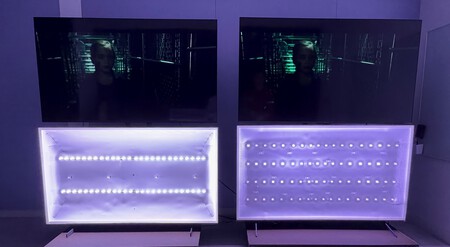
We also wanted to examine the conditions under which those images were being shown. TCL representatives explained to us that all four TVs received signals from the NVIDIA Shield Pro through a distributor and allowed us to review the settings of the two input models. Both were in standard mode, with maximum brightness and contrast. Additionally, the P8L’s menu included local dimming options that didn’t appear on the competitor during the demo. This is an important detail because, as RTINGS explains, the effectiveness of this technology depends on both the number of zones available and the algorithms that operate them.
This difference between what a commercial name promises and how a technology is implemented was also seen in our conversation with Oscar Gracia, Commercial Director of TCL Iberia. “Mini LED is not just a name, it’s how you use the light. (…) You can name it whatever you want,” he explained to us during the visit. His words help us understand the message the creator wanted to convey to us through that display: beyond the label displayed on a television, what matters is how its technological capabilities are used. A position that TCL defends with particular tenacity.

Oscar Gracia, Commercial Director of TCL Iberia, during a visit to the company’s office in Madrid. | Photo: Xataka
This location also has a context worth knowing. On August 31, 2026, TCL, through its US subsidiary, filed a lawsuit against Samsung Electronics America for false advertising by marketing some of its M series televisions under the name Mini LED. As reported by Reuters, the Chinese company maintains this model Attributes not met Technicalities that, according to him, should justify that label, while Samsung rejects the allegations and defends the accuracy of its product description. An important distinction should be made: this case was not part of our tour.
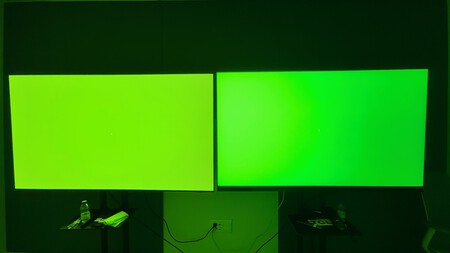
Green color reproduction comparison between the high-end TCL X11 (right) and a competing OLED TV (left). Differences are seen in color tone and intensity. | Photo: Xataka
The day also lets us know the other end of the TCL catalog. Compared to the entry-level P8L, the X11 they showed us represents their commitment to high-end SQD-Mini LEDs, a technology that combines quantum dots and advanced color filters. This differs from RGB mini LEDs, which use red, green and blue backlight sources. In our conversation, Oscar Gracia defended the greater maturity of the first: “This does not mean that this technology cannot be developed in the future and provide the same level of performance, but at the moment our SQD-Mini LED can provide Better performance than RGB“. This is the assessment of the manufacturer, whose catalog also includes RGB Mini LED televisions, such as the TCL RM9L tested by our colleague Ruben.

This technical commitment has a commercial dimension. “We want to be recognized in the market as the big inch brand using mini LED technology,” Gracia explained to us. We left with a very positive impression of the black control we observed, although forgot that it was a demonstration organized by the manufacturer. After all, we took away something interesting: a better understanding of what can change when light is directed in different ways.
Picture | Xataka
In Xataka | The rival to beat in 2026 is going to be OLED: these technologies want to overtake it