China has been demonstrating for decades how far engineering can go when it starts building on an extraordinary scale. There we have the Three Gorges Dam, a 55km link that connects Hong Kong, Zhuhai and Macau via bridges, tunnels and access roads, or the Huajiang Bridge, whose deck 625 meters above a river. These are very different tasks, but they all share something: behind their scale are technical challenges that force unusual solutions to be developed. And, while we tend to focus on the end result, the machines needed to make it possible also have amazing stories.
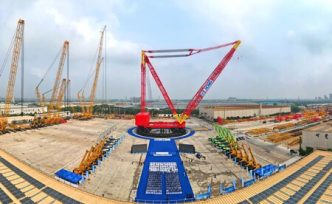
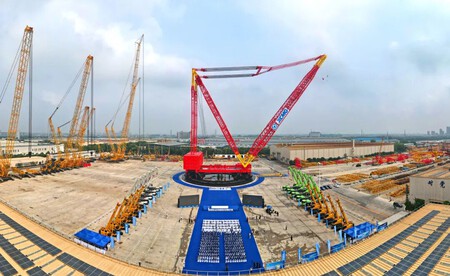
In the same search for large-scale construction solutions, we find a project taking shape in Zhuzhou, Jiangsu Province, China. There, XCMG and Sinopec Heavy Lifting & Transportation developed a ring crane that, in its full configuration, can lift loads of up to 14,000 tons. On August 28, 2026, the manufacturer announced that it had finished assembling the first of two main units that would integrate the system. This is an important advance, but it does not mean that the set is already in place. And here the peculiarity of the project appears: to achieve such capabilities, both units must work together.
The key is that each of the two units is separately designed to lift up to 7,000 tonnes, according to information released by Crane and Transport Briefing. Both can work independentlyBut combined facing larger operations. This configuration will allow the equipment to adapt to the needs of each project, without necessarily resorting to its full capabilities in each technique. Of course, there is an important difference: 14,000 tons represents the declared limit for the set, not a load that has already been lifted during a real operation.
A huge (and different) crane
To understand what distinguishes this machine from a conventional crane, it is worth looking at its basis. Ring cranes use rolling systems that distribute large loads and allow the lifting structure to rotate with the help of large counterweights. Equipment such as the SK6000 from Mammoet shows that the layout of these systems can be varied to suit the needs of each project. But lifting a lot of weight is not the same as placing it at a fixed distance: the further it is from the axis of rotation, the more stress the structure must withstand. XCMG declares a maximum lifting moment of 700,000 ton-meters, a dimension that is precisely related to both variables. And, as the specialized publication Vertical warns, we still don’t have a complete public table that allows us to determine how much weight you can lift at each distance.
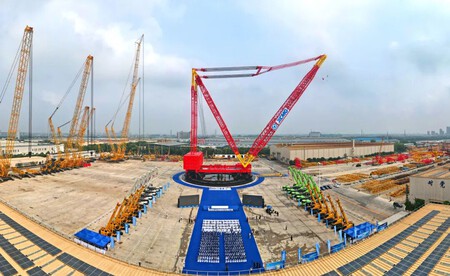
Let’s think about a nuclear power plant under construction, where various components are partially assembled and must be placed in very specific places. The larger these modules are, the more demanding the operations required to install them will be, especially when you need to work on several nearby structures. The solution proposed by XCMG uses its system Serving two nuclear islandsA set of facilities associated with two reactors from the same location and with the same arm configuration. According to the manufacturer, this will allow avoiding certain machine movements and configuration changes. It is not about building two complete reactors, but about simplifying the assembly techniques of their facilities.
Building a crane with these features also poses challenges that go beyond its dimensions. The Chinese company NGC, one of the project’s suppliers, has developed reducers for the lifting and displacement mechanism, sets of gears that allow adaptation of the rotational speed and torque transmitted by the motor. For its part, Jingcheng Special Steel, part of the CITIC Group, has supplied high-strength steel for components subjected to high stress. Therefore, it is not enough to make huge parts: it is necessary to ensure that they withstand the expected load and work in a controlled manner during the maneuvers.
To put these numbers into perspective, take a look at some of the larger land ring cranes we already know. Dutch company Mammoet’s SK6000 has a maximum capacity of 6,000 tonnes, while Sarens’ SGC-250, known as the Big Curl, reaches 5,000. Face them, development XCMG aims to reach 14,000 tonnes. The comparison allows us to understand the dimensions of the project, but we must remember that these figures correspond to the maximum nominal capacity and the weight that a crane can lift depends on its configuration and the scope of each maneuver.
The journey of this machine began long before its presentation in Zhuzhou. According to XCMG, joint research and development work began in 2015, while project details were made public in 2024 and the contract was signed with Sinopec on October 10, 2025. Completion of the first major unit, reported in August 2026, marks an industrial breakthrough, but it remains to be seen how both parties will respond when they work together. In the end, megastructures draw attention to what we end up seeing, but behind them are also engineering projects that need years of development before they can demonstrate what they can do.
Picture | XCMG
In Xataka | Someone sells an island with a castle in the middle of the Avila reservoir: 11 bathrooms, self-contained and 3 million euros