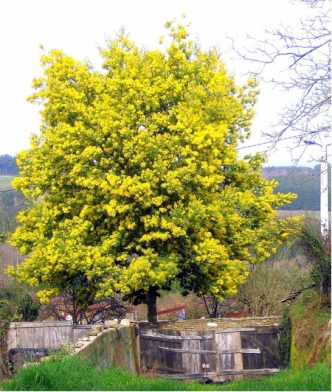
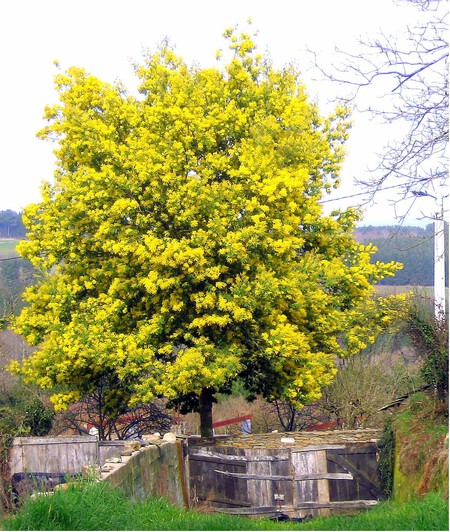
If you live on the Cantabrian coast, you have probably already noticed that when winter comes, a tree begins to bloom with its characteristic yellow clusters and a sweet smell that permeates the environment: mimosa or acacia (Acacia Dealbata) and although we have seen it so much, especially in the northwest of the peninsula, that we have experienced it all our lives, the same thing happens to Acacia as Ailanthus: it is an invasive alien species in Spain (except the Canary Islands and the Balearic Islands).
presentation. Although its flowers and scent are characteristic enough to identify it, mimosa is a tree that can reach 15 meters in height and is evergreen. Its bark is gray or whitish, very smooth and much branched. The leaves are doubly pinnate and form flat, curved pods containing four to five seeds. In the early stages it does not tolerate shade and frost is not suitable at all, which is why it grows in mild climates.
How to get it here. Although its presence is spread to a greater or lesser extent throughout the Iberian Peninsula, the origin of this tree is literally in the antipodes: it comes from Australia and Tasmania, but in 1824 it came to Europe to stay and it was not accidental, but intentional: as the eucalyptus landed for cheap wood, it was a cheap wood with Leitkoration. So it’s a garden and walking classic.
Whoever came up with the idea had no shortage of reasons: its elongated and attractive flowers are eye-catching, it blooms when no one else does (from January to March) and it grows quickly. In addition, it is a plant that care is not very demanding and very grateful. The icing on the cake is that it can help fix the soil, and rubber and other products can be obtained from its trunk. Acacia seems like a real blessing, but no.
Galician plague. In Galicia, acacia is already a full-fledged pest: widely naturalized, it occupies the lower and middle parts of the region up to an altitude of about 600 m. It has been around for about two centuries, but it has already become a characteristic part of its landscape, occupying areas where vegetation has been damaged by logging, harvesting or fire. In fact, it is so compact that its branches are even used to guide the Ribeiro vineyards, as explained by the Ministry of Environmental Change and Demographic Challenges of the Government of Spain.
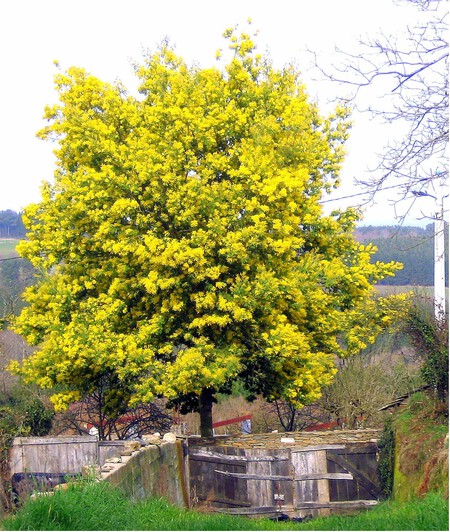
Certo Xornal from Ribera, Galicia. Wikipedia
fireproof. Some of its virtues are also its drawbacks: when acacia is established, it grows and spreads so rapidly that it displaces all other native species within a few years. In addition, it is a great consumer of water and makes the soil acidic, which makes it poorer and less suitable for other plants to settle. But Mimosa’s biggest problem is fire.
Acacia is a pyrophytic species: it burns very quickly when there is a fire, which favors its spread, and since its seeds can remain dormant in the soil for a long time, the high temperatures caused by the fire favor their subsequent germination, colonizing burned land and preventing regeneration with native species. So they help spread the fire and then take advantage of its consequences. Because it typically lives an average of 50 years (with specimens that can reach longer), a specimen can remain in terrain conditions for decades.
What are we doing to deal with it?. MITECO is clear: it is difficult and expensive to eliminate, among other things, because it needs to be constant over time. Some of the proposed measures are obvious such as stopping its use in gardens or avoiding forest fires, maintaining natural vegetation cover in good condition, mechanized methods where access is possible and, if not, applying glyphosate to stumps.
The largest operation known is on the Tajo and Guadiana accounts, in Extremadura, and applies to both mimosa and ailanthus. A pilot trial has taken place in Mérida, where control of regrowth after cutting contaminated by fungi is tested, while physical, chemical and biological control is applied in Madrid.
In Xataka | Madrid’s most emblematic tree is a threat to the Canary Islands: deadly crossings that worry biologists
In Xataka | Spain planted millions of eucalyptus trees for cheap wood. 90 years later, we have confirmed that they are a green desert
cover Eugene Zelenko