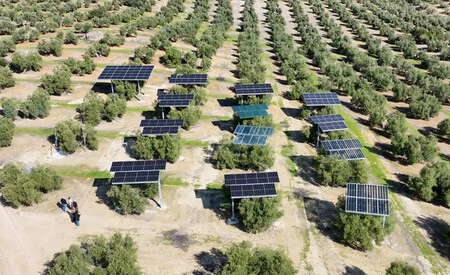
Acesur, Seville Oil Group, Coosur owns the La Española and Guillén brandsConstruction has begun on a solar plant in Vilches (Jaén), which will be built on an olive grove in production. they will be More than 5,150 panels rise more than four meterswhich totals 3.65 MWp (maximum power under full performance conditions) and is located next to the company’s packaging machine, “Respecting 100% of existing trees”According to their statement.
Since they are elevated, according to Acesur, normal agricultural operations can be maintained (including harvesting), although their installation requires greater structural complexity.
The system has a storage capacity of 3 MWh Designed for “Optimize self-consumption and improve management of generated energy”According to the company, and Greening, a renewable energy company from Granada, is in charge of the implementation with a support of 2.8 million euros. Institute for Energy Diversification and Saving (IDAE).
The University of Jaén is collaborating on the project through Pedro Perez, Professor of Electronic Technology and Project AdvisorWhich is seen in the video that Acesur and Greening released along with pictures of the Navas de San Juan prototype as a reference for the project.
Questions have been raised as to whether partial shade represents a loss for olive cultivation, or whether it can create a certain protection for olive trees during stress, but Acesur’s press release did not include production data from the pilot project.
“For ACESUR, innovating makes sense when it’s done from scratch”highlight Nicolas Tejada, Director of Environment at Acessorwhich explains that the project allows progress in renewable self-consumption and “Protect the olive grove from which our oil is born”.
Juan José Perez, Greening’s head of research and developmentIndicates that the project displays “That energy innovation can be integrated into the region in a respectful and efficient way”.
What the University of Jaén research says
Shadow is a point of comparison with other studies Jain Universitywhich in 2023 published a study in Applied Energy entitled “Possibility of agrivoltaics systems in olive groves in the Mediterranean region”, which concluded that, in this case, the modules should have between 57% and 71% transparency so as not to slow down the growth of the trees; This is, apparently, a specific characteristic of ultra-intensive olive groves, while Acesur points out in its press release that the Vilches olive grove is traditional.
As the same study highlights, the model suggests that 1% of the surface of Mediterranean olive groves could mean growing with such benefits. 2.5% of global photovoltaic capacity and reduces about four million tons of CO₂ per year; However, this is an assumption based on the authors’ model, which indicates another type of olive grove.
How much will the plant produce?
They are also not included in the press release. MWh that the installation will generate per year (Its coverage of electricity demand, not its cost, aside from 2.8 million from IDAE, they don’t say how much of the total investment). To speak of the forecast that has been circulated More than 5,000 MW per yearAn image that the press release doesn’t even specify.
A calculation by the European Commission’s Photovoltaic Potential Assessment Tool (PVGIS) and free, suggests about 5,900 MWh per year for a 3.65 MWp system, with Vilches coordinates, crystalline silicon panels, south orientation, 30 degree inclination and 4% character loss that cannot cause 4% plant loss. of the real system.
If the Vilches plant comes close to that estimate, All four facilities will produce more electricity annually that he has already launched the company; These facilities are located in the company’s four factories, two of them in the province of Jaén (Vilches and Jabalquinto) and the other two in Seville (Dos Hermanas and La Roda de Andalucia), with an area of 30,000 square meters capable of producing 3,654.70 MWh per year and providing approximately 18% of energy.
Sooner or later anyone who has searched for information on whether it is worth putting solar panels on their roof will see the shadow issue (and whether there are other things that can generate electricity instead). We’ve already published an article about ShadowCalculator, a free website that simulates the shadow cast by a building over a point of interest (and the original version of the article is from 2022). The difference, in this case, is not how much electricity is lost due to shading, but how many olives are lost; A figure not cited in the press release.
Picture | Acesur