On March 30, 2026, the president of the Cabildo of Gran Canaria, Antonio Morales, appeared with good news: after the last storm, the island’s water reserves multiplied by 17, with 35 complete dams and five years of irrigation. “We can also talk about a historical situation,” he said.
And it was true. But every good news hides its shadow. Only six of the Cabildo’s seven dams were full. The seventh, incision, remains at 51%. The thing is, it was already a lot. The Insular Water Council needed to go under the glass and they started the house from the roof.
An island that must save everything. Gran Canaria has 172 dams covering approximately 1,560 square kilometers. That is one reservoir in every nine. This is why, over the years, it has been called “the world’s most victim-dense place”. This is certainly not a whim: almost all of them were born with the same logic: you need to catch the little water that falls and direct it to where it is needed. In this case agriculture.
A classic example of incision. Construction began in 1941 and was completed in ’64. With 5.64 hm³ it is the second reservoir of the island and throughout this time, it has been storing water Without further ado.
But someone had an idea. In 2022, Red Electrica began building a cave pumping plant between Chira and Soria. The idea was to use it to boost water from second to first whenever there was residual renewable energy. Thus, they wanted to turn the system into a huge battery of about 3.5 GWh.
In 2026, according to its technical director, Yonay Concepción, the work was 60% complete. The problem is that something fundamental was missing.
How does a dam release water? In general terms, there are three ways to remove water from a dam: through spillways (when the water overflows), through irrigation (irrigation channels) and through bottom drains. However, the incision was thought of as an irrigation pond and as such, its aim was to retain as much water as possible. No one felt the need to empty from the bottom.
The situation changes when we talk about a hydroelectric battery. If not drained, 51% of the incision will take six to eight months to drain. With extraction, it will take several weeks. If we want a truly functional battery, we need a drain. But the work is delayed and delayed.
What else happened? That, the Save Chira-Soria Citizens Platform strongly condemned, with the historic rains in March, some parts of the works were flooded. Platform wise it has always been demonstrated that the project has been in trouble since its conception; That, as we said before, we start the house with the roof.
And now that the La Palma blackout is fresh in our minds, we’re faced with the same question as always: What are we doing with the country’s infrastructure? Where are we going?
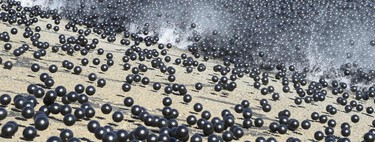
Picture | Citizen Platform Save Chira-Soria
In Xataka |
In 1971, Quebec flooded 11,500 km² of forest to create a mega-reservoir and unwittingly poisoned an entire city.