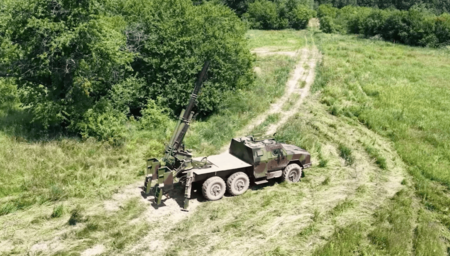
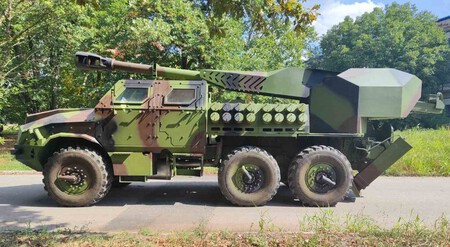
Serbia has unveiled the first image of an artillery piece that seems to defy the rules of military engineering: a giant mortar mounted on a relatively light truck. Their proposal is as simple as it is brutal: launch a projectile weighing about 100 kilos against a fortified position and quickly evacuate the site before the enemy has time to react.
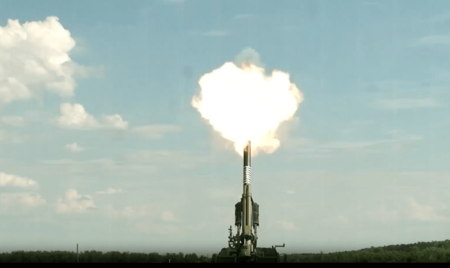
A monster on six wheels. The Serbian Ministry of Defense released the first photos of actual shots of the TSMB M-25 firing, although it did not specify where or when the tests were conducted. The system, developed by Serbia’s Military Technical Institute, was presented publicly for the first time at the Partner 2025 defense fair in Belgrade.
Its main feature is a massive 203 millimeter mortar mounted on a three-axle military truck, an unusual combination for a weapon of this caliber. The set weighs about 19 tons, considerably less than other self-propelled heavy mortar systems.
A hundred kilos destroyed. The M-25 is designed to fire projectiles weighing approximately 100 kg, of which approximately 27 are matched with explosive material. According to the announced specifications, these weapons can hit targets located at a distance of about 12 km and create a destruction radius of about 76 meters with the help of impact fuses.
The weapon has a barrel measuring 203 millimeters in length and 24 caliber, with an elevation ranging from 0 to 75 degrees. It can use “high-explosive” ammunition and concrete-piercing projectiles, designed to attack bunkers, shelters and other fortified positions. Its developers also contemplate rocket-assisted munitions and precision guidance systems, although their operational capabilities have not been publicly demonstrated.
shoot away The real uniqueness of the M-25 lies in its platform. Instead of resorting to a heavy tracked vehicle, Serbia installed the mortar with a 6×6 drive on a FAP 2026, manufactured by the Serbian company Fabrika automobila Priboj. The truck can reach a top speed of around 80 km/h on the road and has a claimed range of around 800 km.
It has an armored cabin for four crew members and inertial navigation, ballistic calculation and fire control systems. Its purpose is to implement the technique known as shoot and scoot: shooting from one position and quickly moving to another position to reduce exposure to counterbattery fire. Of course, 80 km/h corresponds to its maximum road speed, not the speed at which it can leave a combat position.
Three shots per minute. Another of the most interesting features is its automatic loading mechanism. The mortar must return to an elevation of zero degrees before returning to the target. Despite this approach, Serbia declared a maximum rate of three shots per minute.
To put that in perspective, the Russian 2S4 Tyulpan 240-millimeter self-propelled mortar can fire about one projectile every 62 seconds. The Russian system uses a tracked vehicle weighing about 27.5 tons compared to 19 tons for the Serbian model, although it fires conventional ammunition weighing about 136 kg. The comparison shows two different philosophies: a heavier and more secure platform versus another that prioritizes road mobility and deployment speed.
An old concept with a new body. The M-25 has its roots in the Yugoslav M-65 155-millimeter howitzer, derived from the American M114, which dates back to World War II. However, Serbia has channeled that legacy into a slightly different concept: cramming a lot of explosive power into a car that’s relatively cheap, easy to maintain and capable of going fast.
The choice also responds to the particularities of the Balkan region, where mountainous terrain and fortified positions have historically favored high trajectory mortars. Its main drawback is range: about 12 kilometers ad well below many modern 155-millimeter howitzers, making the M-25 a specialized weapon and not a substitute for conventional artillery.
What still needs to be proven. The photos released by Serbia confirm that the M-25 has undergone live fire tests, although they do not allow us to verify all the announced features. It is unknown whether it actually reached three shots per minute, how it behaved during prolonged firing sessions, or whether it officially entered operational service.
It is also unclear how much its mobility compensates for lower safety and off-road capabilities compared to the track system. In any case, Serbia presented an unusual proposal: combining a 203-millimeter mortar with a truck capable of moving at 80 km/h. A way to understand heavy artillery where it is not only important how much damage a projectile can do, but how fast it can leave the vehicle from where it was fired.
Picture | Serbian Ministry of Defense
In Xataka | The countries shown in this graph have the most battle tanks An unexpected guest entered the stage: North Korea
In Xataka | The world’s fifth military power has started supplying Black Panther tanks to European countries threatened by Russia. Morocco wants it too