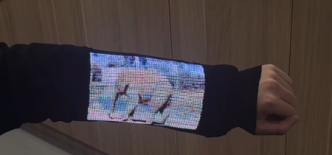
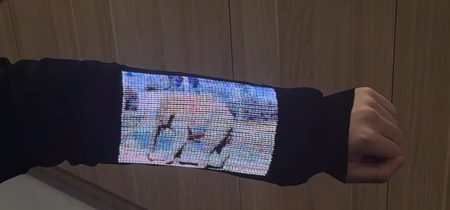
A team of researchers at the University of Singapore has integrated a functional touch screen into the fabric of a sweater, using thread-like fibers that act as both pixels and touch sensors. The amazing thing is that the fabric is still washable, flexible and breathable. The research was published last October in the journal Nature. Below these lines we tell you all the details
A garment fabric is a touch screen. We’ve seen many wacky innovations integrating screens into t-shirts and other garments, but very few have managed to integrate the screen into the fabric itself. The NUS team, led by Associate Professor Tural Khudiev of the Faculty of Design and Engineering, claims it is the first touchscreen integrated into a garment. If the approach is scaled, clothing can display information and respond to touch without the need for a rigid panel inside.
Details. As the study explains, the sleeve uses 54 pixel fibers, each approximately one millimeter thick and with 96 LEDs. Together they create a 96 by 54 pixel display measuring 168 by 105 millimeters, with a refresh rate of 30 frames per second and a color depth of 8 bits. Each fiber has its own control channel, so if one breaks, it doesn’t affect neighboring fibers, and the screen can register multiple touches at once.
The invention is quite interesting, since in addition to the screen, there are other versions that include microphones, speakers, motion sensors, magnetic orientation and even temperature and ambient light. So, as explained in the study, with all these capabilities you can play videos or show photos, run functions like calculator and compass, transfer files, execute voice commands, adjust screen parameters or read our body temperature.
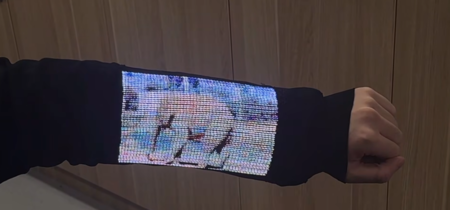
the hard part A circuit board is flat, and a wire isn’t, so integrating the wire into such a tight spot was one of the researchers’ biggest hurdles. They started with tiny insulated wires, used a laser to expose the points needed to connect each LED chip, and wetted the surface in a controlled way so that the molten solder stuck only to those points. This allows them to assemble more than 5,000 chips through more than 20,000 electrical connections.
After all the hassle, the LED strips are drawn onto a multilayer polymer fiber using thermal stretching, a process that stretches a heated structure into a thin thread. A touch-sensitive layer sits below the LEDs. Tapping the fiber closes a circuit, and the system determines where the finger will land to change the behavior of the nearest pixel.
“A fiber has a one-dimensional, axisymmetric geometry, which makes it difficult to create complex circuits using advanced methods for conventional two-dimensional electronics,” Khudiev said in the NUS statement.
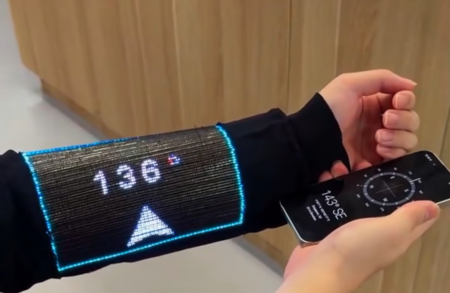
daily use According to the researchers, light emission and tactile response were virtually unchanged after 50 washes with detergent in a conventional washing machine and 1,000 folds around a five millimeter radius. They also report that the screen is just as breathable as cotton, polyester and denim and is within safe limits for skin contact.
Other proposals. As Popular Science reports, the best-known commercial efforts, Levi’s and Google’s Jacquard jacket, only provided touch sensors and haptic feedback on the cuff, and Google shut down the project in 2023. Today, most electronic fabrics either adhere electronic components to the fabric or conduct simple sensing and lighting.
border The invention is quite amazing, although it has obvious limitations. And in addition to the obvious lower resolution, the researchers say that, for the time being, audio affects the fluidity of video, since frames drop when audio is present. Additionally, there is still no clear method on how to power the display, nor is it known how long it can last between charges. Additionally, it should be noted that one-millimeter fiber is still relatively thick for clothing.

What next? The team says that smaller chips and finer fibers, both supported by their method, should allow for sharper, larger displays. Since the electronics run along the fiber, thin versions can be woven, interconnected or embroidered, according to NUS. Researchers are working on more sensing capabilities and even integrating AI into devices.
One of the uses that researchers talk about the most is in health. “A garment can continuously collect physiological information through fiber-based sensors and allow the user to access and interact with that information directly through their garment,” Khudiev said.
Picture | National University of Singapore
In Xataka | We’ve been trying to reinvent the wheel for years, and all we had to do was replace it with a Pilates ball