

China started 2026 with a historic record. In January its National Statistics Office revealed that the birth rate fell to the lowest level since 1949, the year the People’s Republic was founded. The puncture exacerbated the damage to the general population and confirmed the profound social and cultural changes the country was undergoing. Its demographic data, however, leaves another, far more alarming reading: As the Asian giant ages, it sees weight gain in its dependent elderly population.
In fact, there are indicators that suggest that, for the first time in history, Chinese workers support more elderly people than children.
What happened? Like Japan, China is getting used to the cold shower of demographic reports from its National Statistics Office. This happened in January with birth rate updates. And it has now happened again with the update of another important indicator: the elderly dependency ratio, a tool that shows Chinese society (and the authorities) how much the ‘non-working’ age population weighs compared to the contributing age population.
To no one’s surprise, that rate is rising. and fast.

What exactly does it look like? That the elderly dependency rate in 2025 stands at 23.1%. There are two ways to analyze the data. And both make for disturbing reading. The first is obtained by reviewing the historical archives of the Office for National Statistics, which show that the dependency rate of the elderly population has been steadily increasing over the years. In 2016 it was 15%, in 2021 it exceeded 20% and now it has already exceeded 23%.
Percentages aside, this sequence tells us that the older population does not stop gaining weight compared to the ‘working age’ population. This is not just a general population curiosity. This gap has a direct impact on the pressure on the Chinese economy from pension and health and care costs, which are expected to increase as the country ages.
And second reading? This is obtained by broadening the focus and observing data from other dependent population cohorts, such as those composed of young children. According to the Office for National Statistics’ latest annual balance in 2025, its index stands at 22%.
In other words, the dependency rate of the elderly (23.1%) in China currently exceeds that of children (22%), a situation that has never happened before. It is estimated that there are more than 223 million people in the country who have already extinguished 65 candles, while the group consisting of children under the age of 14 has just reached 213 million. Which gives us an idea of the current situation. And also signals about what will happen in the coming decades.
Why is it important? Especially for that last one. In terms of trends, what the data shows us about the future of China, a country plunged into a birth rate crisis after decades of strict enforcement of the ‘one-child policy’ that its authorities have yet to reverse. And they tried their best to achieve it.
Despite these efforts, the Chinese population has been steadily declining for four years, the country has lost the ‘scepter’ of the world’s most populous nation, and the aging of society is unstoppable. A report by Our World in Data shows that in 1965 the median age of the Chinese population had not reached 25 years, which is considerably lower than that of the British. In 2025 both countries had already converged at around 40.
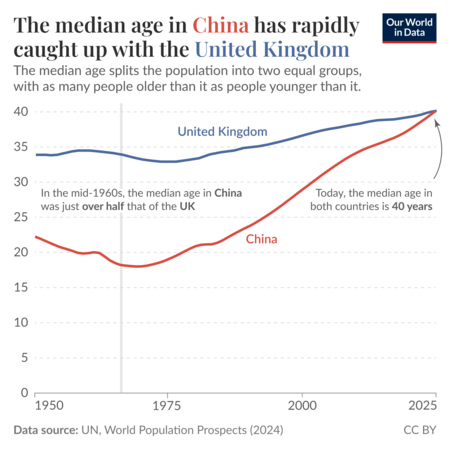
What does this mean? That China is slowly ageing, a trend that will continue in the medium term, if we consider its latest birth rate data. The problem is not the growth of an aging population in itself, but what it entails: greater public spending on pensions and health services.
The BBC notes that by the end of 2025 more than 53 million people will be receiving subsidies and benefits for the elderly. The most alarming data, however, came from the Chinese Academy of Social Sciences in 2019, when it warned that, if measures are not taken, the state pension fund could run out by the middle of the next decade due to an imbalance in the worker-retiree ratio.
There are those who warn that recent statistics should be handled with caution, as they may present a “dependent” population as older people who in reality are not. In any case, there are two indisputable realities. The first is that the future of pensions has been in focus for some time. Second, Beijing decided to take firm action and raise the retirement age.
Picture | Jaylin Goh (Unsplash), Toxic Smoker (Unsplash) and Our World in Data
In Xataka | Faced with a low birthrate, an aging population and a slowing economy, China has found a way out: emigration